Courtesy I Wonder Pictures
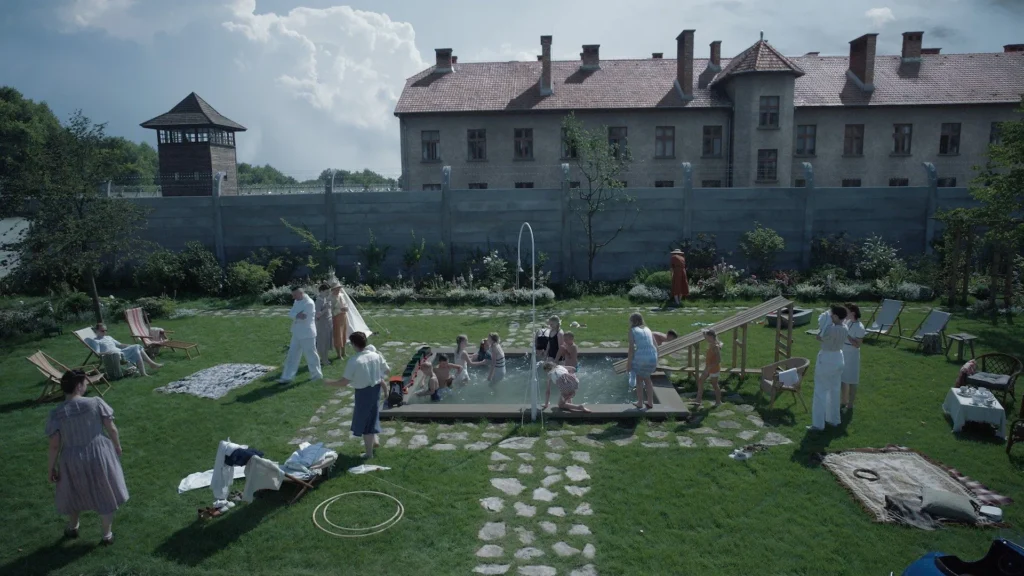
The sun shines on everyone. This is the “democracy of light”: rising each day in pale whites and pinks, setting in burning tones. This primordial element becomes the central paradox of The Zone of Interest: the golden noons of Auschwitz are the same for the bourgeois family tending their garden and for the Jews who, just a few hundred meters away behind the wall, are worked to death, executed, sent to gas chambers, and then “processed” within the efficient machinery of the crematoria, a system the film’s protagonist helped design.
The film was named among the top five of 2023 by the National Board of Review and, more broadly, stands as one of the most significant cinematic works addressing the Holocaust. Its disturbing power lies not only in depicting the banality of evil, but in exposing how easily one can live alongside horror.
It is not only about the family of Rudolf Höß, who lived in apparent serenity—gardening, fishing, spending afternoons by the pool—just steps from the extermination camp. It also concerns our own selective perception of reality. We tend to ignore death, devastation, suffering, illness, war, and poverty around us because focusing on them would make life unbearable. And yet, we know they exist, and that they are devastating.
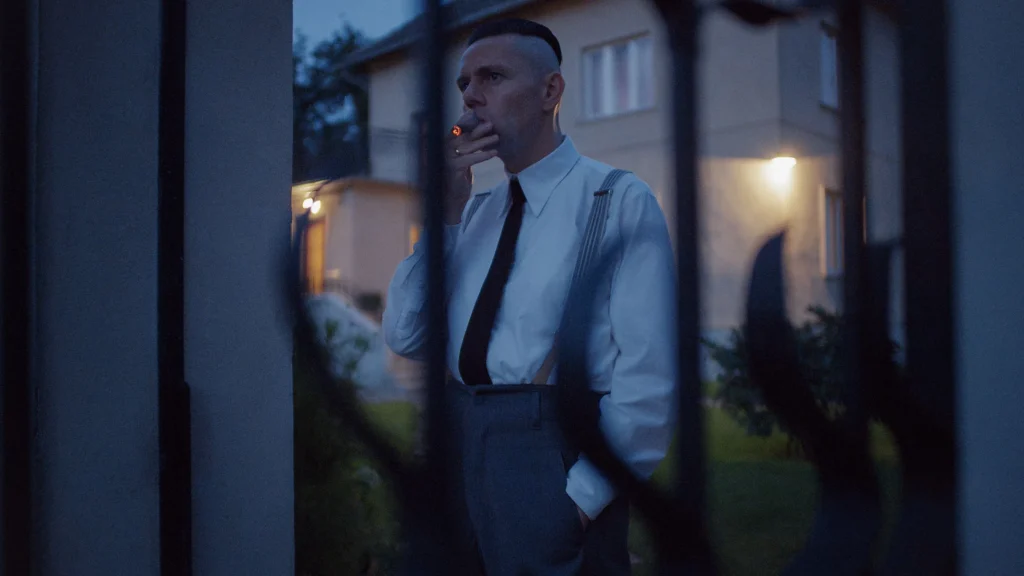
It is precisely within this space of removal that the light of The Zone of Interest operates, suspended between awareness and provocation. On the one hand, there is the option of adopting an almost documentary-style approach, with no artificial lighting or special effects. On the other hand, there is a profound aesthetic fracture: the illumination of a single location, Auschwitz, which is divided by radically different realities and ways of life.
Before The Zone of Interest: from Sexy Beast to Under the Skin
Before his 2023 masterpiece, Jonathan Glazer had already experimented with films that challenged the viewer on a sensory level through cinematography. In Sexy Beast (2000), Spanish sunlight is blinding, a harsh Andalusian white that conceals moral darkness beneath the surface. In Birth (2004), whiteness becomes alien, with a polished visual language enveloping Nicole Kidman in an unsettling aura. With Under the Skin (2013), Glazer reaches the peak of predatory darkness, a void into which victims sink without escape.
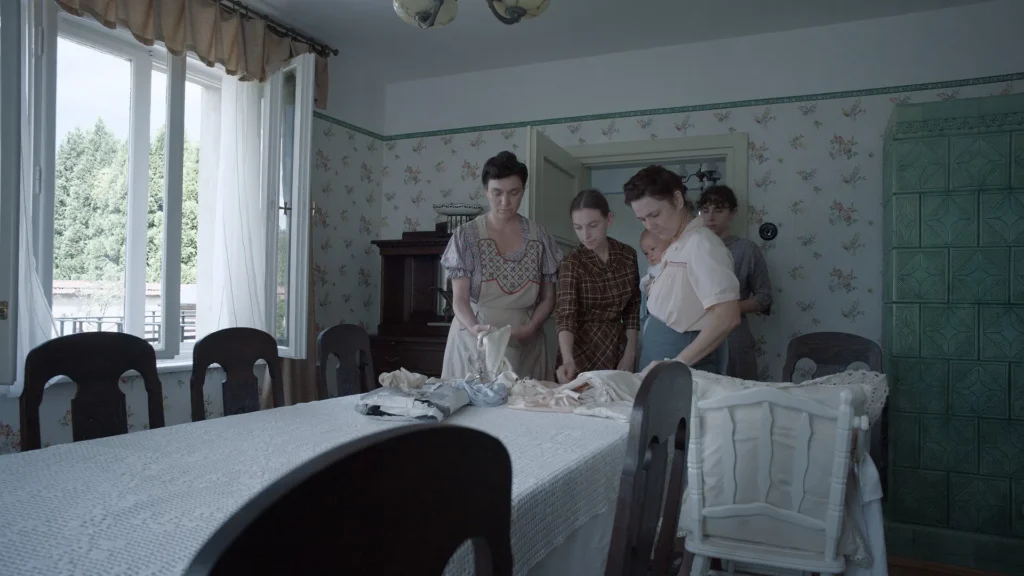
After these visual extremes, The Zone of Interest returns to a neutral style that functions almost as an anti-manifesto,respecting the sensitivity of its subject by rejecting cinematic embellishment or spectacle. 3Glazer’s visual trajectory can be read as a Hegelian structure: first white—apparent, almost supernatural—as thesis; then black, concrete, abyssal, as antithesis; and finally neutrality of vision, which becomes the most radical way to represent an atrocity that everyone chooses to ignore, the synthesis on which The Zone of Interest is built.
Why does The Zone of Interest use natural light?
Glazer acquired the rights to Martin Amis’s novel in 2014 and established a fundamental principle early on: the film would be shot using only natural light.
The opening credits unfold against a black backdrop, accompanied by a disturbing soundscape of noises, screams, creaks, and sighs that evoke an evil presence without showing it. Then, from the very first scenes, the film shifts to a restrained, everyday visual language, chilling in its normality. No spotlights or artificial lighting, only the full force of midday sun, and, in nighttime scenes, authentic moonlight. «To strip away the artifice and conventions of cinema that lead you down a path that didn’t feel appropriate here. It’s screen psychology», Glazer explained to Vanity Fair. «The way cinema fetishizes, glamorizes, empowers, none of those things were appropriate in this context».
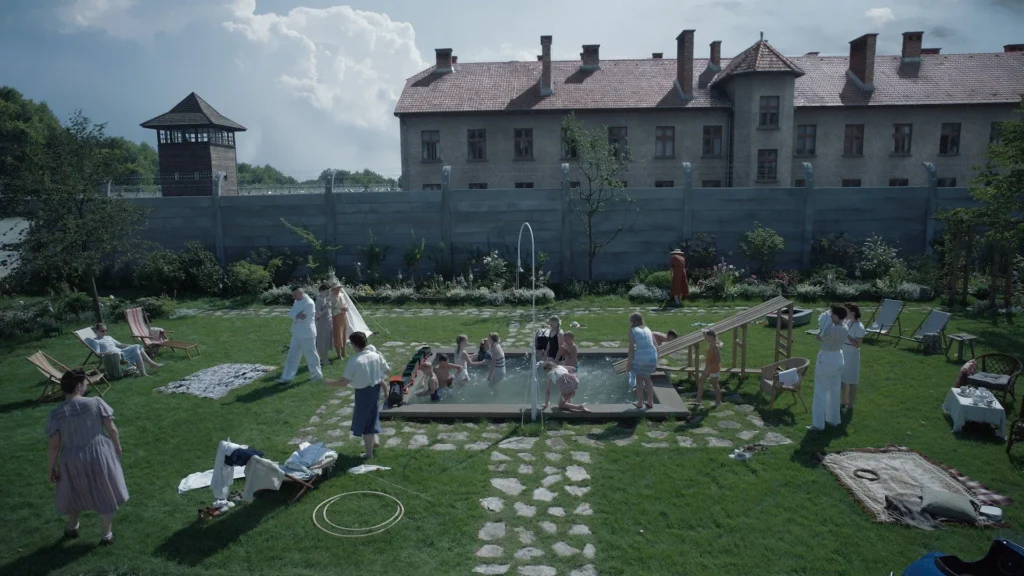
But this is not only about respect for the victims of genocide. Glazer chose neutral light to avoid placing himself on a moral plane above his characters. He did not want to judge them for their ability to forget the human beings behind the wall. All he wanted was to tell a story and show that we are not so different from Rudolf, his wife, and their children.
In some ways, we are also like Hedwig’s mother, who glimpses the crematoria from her granddaughters’ window and is shaken: we feel empathy and horror, yet the necessity of survival often leads us to remain within our own gardens, tending flowers, raspberries, and roses.
Łukasz Żal’s cinematography: shooting without artifice
A challenge that both intimidated and excited cinematographer Łukasz Żal, the Polish prodigy nominated for an Academy Award for Ida and Cold War, and later responsible for Hamnet (2025). The film was shot using ten remotely controlled Sony VENICE cameras on a set lit exclusively by natural light, with no reflectors or fill light. According to Sony, the camera’s dual base ISO of 800 and 2500 allowed for effective work across varying light conditions, while its high dynamic range ensured precise control of backlit scenes and strong contrasts.
«It was a completely different approach, which meant forgetting everything I had been taught about cinematography», Żal told The Hollywood Reporter. «Trying to shoot beautiful backlight, chasing golden hour, that’s how you usually make things look good. We always shot in natural light. Even when it was “ugly.” We shot with frontal light, we shot at noon».
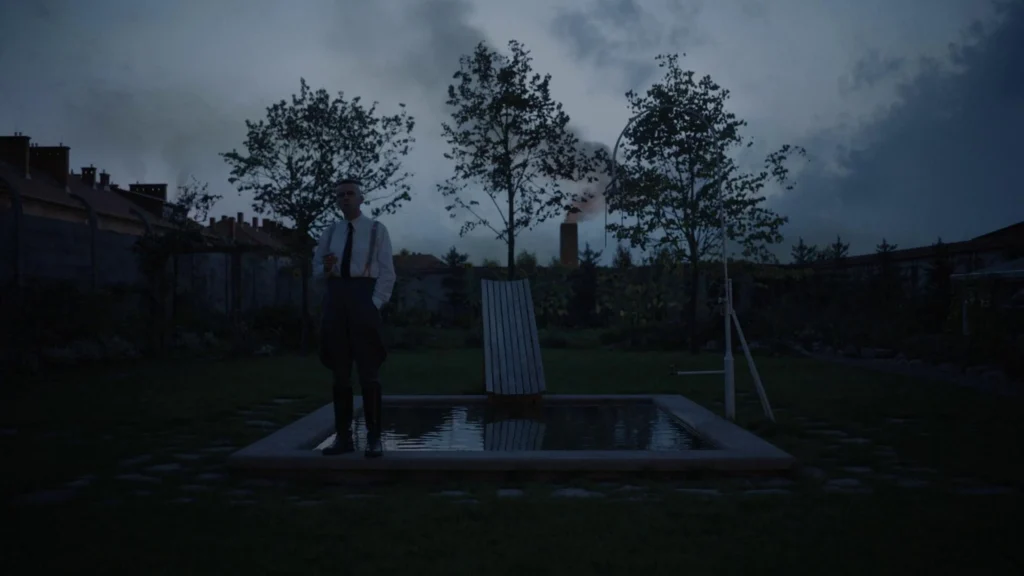
And when light was scarce? Scenes were shot in low light, as if captured by a military camera. «The dogma was to look at this story through a 21st-century lens», Glazer explained to THR. «Even if it feels strange or alien, it comes from the same mindset—the same desire to look at everything without embellishment». Even vintage tones, nostalgic songs, cream-colored cinematography, and period costumes can become forms of aestheticization—and Glazer deliberately avoided them. His goal was to construct an image as aseptic as possible, capable of observing events without emotional filters, without stylistic embellishment.
To achieve this neutrality, composition was kept simple, with no panels or reflectors. Żal also chose to use only a single “practical” light source, such as a bare bulb, because it more closely reflects real-world conditions.
The girl in The Zone of Interest: thermal negative sequences
Throughout the film, sequences shot in thermal negative appear repeatedly: images of a young girl hiding apples in the grass of a vast field. In the background, a speeding train and the ominous smoke of the crematoria—constant presences—loom over the scene.
In a film built on natural sunlight, it is paradoxically darkness that becomes a form of salvation. The girl embodies hope within a blackened world. «That small act of resistance—the simple, almost sacred act of leaving food—is crucial because it’s the only point of light», Glazer explained to The Guardian.
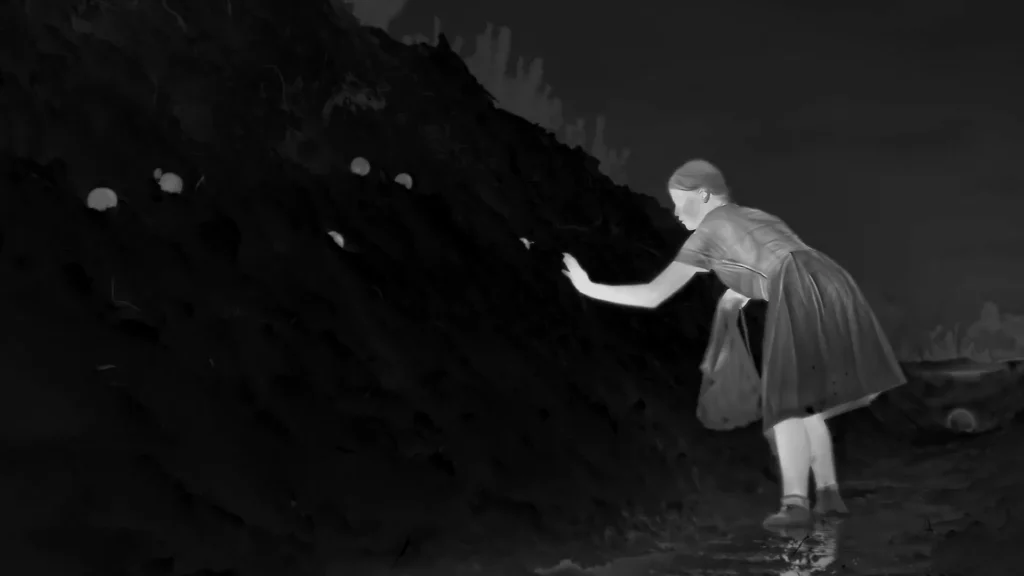
The negative image becomes a form of redemption precisely in opposition to sunlight. Only those who resist this apparently normal, orderly world, where extermination coexists with an obsession for manicured gardens and afternoons by the pool, can disrupt the system. And if the system exists in light, then the only way to overturn it is to choose shadow.
Within this representational economy, natural light becomes the horror counterpart to the film’s sound design, Glazer’s anti-aesthetic choice to portray Auschwitz through the sound of trains, screams, and gunshots, without ever showing the extermination camp itself. This is how everyday light becomes more disturbing than darkness.
The Zone of Interest leaves us with a question: what happens when light no longer comforts? Glazer demonstrates that visual neutrality does not exist; every lighting choice is already a position. The sun illuminating the Höß family’s garden is not innocent. And in this radical inversion, where full daylight becomes the ultimate form of disturbance, the film reveals its most enduring legacy, and its challenge to contemporary cinema.