
Light is almost always associated with temporality: installations, festivals, and site-specific interventions designed to “shine” for a limited time. However, there is also a more stable geography consisting of museums, foundations, and spaces that have incorporated neon, fluorescent, and light environments into their permanent collections. We selected six Italian institutions: places to visit, but above all to observe through light.
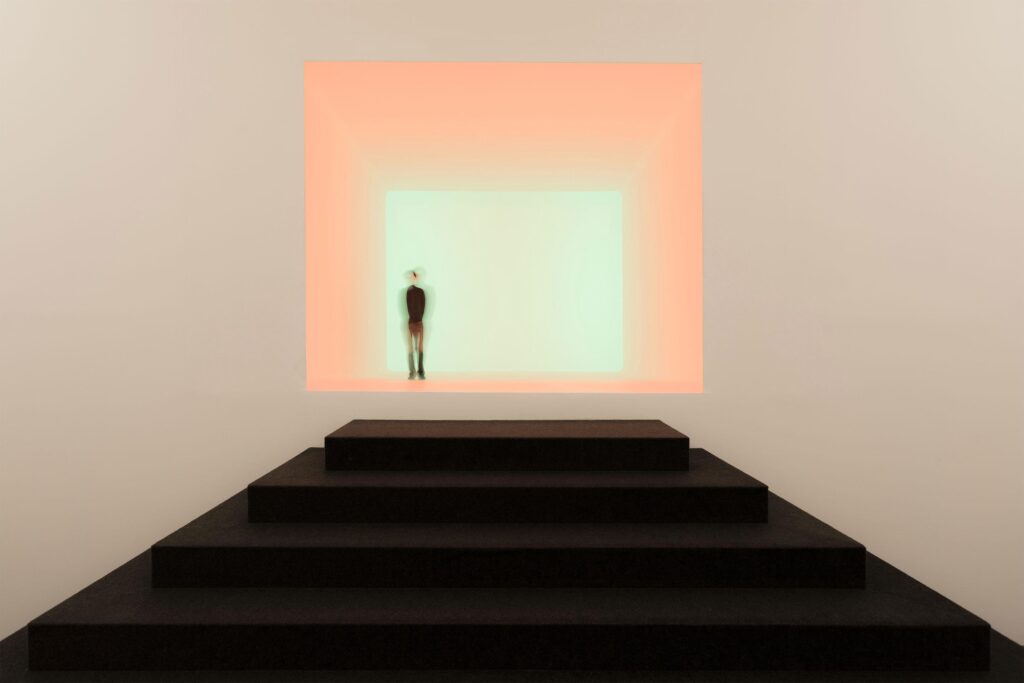
Dan Flavin, James Turrell, Villa Panza, Varese
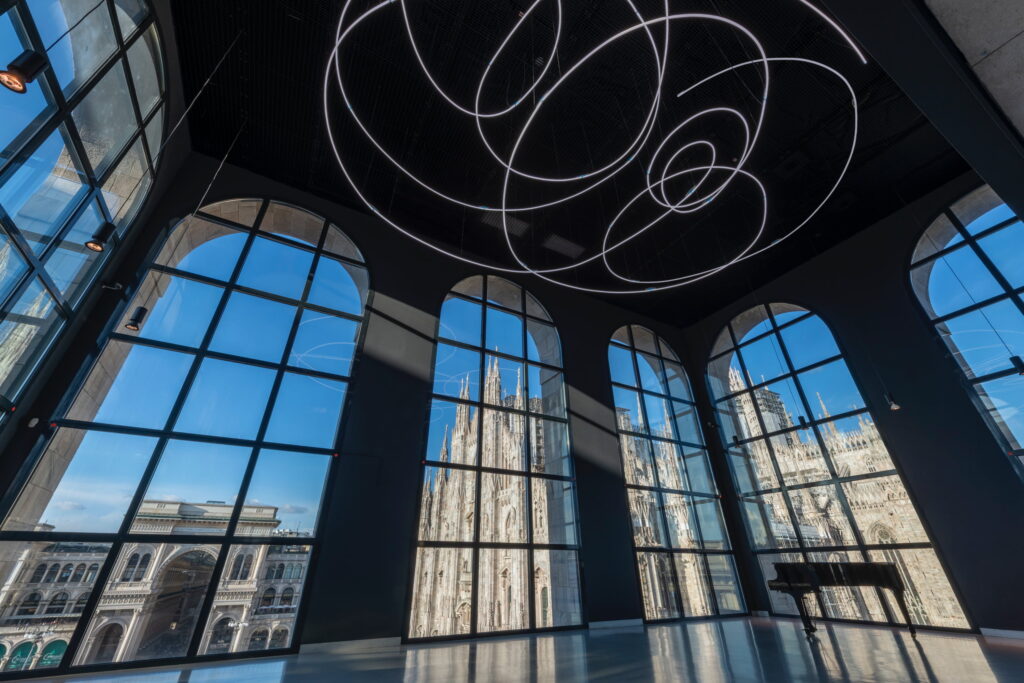
Lucio Fontana, Museo del Novecento, Milan
The Museo del Novecento is a civic museum dedicated to 20th-century Italian art. Located in the Arengario in Piazza del Duomo, it was inaugurated in 2010 and is organised into monographic sections, including one focused on Spatialism. Within the Fontana Room, Struttura al neon per la IX Triennale di Milano (1951) is permanently installed, reconstructed from original drawings and later authorized versions. The work consists of a continuous white neon line suspended in space, characterized by a cool color temperature (around 6500K). The system extends for approximately 100 linear meters of hand-bent glass tubing, suspended by metal cables. It is one of the earliest examples of neon used as an autonomous spatial element, independent from purely functional lighting purposes.
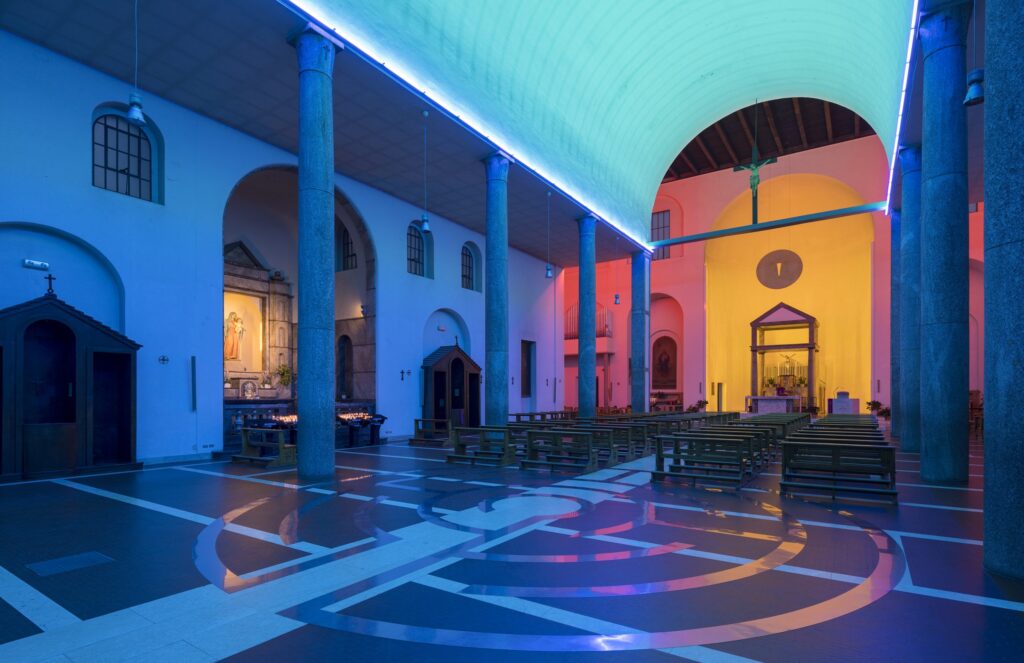
Dan Flavin, Fondazione Prada, Chiesa di Santa Maria Annunciata in Chiesa Rossa, Milan
The intervention by Fondazione Prada involves the Church of Santa Maria Annunciata in Chiesa Rossa, a building designed by Giovanni Muzio and completed in the 1930s in southern Milan. In 1996, the foundation commissioned Dan Flavin to create a permanent installation, completed in 1997 after the artist’s death, following his instructions. The project was developed in collaboration with the Dia Center for the Arts in New York and the artist’s estate, ensuring fidelity to the original concept. The work, Untitled, uses standard fluorescent tubes to intervene across the entire ecclesiastical volume: green in the nave, blue in the transept, pink in the apse, with additional chromatic variations. It is a permanent, site-specific intervention fully integrated into the architecture and realized without structural modifications.
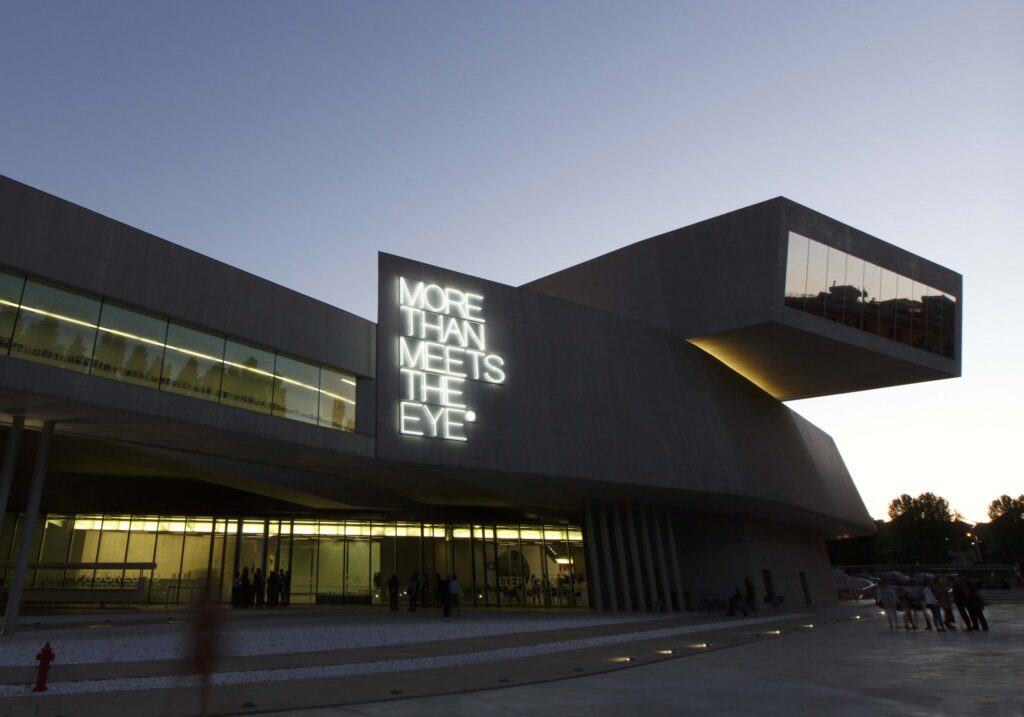
Maurizio Nannucci, MAXXI – National Museum of 21st Century Arts, Rome
The MAXXI, inaugurated in 2010 and managed by the Fondazione MAXXI, is housed in a building designed by Zaha Hadid. In 2015, the museum acquired More than meets the eye by Maurizio Nannucci for its permanent collection. The work was produced as part of the Where to Start From exhibition and entered the collection with the support of the Amici del MAXXI association. Consisting of a neon text installed on the building’s façade, the piece was created using linear tubes and is intended as a permanent installation.
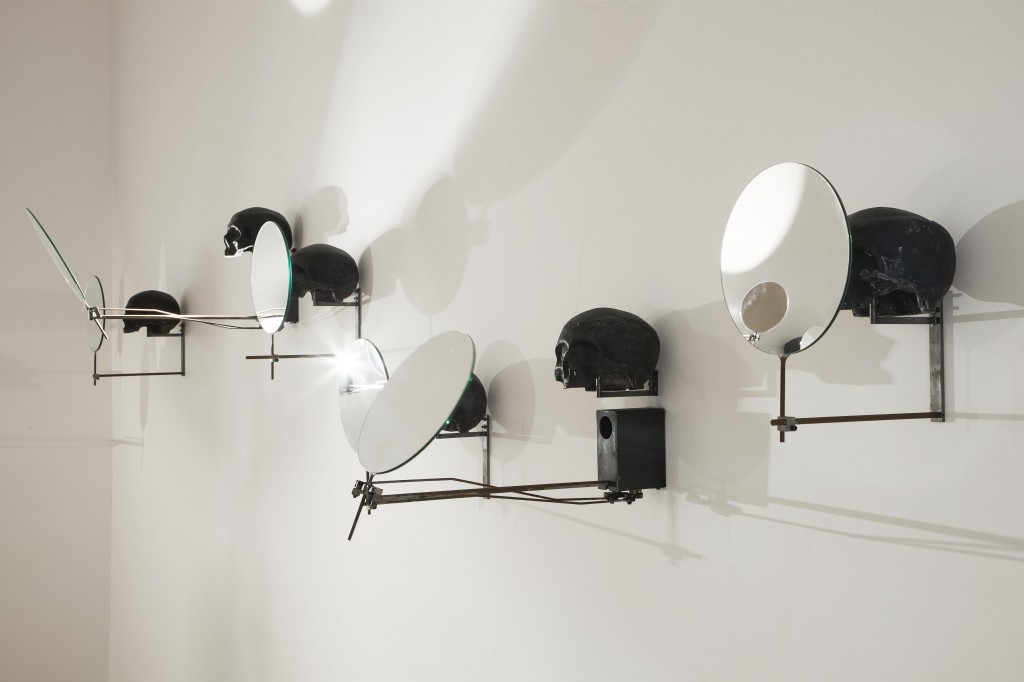
Rebecca Horn, Museo d’arte contemporanea Donnaregina (Madre), Naples
The Museo Madre is housed in the historic Palazzo Donnaregina, which has been converted into a museum and is managed by the Fondazione Donnaregina per le Arti Contemporanee, a Campania Region institution. The permanent collection includes environmental installations by international artists from the 1990s and 2000s. Among these is Spirits (2005) by Rebecca Horn, which consists of cast iron elements and neon rings and features a sound component. The work formally derives from a votive skull of Neapolitan tradition (capuzzella), reinterpreted in an installation format. It is part of the permanent collection and occupies the space as an immersive environment.
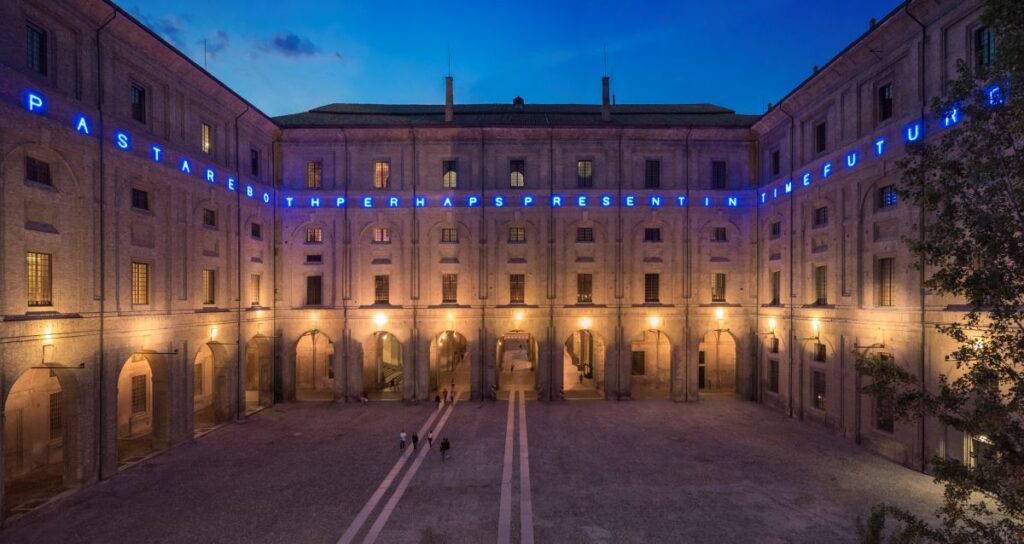
Maurizio Nannucci, Complesso Monumentale della Pilotta, Parma
The Complesso Monumentale della Pilotta is an Italian Ministry of Culture institution that encompasses several museums, including the Galleria Nazionale, the Teatro Farnese, and the Biblioteca Palatina, within a historic complex dating back to the 16th century. In 2019, in the Cortile di San Pietro, the permanent work TIME, PAST, PRESENT AND FUTURE by Maurizio Nannucci was installed. The intervention consists of a sequence of 55 neon blue letters, made in Murano glass and arranged along the perimeter of the courtyard. The work is approximately 190 metres long and takes its title from the opening line of Burnt Norton, which is part of T. S. Eliot‘s Four Quartets.