
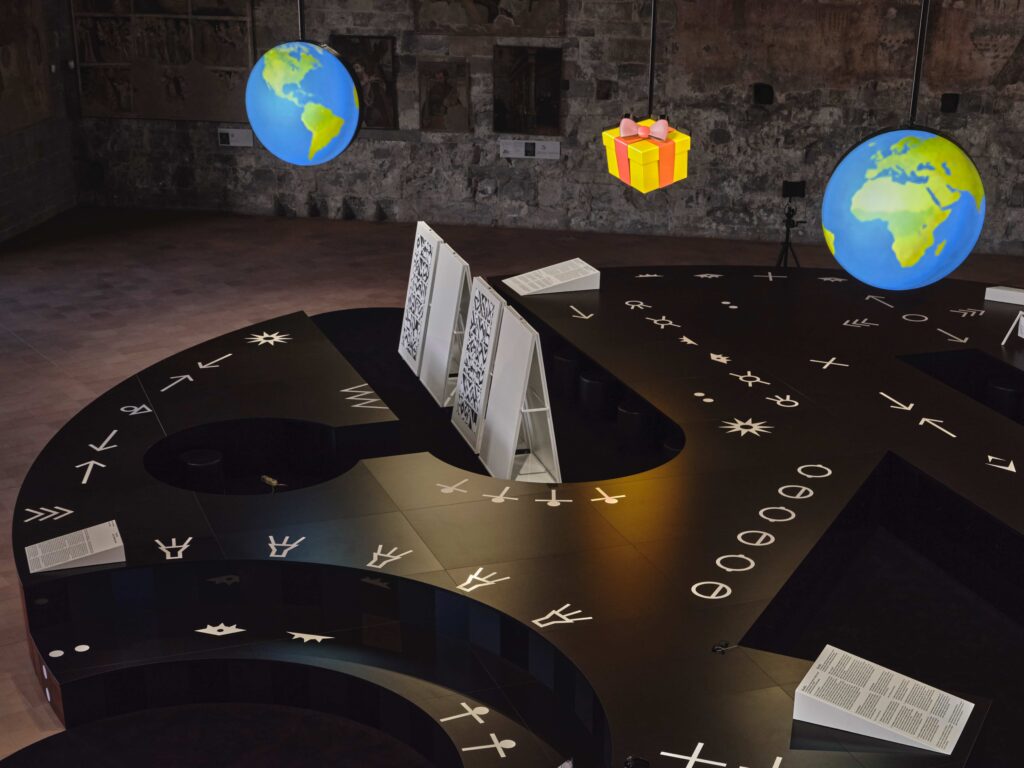
Cover photo: Installation view, GAMeC / Palazzo della Ragione, 2026. Photo by Nicola Gnesi Studio
Suspended within the solemn medieval space of the Sala delle Capriate in Bergamo’s Palazzo della Ragione, five luminous, emoji-shaped sculptures float through the space like ghostly representations of contemporary forms of communication. This is the central element of the site-specific installation conceived by the artistic duo Claire Fontaine for “Tabula Plena” (June 4 – October 18, 2026), an exhibition presented by GAMeC as part of the “Pedagogia della Speranza” program, under the artistic direction of Lorenzo Giusti, curated by Sara Fumagalli, Valentina Gervasoni, and Irene Guandalini, and featuring the participation of Sara Tonelli and Rachele Bellini from GAMeC’s education department.
The five illuminated emojis, conceived in close dialogue with the entire installation designed by the Fosbury Architecture collective, prompt reflection on the processes of knowledge and education, highlighting the growing influence of electronic devices and artificial intelligence on the way we build relationships, process information, and shape our perception of the world.
The light of readymade emotions
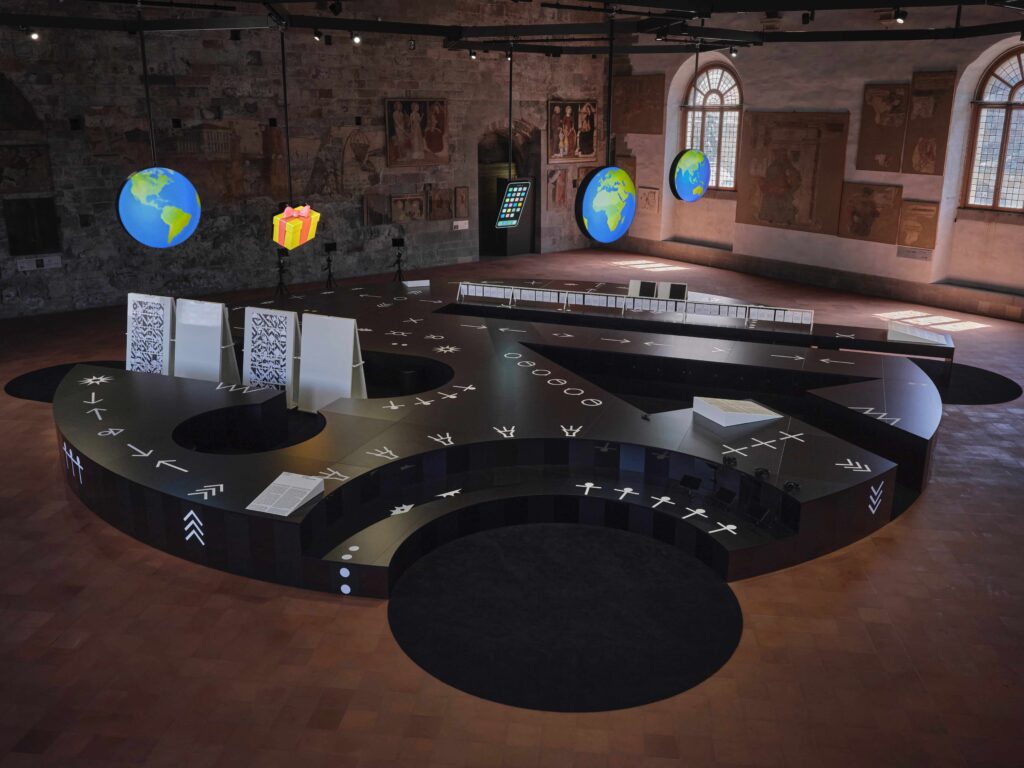
In Claire Fontaine’s project, writes Anita Chiari in “A User’s Manual to Claire Fontaine” (Lenz Press 2024), «The readymade [is used] as a critical practice to perceptually and affectively trace the shifting dynamics of the commodity-form within the volatile terrain of the capitalist mode of production». This work by the duo Fulvia Carnevale and James Thornhill falls within the framework of what Chiari refers to as “affective conceptualism,” a practice that connects emotional experience with social theory. By appropriating emojis – prefabricated graphic icons we use to convey our emotions in digital exchanges – Claire Fontaine extracts them from the ephemeral flow of screens and transforms them into physical, three-dimensional, luminous objects.
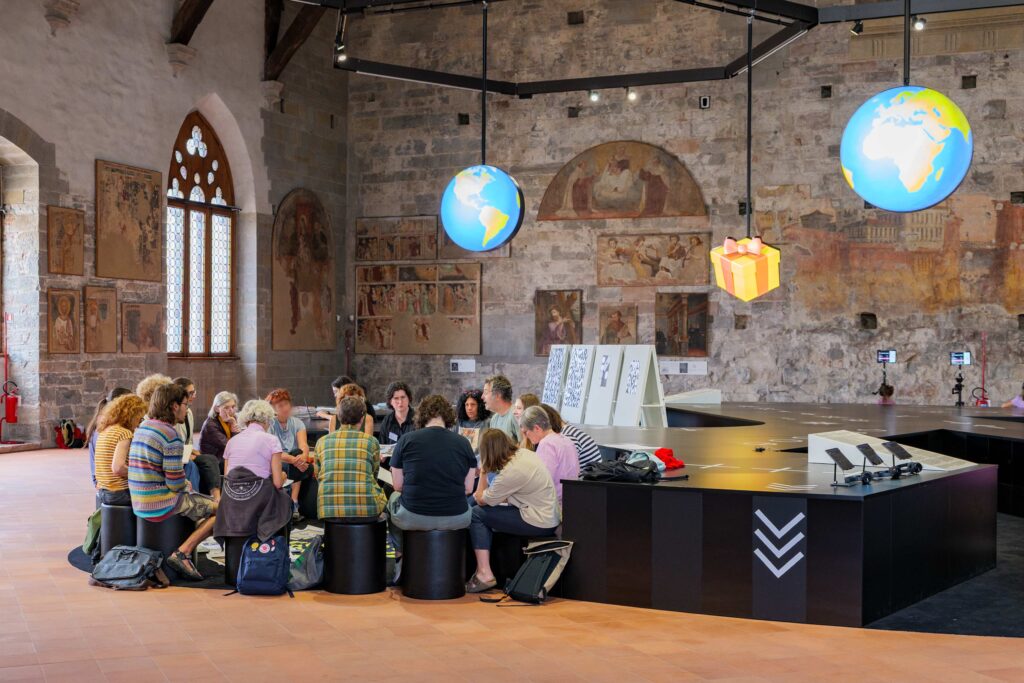
Here, light becomes a tool that helps activate the readymade: the visual object is taken out of virtual circulation and reignited in the exhibition space, transforming into a “readymade emotion” (as Chiari puts it). The five light sculptures on display include three different depictions of the planet Earth, a smartphone, and a gift package.
Suspended directly above visitors’ heads, the three Earths serve as a reminder that the complexity of the world requires multiple, 360-degree perspectives, transcending the two-dimensional view of screens; the smartphone, stripped of its reactive luminosity, becomes a portrait of isolation and pervasive technological mediation; the gift package invites us to question the logic of consumption in relation to the value of the gift. In this way, the luminous presence acts as a tool for unlearning, interrupting digital automatism to restore physicality and presence to the perception of space.
A dialogue with the architecture of Fosbury Architecture
Claire Fontaine’s light sculptures float above a large platform designed by the Fosbury Architecture collective. The theoretical and compositional core of the entire project lies in the subversion of the concept of the tabula rasa – introduced by John Locke and historically rooted in classical pedagogical theory, according to which the human mind at birth is like a blank slate upon which the educational process acts as the author.
While the tabula rasa approach presupposes an empty space – in order to impose a new model from above – Fosbury Architecture’s proposal instead adopts Freire’s principle of “tabula plena”. Drawing inspiration from the critical pedagogy of Brazilian thinker Paulo Freire, the project recognizes that both the historic shell of the Palazzo della Ragione and the people who pass through it are not neutral containers or passive presences. On the contrary, the community and the place are already “full” of stories, relationships, memories, and potential. Based on these premises, Fosbury Architecture’s project has taken shape, creating a democratic and fully accessible environment—an invitation to visitors to become active participants in the exhibition experience.
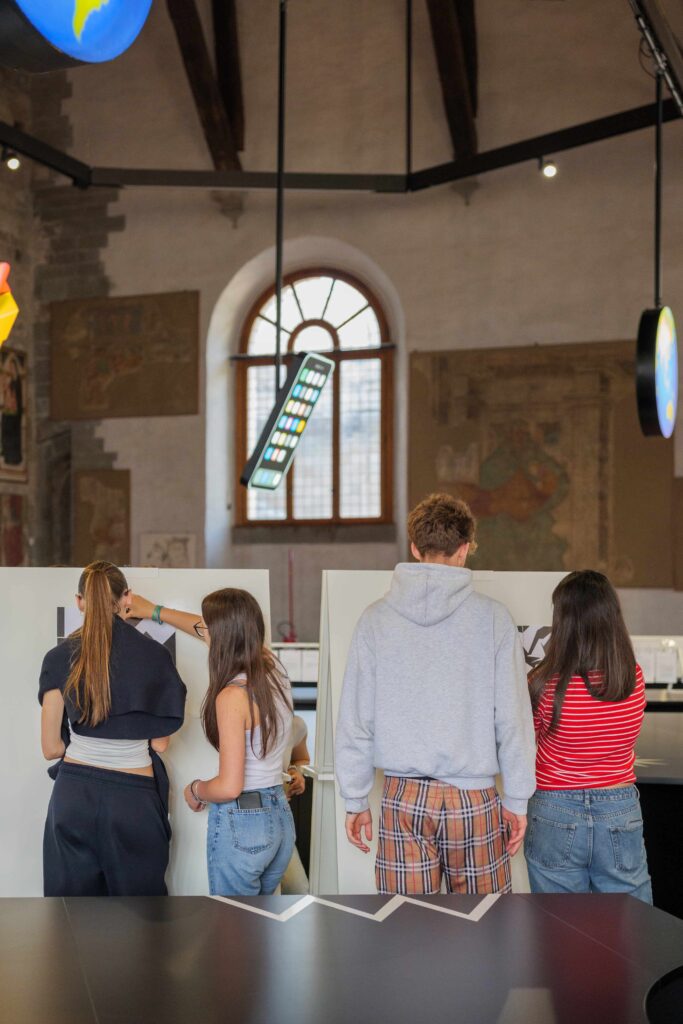
The architecture of the exhibition space is characterized by a black surface reminiscent of a school blackboard, marked by “glyphs” – visual configurations created during workshops held with students from thirteen classes in the Bergamo area before the opening. At the center is an arena designed for meetings and debate, which houses three stations for permanent workshops co-designed with Numero Cromatico (on the deconstruction of algorithms), Sabrina D’Alessandro’s URPS (on the revival of rare words), and Adelita Husni Bey (on the language of education).