
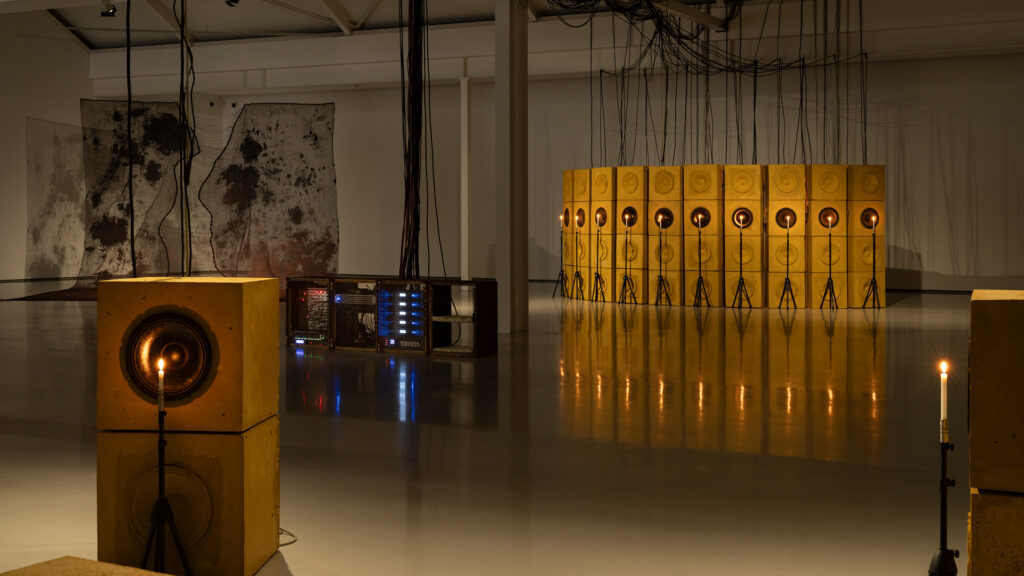
Cover photo: Vivian Caccuri – Ash Fossil II, 2026 and Overheated System, 2026
© Vivian Caccuri. Photo: Frank Kleinbach
“Light is not only for the eyes. It affects bodies, objects and spaces as a whole. Your skin takes it in, both light and colour. It’s not only about providing a visual experience. It exists beyond image. So, it carries a lot…”, says Brazilian artist Lucia Koch (1966, Porto Alegre), who, with her work “Big Loop,” has covered approximately 230 light fixtures in the former SCHAUWERK Sindelfingen warehouse—which stands fifteen meters tall—with colorful, handmade covers. The installation gradually transforms the space, bringing the building’s lighting to the forefront.
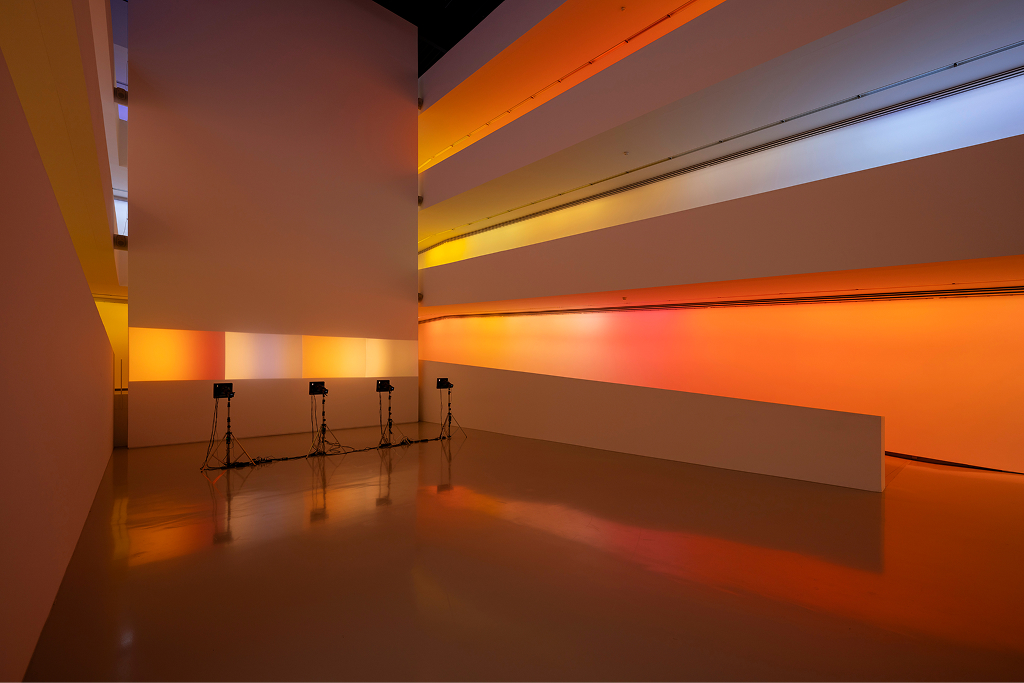
Koch’s work is part of Anatomy of Presence, an exhibition curated by Jérôme Sans and Svenja Frank that, from September 27, 2026, to July 18, 2027, brings together the works of three Brazilian artists at SCHAUWERK Sindelfingen: Lucia Koch, Vivian Caccuri (1986, São Paulo), and Henrique Oliveira (1973, Ourinhos). The connection to Brazil runs deep in the history of this venue: in the 1970s, its founders, Peter Schaufler and Christiane Schaufler-Münch, lived in São Paulo, where they began collecting and exhibiting works that engaged the public through direct experience and interaction. The installations on display, designed specifically for the museum, occupy approximately 3,000 square meters of the former industrial complex. The project draws on a tradition of installation art that developed in Brazil in the 1950s and 1960s, placing the physical experience of the artwork at the center.
Light guides visitors along the path from the very entrance, where Lucia Koch’s “Atmosphere Box” filters natural and artificial light, evoking the hues of dawn and dusk. These effects are also visible in Vivian Caccuri’s “Gatonet,” where the low frequencies from the speakers cause the candle flames to flicker, in an installation inspired by the tangled web of electrical and data cables in Brazilian cities. A bright light that Sans describes as “almost clinical” highlights Henrique Oliveira’s recycled plywood and the relationship between its root-like forms and the structure’s metal framework. We talked about the project with Jérôme Sans and Svenja Frank, reflecting on the decisions and challenges involved in a project that assigns light a decisive role in the experience of the artworks.
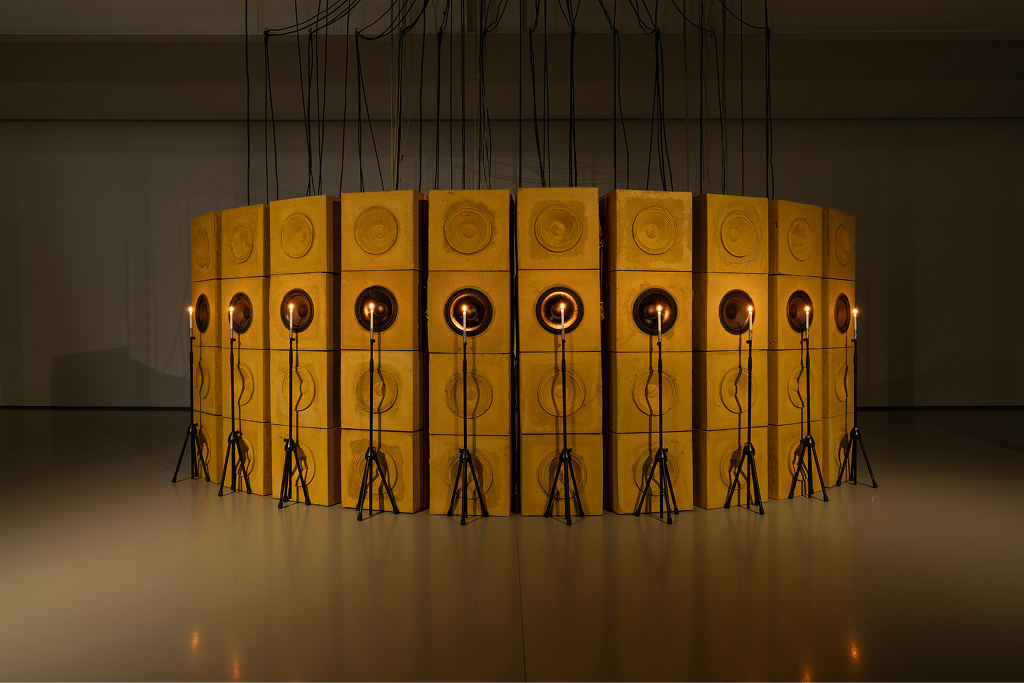
Light plays a central role in ANATOMY OF PRESENCE, from Lucia Koch’s large-scale interventions to the flickering flames activated by sound in Vivian Caccuri’s installation. From a curatorial perspective, how does light operate across the exhibition?
J.S. “Light is never treated as mere illumination in Anatomy of Presence; it operates as a medium of perception in its own right, on a par with sound and sculptural mass. In Lucia Koch’s intervention it becomes atmosphere itself: colour filters suspend the entrance between dusk and dawn, producing a chromatic threshold where two contradictory temporal states coexist, suspending the visitor into this impossible time and into a condition of perceptual uncertainty. Light here is infra-thin, working at the edge of what the eye can register, so that architecture turns into a sensitive membrane recording passage and time. […]Across the exhibition, light is less a tool of visibility than a register of presence, making tangible what usually escapes attention: duration, vibration, the fact of being there.”
S.F. “Each artistic position approaches light differently. For Lucia Koch, light itself becomes a material. It shapes spaces and alters our perception, both physically and visually. Vivian Caccuri uses candlelight to make the effects of invisible sound waves perceptible. […] For Henrique Oliveira, light emphasizes the materiality of the wood and intensifies the dialogue between organic growth and the rational structure of the building.”
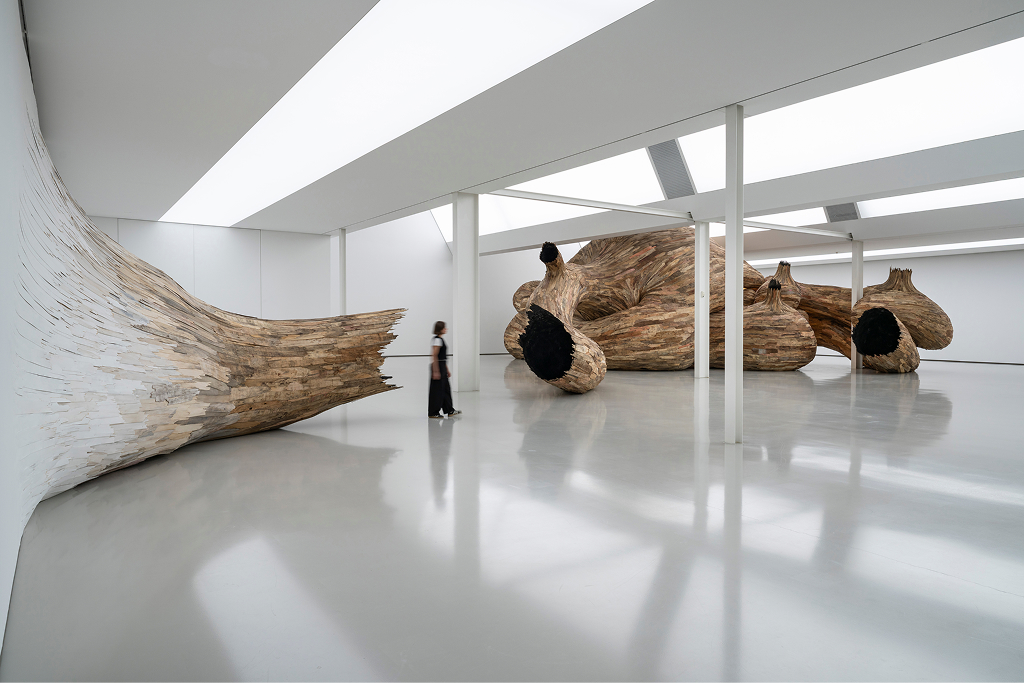
The exhibition was conceived specifically for SCHAUWERK’s former industrial architecture, including the fifteen-metre-high former warehouse. How did the particular scale, materiality and existing light conditions of the building influence the development of the installations? And how does artificial light enter into dialogue with the architecture rather than simply illuminate the artworks?
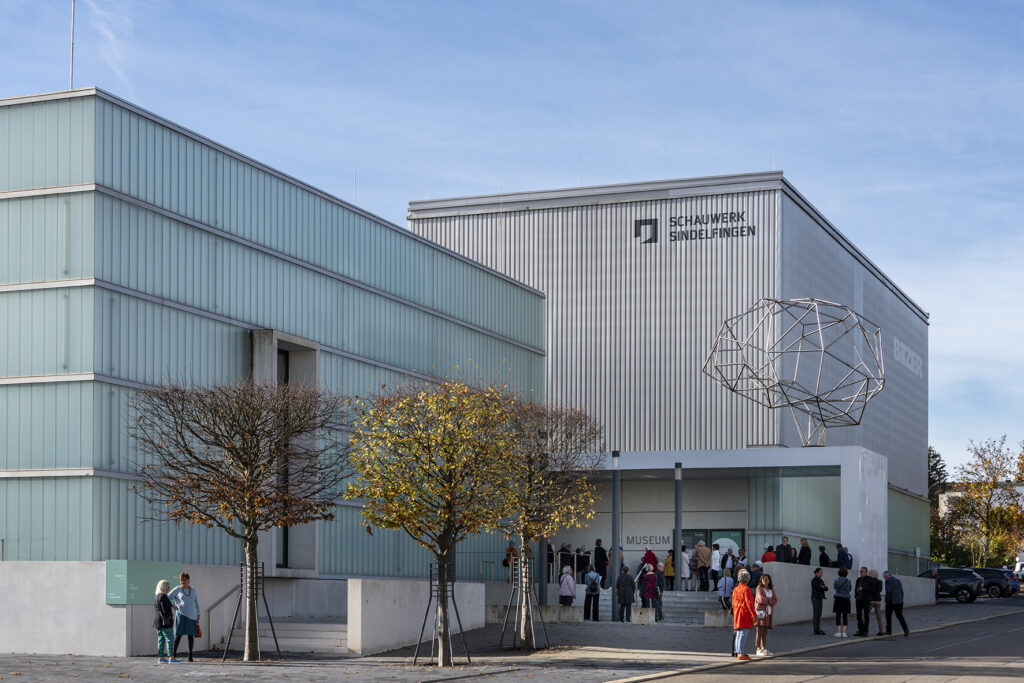
J.S. “SCHAUWERK Sindelfingen is first and foremost an industrial building: a great architecture, rigorous and silent, but one that maintains no direct relation between inside and outside. No window opens onto the exterior light, no view connects the visitor to the world beyond its walls. The building is, in this sense, a pure and beautiful large-scale white cube, a vessel sealed upon itself, closer to a shell than to a space in dialogue with its surroundings. This absence of exchange with the outside became the exact condition the exhibition wanted to address: rather than adapting existing works to the space, the project required importing pieces that had, a priori, nothing to do with this architecture, so that each intervention could only exist as strictly site-specific.”
S.F. “From the outset, the architecture of SCHAUWERK was more than simply an exhibition venue. All installations were developed specifically for the former industrial building and respond directly to its scale, materiality, and history. This is particularly evident in Lucia Koch’s work. For ‘Atmosphere Box’, she drew inspiration from Alexander Dorner’s idea of the museum as a dynamic experiential space and a powerhouse of perception. Using colored films, she transforms the entrance area into a transitional realm suspended between sunrise and sunset. In doing so, she consciously incorporates both natural and artificial light, revealing how light shapes our perception of space and time.”
“Anatomy of Presence” places physical and sensory experience in deliberate contrast with an increasingly virtual world. Light is particularly interesting in this respect because it is intangible, yet capable of producing very physical experiences of colour, depth, temperature and spatial orientation. What role does light play in reconnecting visitors with their bodies and surroundings as they move through the exhibition?
J.S. “ Light’s paradox is precisely what makes it central to the exhibition’s argument: it has no mass, no texture one can hold, yet it produces unmistakably physical sensations of warmth, depth, disorientation and colour pressing on the retina. In a moment when experience is increasingly mediated through screens, where presence risks being reduced to image, light offers a counter-model: a phenomenon that is immaterial in substance but entirely embodied in effect. […]Light, in this sense, reconnects visitors to themselves by refusing to be purely optical: it asks to be felt in the skin and the inner ear as much as in the eye, returning the body to its role as the primary instrument through which the world, and the exhibition, becomes legible.”
S.F. “As we move through the exhibition, our perception is constantly shifting. Light makes it clear that perception is not an abstract process but an embodied one. In this sense, the exhibition invites visitors not merely to look, but to become aware of themselves as perceiving bodies within space.”