
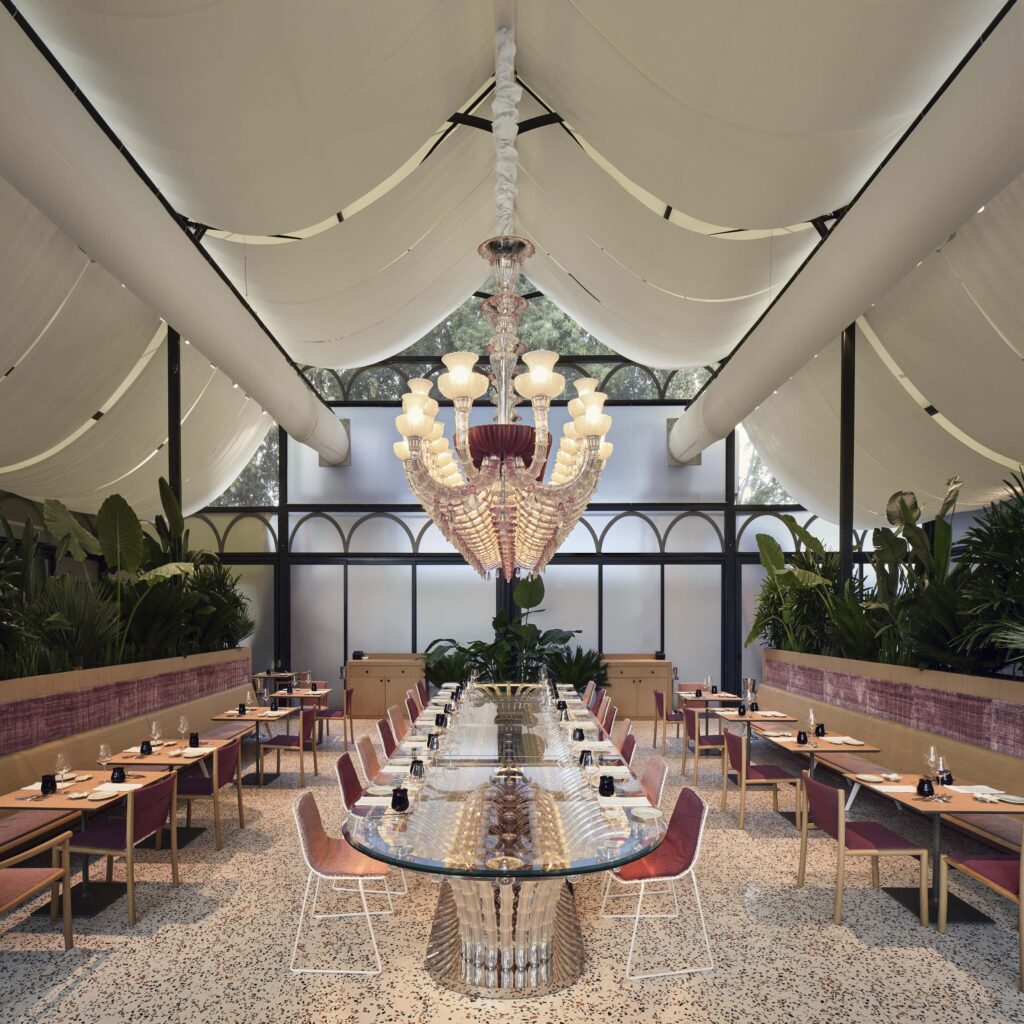
Cover photo: Couture, the chandelier created by iDOGI and designed by APML | Architetti Pedron / La Tegola. Courtesy iDOGI and APML.
From 1 to 30 September, the island of San Giorgio Maggiore hosted the fourth edition of Homo Faber 2026, the biennial dedicated to contemporary craftsmanship, promoted by the Michelangelo Foundation for Creativity and Craftsmanship together with the Fondazione Giorgio Cini and the Fondazione Cologni dei Mestieri d’Arte. This year, artistic direction was entrusted to artist and stage designer Es Devlin, who made light the connecting thread of An Island of Light, bringing together 15 installations across the historic rooms and gardens of the Fondazione Giorgio Cini.
One project in particular offered a way of looking beyond the event itself: the Glasshouse, the fine-dining restaurant designed by APML | Architetti Pedron / La Tegola, where chef Salvatore Sodano’s menu was served. Conceived as a winter garden, the space explored the relationship between material and light: soft pink tones and richly textured fabrics met natural oak, pure white and delicate green furnishings, while the transparency of the glass and the reflections of light enhanced the soft, powdery effect of the whole. Almost 50 Kata Chairs, 16 Leaf Chairs, eight Zinta benches, 21 Dizzie tables and two Onemm tables by Arper furnished the space, introduced by a semicircular welcome desk made by De Castelli: a volume in polished stainless steel, marked by deep grooves and finished through a process of hand-applied fire oxidation.
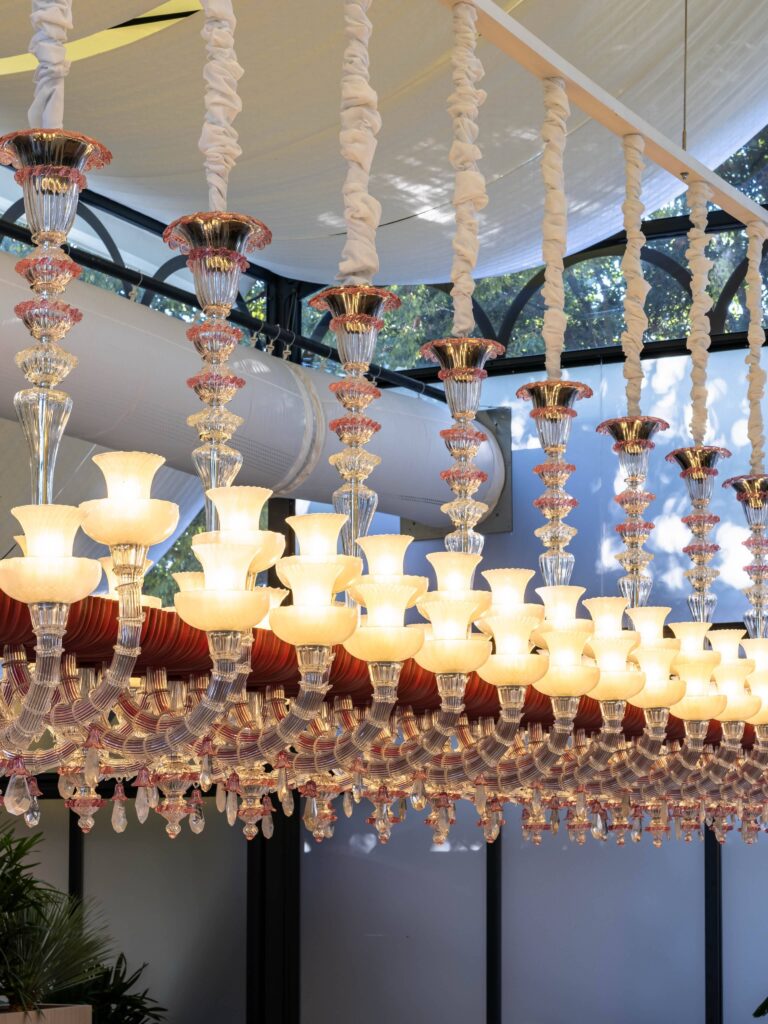
A chandelier made of 1,350 pieces, each slightly different
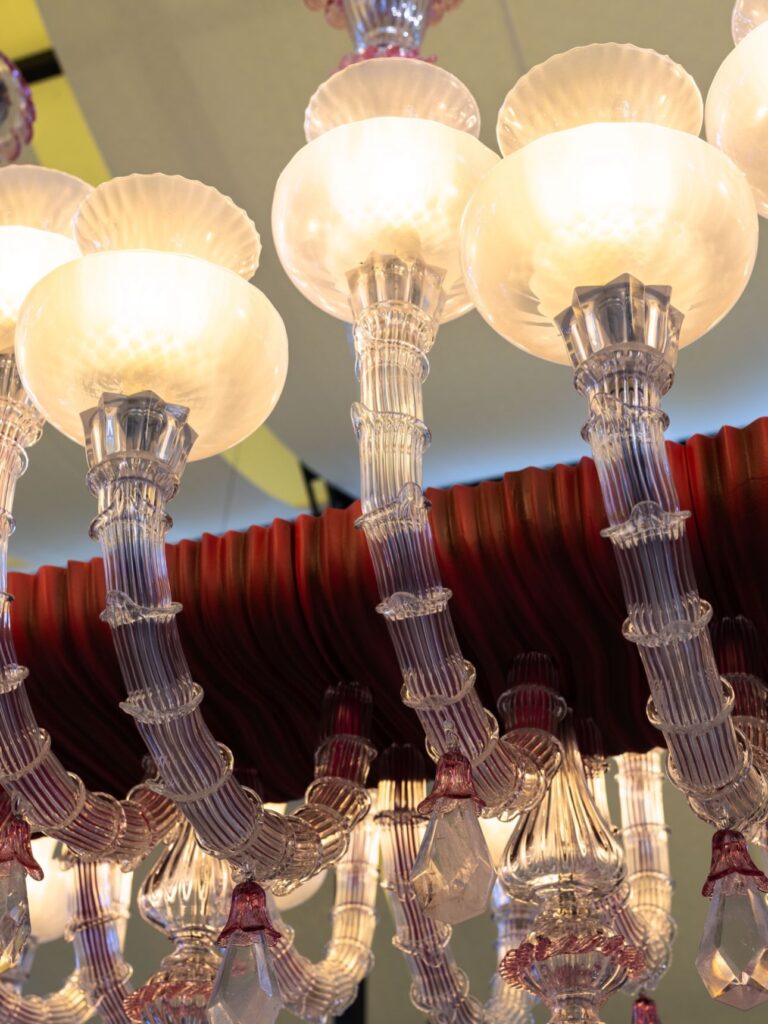
Suspended above the Glasshouse was Couture, the chandelier created by iDOGI, a Venetian company specialising in artistic lighting, and designed by APML, bringing together Murano art glass and rock crystal. Thousands of bossole, a distinctive element of Murano glassmaking, shaped the volume of the chandelier, interspersed with hyaline quartz pendants that caught and reflected the light. Below, the illuminated Waterfall table, more than seven metres long and also made from thousands of bossole, completed the chef’s table.
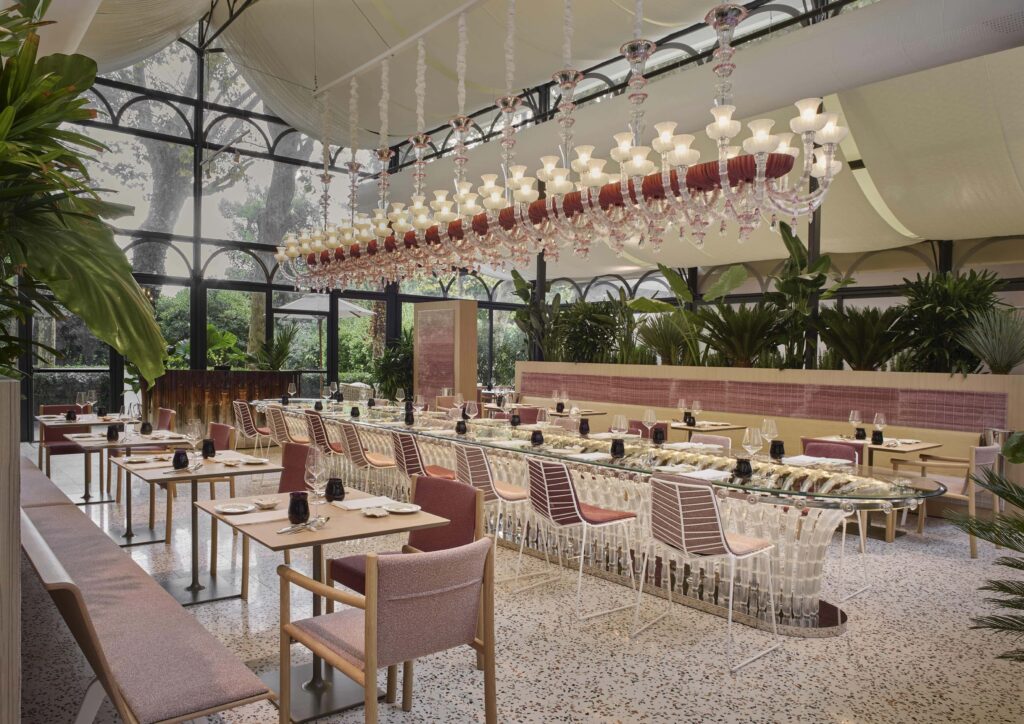
Beneath the chandelier, the illuminated Waterfall table completes the Glasshouse chef’s table. Measuring over seven metres in length and composed of thousands of bossole, it echoes Couture’s material language and heightens the dialogue between glass, light and transparency. Courtesy iDOGI and APML.
It is an extraordinarily complex object, made from around 1,270 glass and crystal elements, all blown and worked by hand. Rather than perfect uniformity, it is precisely the differences between these handcrafted pieces that create the overall effect. As Alessandro Pedron, architect and designer at APML, explains: «They are all slightly different from one another. Then there are 80 elements in hyaline quartz: rock crystal, which no one blows because geological time has already formed it. Among the glass, it behaves differently — harder, with a sharper refraction. The vibration of the whole comes from these tiny differences, multiplied by 1,350».
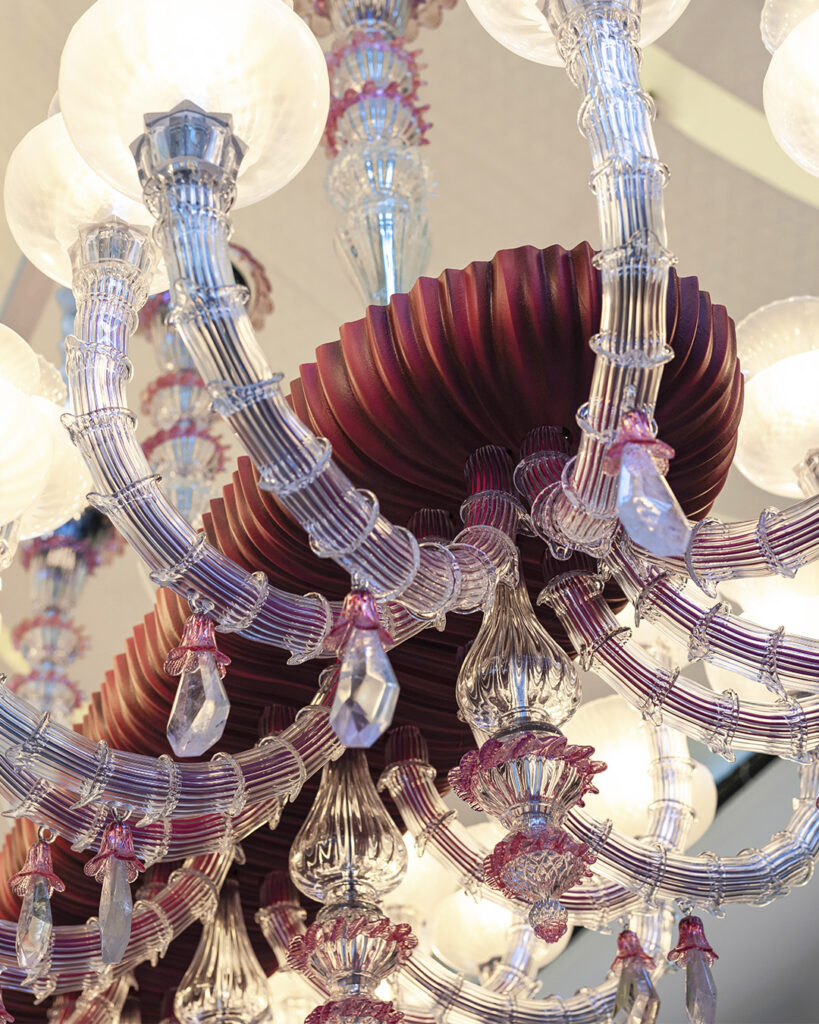
«The glass determined the rhythm, colour and scale of the installation», Pedron sums up. And colour is perhaps the clearest example: Ruby Red is created by melting pure gold into the glass, while in the cups housing the light sources, the sandblasting gradually shifts from full transparency near the arm to opacity at the edge.
Where does craftsmanship end and technology begin?
Behind this object, which fully embraces the savoir-faire of Murano craftsmanship, is an entirely innovative structure combining algorithmic modelling, 3D printing, lost-wax casting and CNC machining. «We developed the creative process together with iDOGI CEO Domenico Caminiti: two different ways of looking at the same curve, and a long discussion about where the metal should end and the light begin», Pedron explains, referring to the structure supporting the glass. The chandelier’s aluminium and glass spine measures 5.40 metres and was developed to support and distribute the weight of the monumental composition without taking attention away from the crystal.
To avoid the serial repetition typical of industrial modules, APML digitally designed a single fluid, continuous form, shaped by waves and asymmetries, only later dividing it into 18 modules, each one different from the next. The choice preserves a surprisingly high degree of uniqueness, rather than standardising the object. 3D algorithms generate the variations in the structure; the models are then 3D printed and used as sacrificial patterns for lost-wax aluminium casting at an art foundry. Finally, the 17 flanges connecting the modules are precision-machined using five-axis CNC centres, ensuring that the joints do not place stress on the crystal. It is this meeting of digital control and deliberate irregularity that Pedron describes as «a calculated error: 3D algorithms generating organic waves and asymmetries, a second language that accepts the rules of the first».