
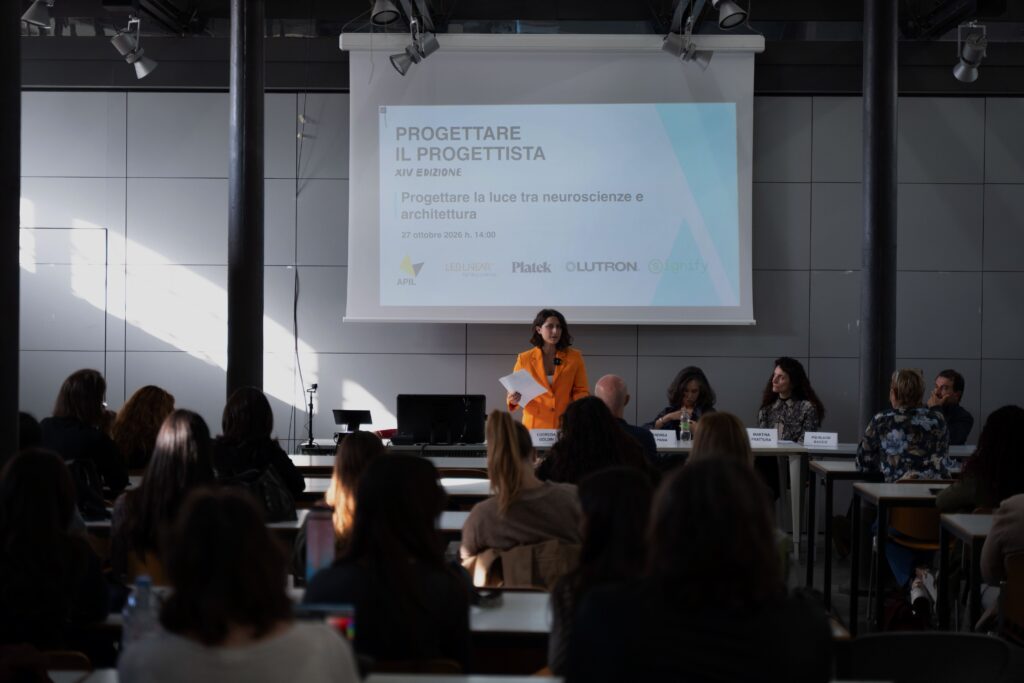
Cover photo: “Progettare il Progettista” in Rome: light, neuroscience, and architecture
When designers approach lighting, they are also designing how a space will be perceived. A wall can gain depth, a material can change its appearance, and a detail can emerge or disappear depending on how it is lit—or on how it absorbs and responds to light. What we tend to forget, however, is that these effects extend beyond the visual realm: they also involve the body, attention, and biological rhythms, and help shape our experience of spaces.
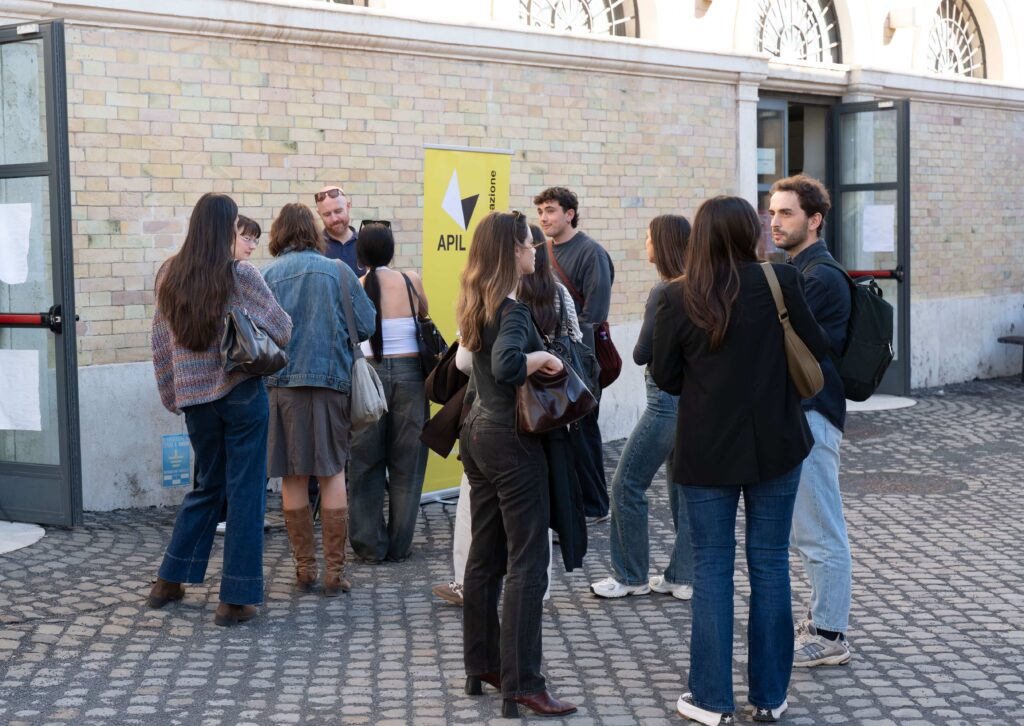
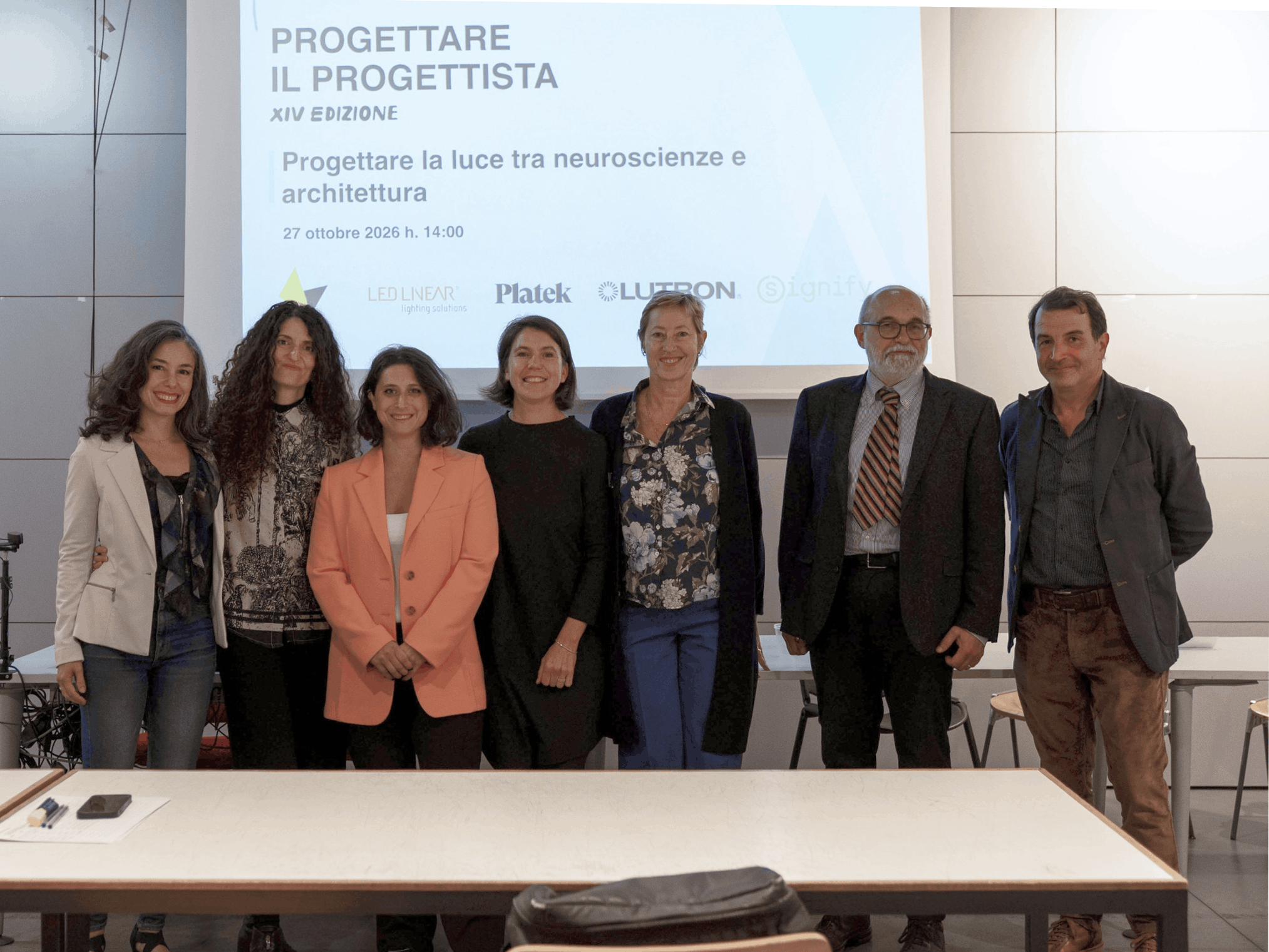
This premise set the stage for the 14th edition of Progettare il Progettista, the annual conference of APIL—the Association of Lighting Professionals—which on October 27, 2026, brought together lighting designers, architects, and researchers at Roma Tre University to deepen the dialogue between neuroscience, environmental psychology, and architecture. Four talks each explored a different dimension of the relationship between light and people, highlighting a central issue in lighting design: how to translate knowledge of perceptual and biological mechanisms into concrete design choices, without reducing the complexity of the experience to a set of parameters.
The brain within space
Andrea De Paiva approached neuroarchitecture through the relationship between environment and brain activity, also considering the effects of aging: how our attention, and the stimulation we take in from our surroundings, shift as the brain changes or declines. Research in this field is now trying to understand how the characteristics of spaces interact with people and how this knowledge can inform design, taking into account the different needs of those who inhabit them.
Starting with natural light, one variable to consider is exposure: during the day, light is linked to processes that affect mood and sleep regulation, while artificial light in the evening can interfere with melatonin production. This makes the placement and size of windows significant design elements too: they determine how much light enters, how it is distributed, and at what time of day it reaches the rooms.
Of course, there are no rules or formulas that hold true in every situation—any knowledge has to be integrated into a reading of the context, along with the intended activities and the habits of the people who will inhabit the spaces being designed. Scientific research can certainly help formulate hypotheses and test design choices, giving designers useful tools, but what ultimately drives complex work is awareness and the human factor.
Comfort is not the same for everyone
Another important aspect of lighting design concerns comfort and well-being—terms that sound similar but actually represent two complementary perspectives: while comfort also concerns physical conditions, well-being involves emotional response and the way each person relates to a space. In her talk, Martina Frattura examined comfort and well-being in relation to perception, challenging the notion that environmental quality can be defined exclusively through measurable parameters.
Visual perception is not a neutral recording of what is in front of us: the brain interprets stimuli based—in part—on past experiences, expectations, and information from the other senses. For this reason, the same environment can be perceived in different ways, and a lighting intervention can reshape the hierarchy of elements, directing our attention without our fully realizing it.
Light also needs to be considered in relation to sound, temperature, and touch, which all contribute to shaping the experience. For the designer, this means observing the specific conditions of a space and imagining how it will be experienced, rather than assuming that everyone will respond the same way. Neuroscience can support this process, but it cannot replace design judgment.
Light as a biological clock
Pier Luigi Sacco’s talk then shifted the focus to the non-visual function of light. Beyond allowing us to see, light transmits signals that help regulate circadian rhythms—our internal biological clock—influencing the sleep-wake cycle.
Traditional lighting metrics, such as illuminance expressed in lux, capture an important part of visual conditions, but they are not sufficient on their own to account for the biological effects of light exposure. We know that certain retinal cells, particularly sensitive to blue wavelengths, help transmit the signals that regulate the internal clock.
Timing matters too: morning and evening exposure can affect the circadian rhythm differently, with the former tending to advance it and the latter potentially delaying it. Intensity, duration, and timing therefore need to be weighed alongside the amount of light itself—especially in spaces used every day, such as workplaces and homes.
For designers, this perspective broadens the field of observation: the quality of light concerns not only what we see at a given moment, but also the relationship between lighting, activities, and the amount of time spent in a particular place.
Building a space through light
Alberto Pasetti Bombardella brought the discussion back to the spatial and cultural dimensions of light. Speaking as an architect, he drew on references closer to the realm of space—such as stage design, a discipline in which lighting means building a relationship between the viewer and what is shown. The position of the body, depth, points of view, and the time available all help define the experience, while the gaze can be guided but also left free to discover details and connections.
This same principle emerges in projects where light progressively changes how a work is read, bringing out details that at first remain in the background. One example, led by the architect himself, is the project for the Ca’ d’Oro in Venice, designed to make the interiors of the palazzo on the Grand Canal visible at night.
In this case, the lighting alters the usual relationship between interior and exterior, drawing attention to decorations, furnishings, and architectural details that are seen under different conditions during the day. The way we observe the building also changes our interpretation, because passing by it in a gondola or on a vaporetto means seeing it in motion, whereas stopping on the waterfront to linger over the details lets the eye return to whatever caught its attention.
This is where lighting design meets the dimension of experience. Lighting becomes a choice that influences how a space is presented, which relationships are highlighted, and how the gaze is guided over time. Neuroscience enriches this reflection with tools for understanding perception and the body’s responses, while architecture and lighting design transform space without losing sight of the place itself, its materials, and the people who pass through it.