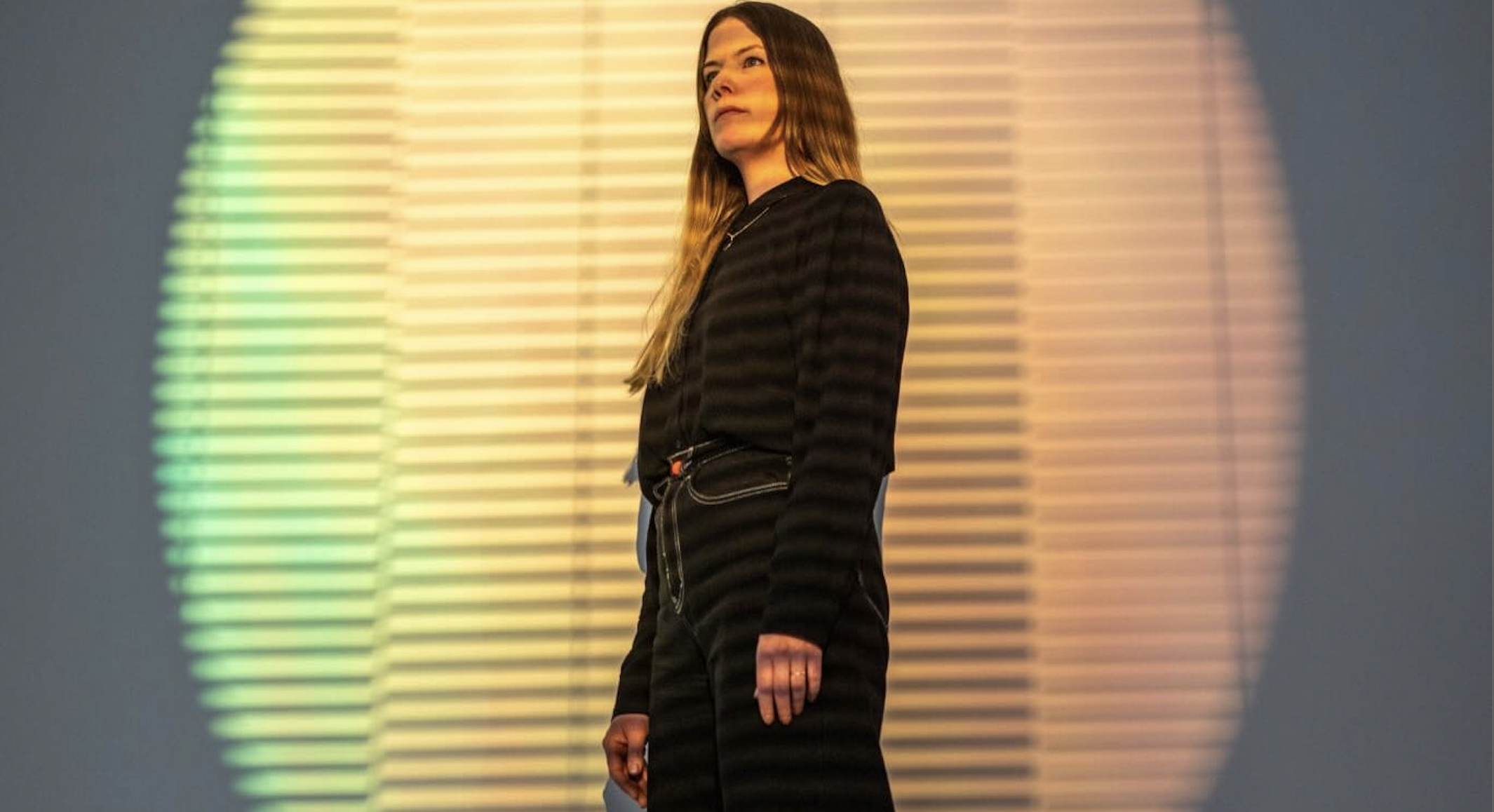
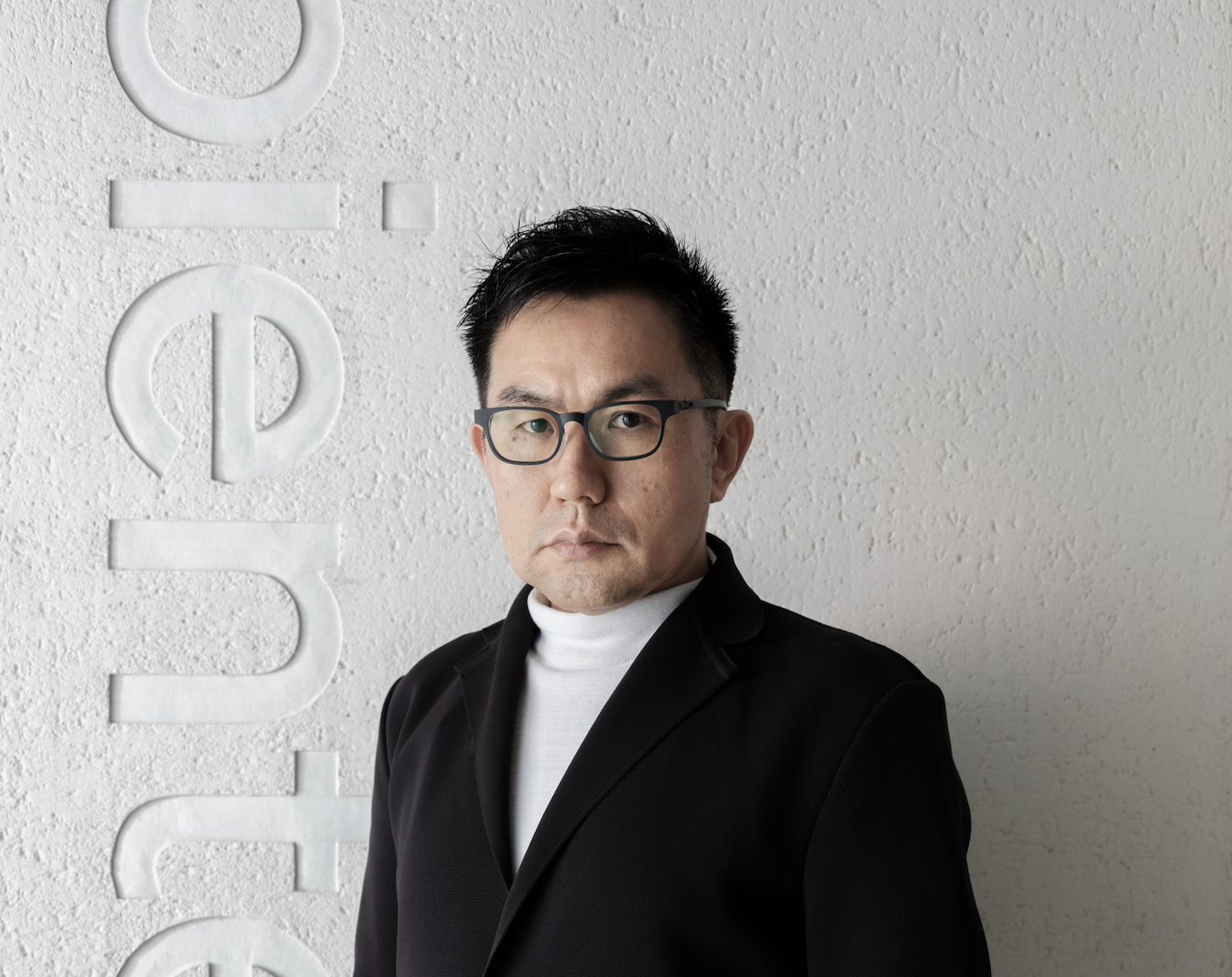
From the macro to the micro, from the image to its smallest unit. It is through this process of reduction that Aka Chang has developed his visual language. A multimedia artist born in Taipei in 1979, he emerged from the digital visual arts scene and VJ culture of the early 2000s, a period during which he worked with moving images, sound, and live performance. Over time, however, his interest gradually shifted from screens to the primary elements that make up the image itself: point, line, and light. This change marked a turning point, as he explains: “I began to realize that even the most visually complex image, reduced to its smallest unit, becomes a single pixel. And once projected or emitted by a device, that pixel is simply light.” And so, for him, light ceases to be a medium for representing something and becomes the very subject of the work. Even today, the artist defines this approach as a continuous process of reduction, aimed at eliminating the superfluous in order to work directly with his object of interest: light.
The Laser as a Pure Form of Light
Starting from this insight, Aka Chang began experimenting with light sources, LEDs, and above all lasers, drawn to the possibility of working directly with light as an autonomous material. Among these, the laser became the central medium of his practice—from which everything originates and is generated—which he considers not merely a technology, but a true creative weapon, a precise and pinpoint brush. “For me, the laser is one of the purest forms of light,” says the artist.
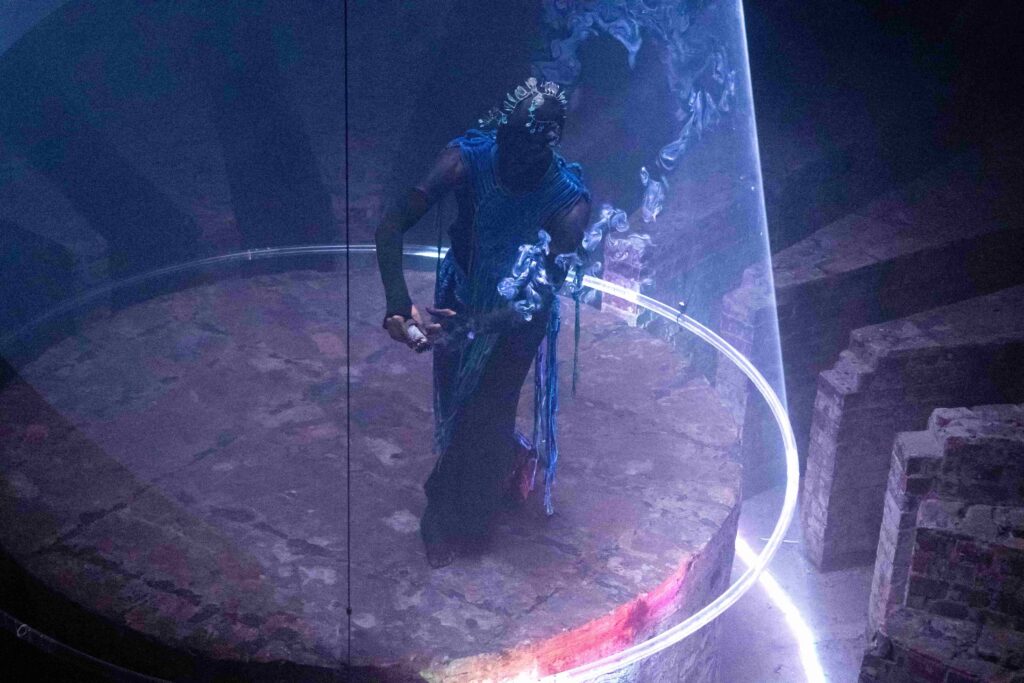
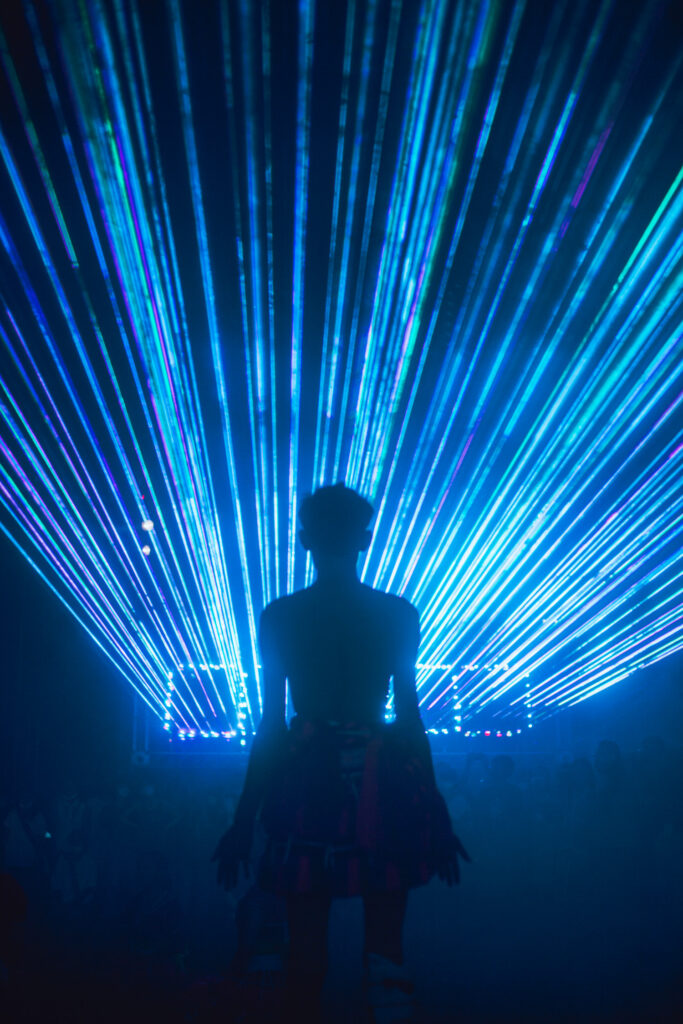
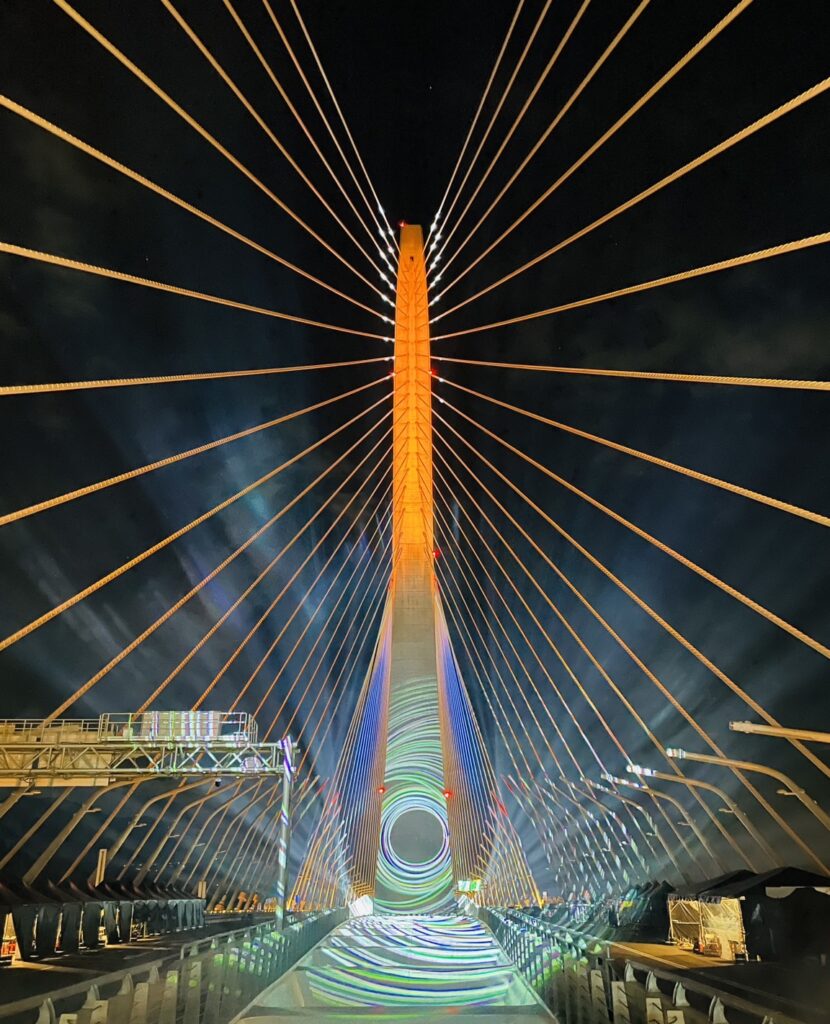
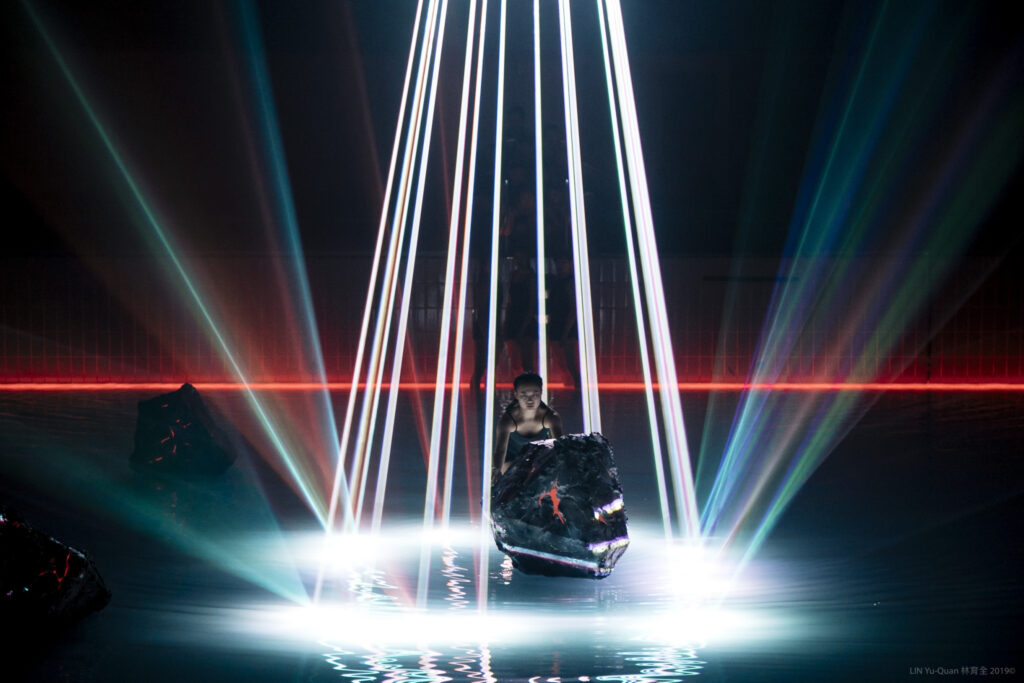
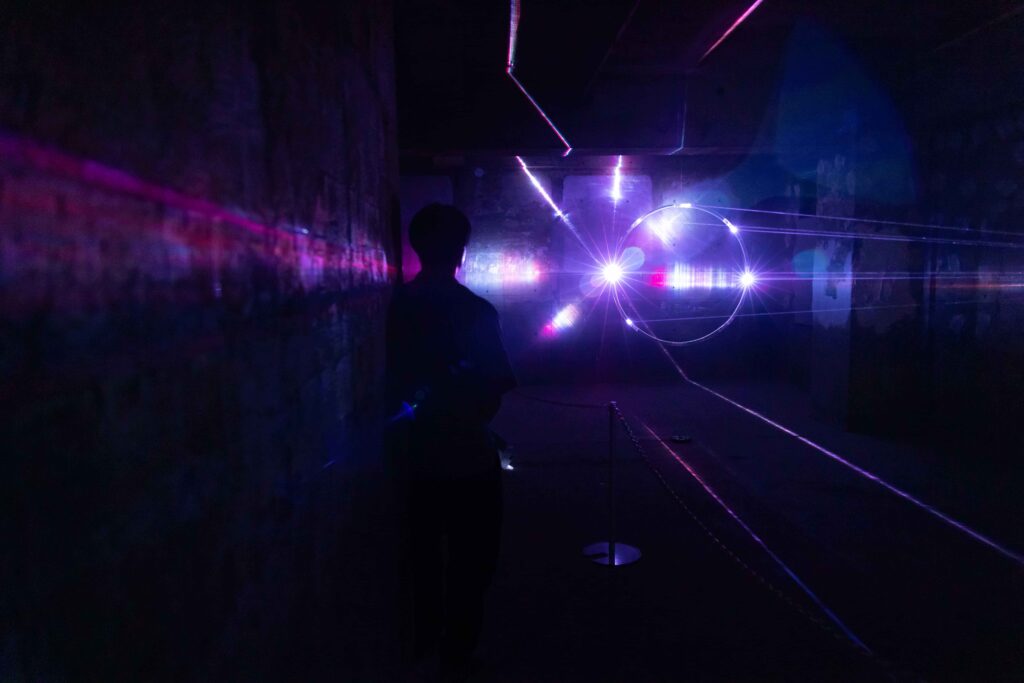
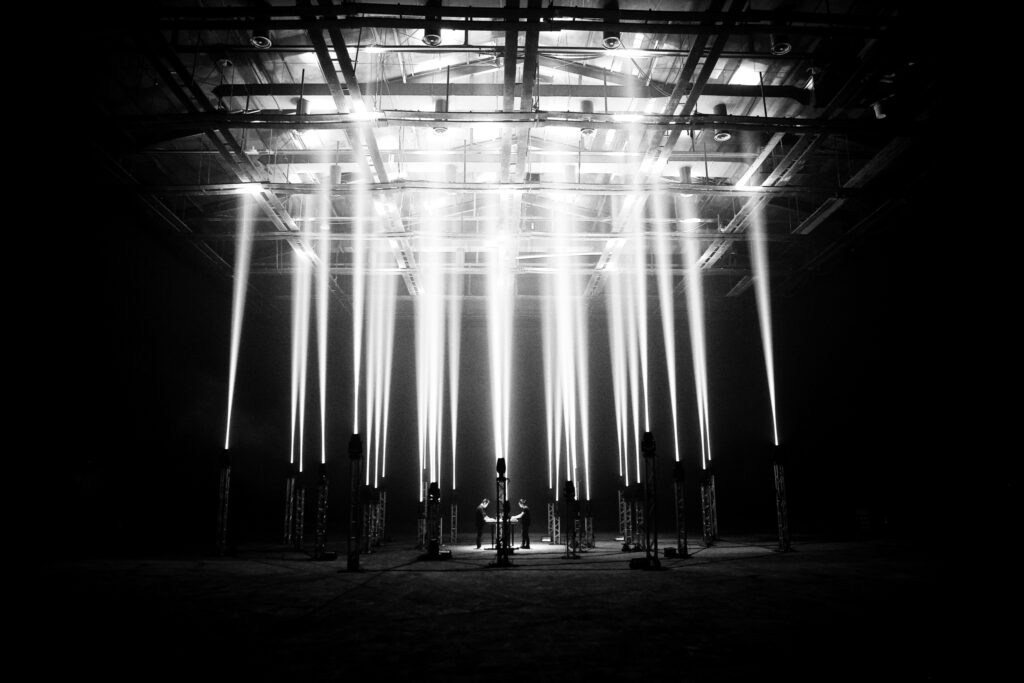
Thanks to its ability to concentrate high light intensity and color within a minimal volume, the laser allows Aka Chang to construct immersive environments and three-dimensional structures that the public can walk through—like luminous cathedrals. But the light beam never acts alone, and to make the light visible and amplify its effect, Aka Chang combines it with elements such as fog, steam, water, and reflective surfaces, which become an integral part of the creative process—not merely scenic elements. It is through this interaction—never the same and never predictable—that light takes on a tangible form.
To achieve this result, simply controlling the light source is not enough: “To shape light with precision, I must control the medium that carries it, such as steam or smoke. In this sense, developing technical knowledge becomes an integral part of the process.”
Technology, optical systems, and mechanical systems are therefore not used by Aka Chang to produce (merely) spectacular effects, but to reveal the qualities of light that normally escape the eye. “I’m interested in using technology to amplify or slow down certain qualities of light, making them more accessible to human perception.” It is precisely in this balance between technical control and subjective sensitivity that Aka Chang’s work takes shape: installations that invite the public not only to observe light, but to experience and live it as a physical presence capable of redefining, expanding, or distorting their relationship with space.
Aka Chang’s Most Significant Immersive Installations
Increasingly recognized on the performance scene, Aka Chang’s artistic exploration continues and takes shape in monumental installations, in which the laser is not used merely as a light source, but as a material with which to construct three-dimensional structures that are constantly transforming and can be walked through. Although they take different forms, all of his works share the same intention: to work directly with light.
Multimmersion
Among the emblematic projects is the Multimmersion series, launched in 2017 and still evolving today. Here, the laser traverses the space like a living entity: light trajectories synchronized with sound continuously reshape the environment, generating temporary structures in which the viewer finds themselves immersed and enveloped. In its most recent iteration, Multimmersion: Upside Down (2025), the laser beam encounters water and reflective surfaces, multiplying and giving rise to different light configurations. The lines extend downward, crossing the liquid surface to create a state of suspension.
Ring and Kosmologia
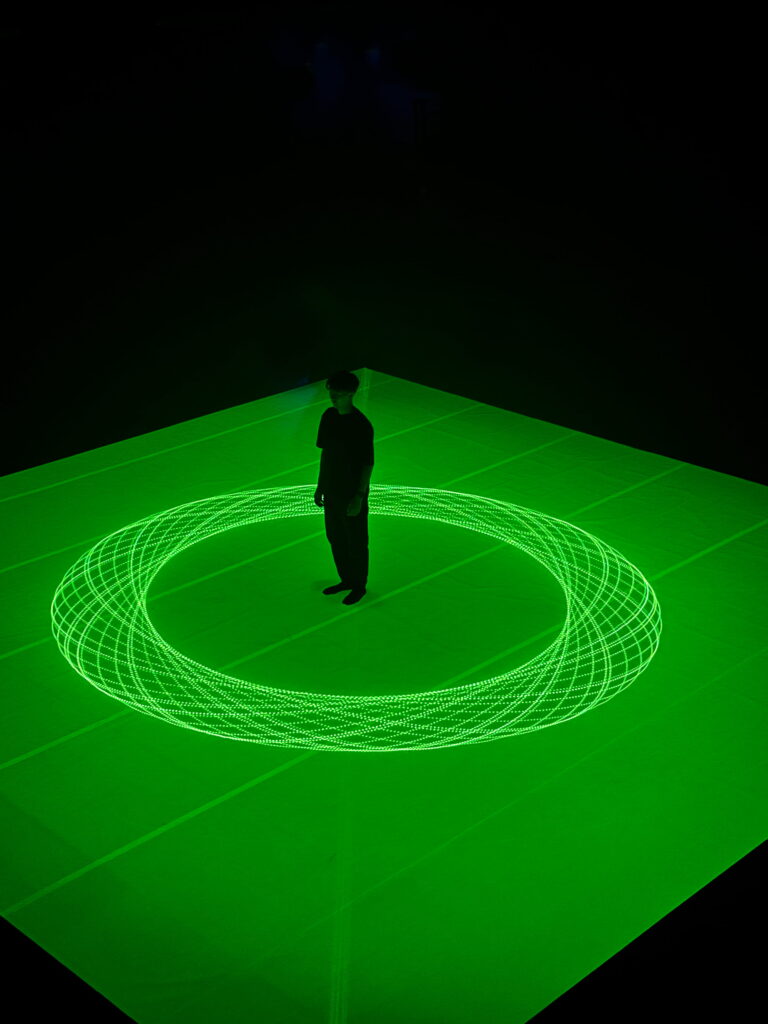
A more contemplative dimension emerges in Ring (2023) and in its subsequent kinetic evolution, Kosmologia (2024), where the movement of light takes on a central role. The laser creates continuous circular trajectories that evoke cycles and recurring movements, transforming the installation into a rhythmic structure. The repetition of the light beam generates an expanded perception in which appearance and fading become one.
Being Somewhere, Sometime
In Being Somewhere, Sometime (2025), Aka Chang uses photosensitive materials to make visible the effects of light’s passage over time. The laser activates surfaces that gradually light up and fade, leaving temporary traces in space.
Void Jungle and Struct by Kindling
With Void Jungle and Struct by Kindling (2018), the Taiwanese designer explores the relationship between generative systems, sound, and light, interweaving them. Laser beams, steam, and audiovisual structures give shape to rarefied, almost bewildering immersive environments, in which the audience is invited to experience new ways of relating to space.
December Nite
Presented in 2024 at the National Taichung Theater, December Nite represents one of the most recent evolutions in his audiovisual practice, where the musical component plays a leading role: sound, voice, and light structures interact in a single artistic experience. Light continues to be the element that shapes the space, yet it now interacts with the sonic dimension.
For Aka Chang, the exploration remains open-ended. Many of the forms of light he envisions are not yet feasible, at least with the technologies and resources available today, as he revealed to us. And it is precisely within this tension between possibility and reality that he continues to conceive his art, now complemented by a body of smaller-scale works designed for exhibition and collection contexts.