
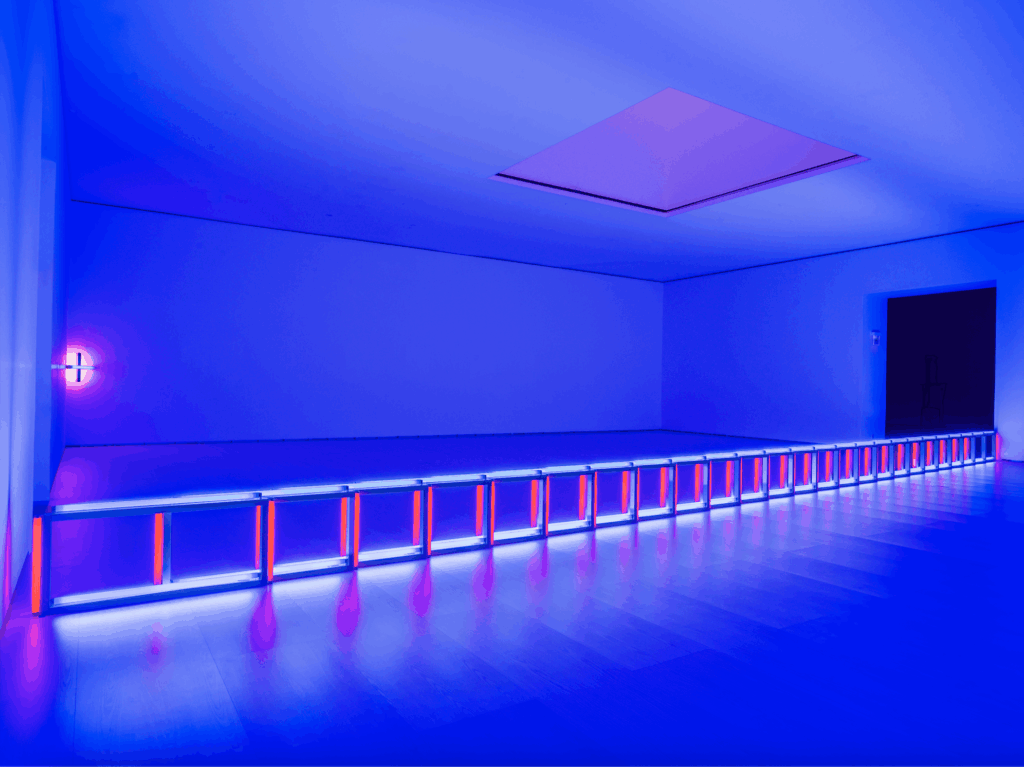
Cover photo: Dan Flavin, an artificial barrier of blue, red and blue fluorescent light (to Flavin Starbuck Judd), 1968
Blue and red fluorescent light. Modular units, each made of two 61 cm vertical fixtures and two 122 cm horizontal fixtures; variable length. Solomon R. Guggenheim Museum, New York, Panza Collection 91.3707. © Dan Flavin, VEGAP, Bilbao 2026. Photo: Erika Ede.
«Flavin’s show is one of the most interesting I’ve seen this year.» Donald Judd begins his review of Dan Flavin’s solo exhibition at the Kaymar Gallery in New York—published in Arts Magazine in April 1964—with these words. He meticulously describes two types of works: pieces in which light bulbs and fluorescent tubes are mounted along the edges of a colored square surface, and the artist’s newly introduced geometric arrangements of fluorescent tubes. What strikes him most is what happens between the light sources—the light emitted and the light absorbed by the space in which the tubes are placed. That same year, Lucy Lippard wrote in Artforum: «Dan Flavin is not a sculptor; his medium is light rather than color.»
The exhibition at the Kaymar Gallery was titled Some Lights, and curator Lauren Hinkson has revisited this same title to put together the new major retrospective dedicated to the American artist at the Guggenheim in Bilbao, Dan Flavin: Some Light, on view through April 4, 2027. The exhibition brings together, in chronological order, more than twenty works from the 1960s to the 1980s, drawn primarily from the Guggenheim’s Panza Collection and enhanced by loans from the Dia Art Foundation.
Dan Flavin’s early works: from Icons to fluorescent tubes
As Judd notes in his review, Flavin had begun experimenting with the works in the Icons series – Masonite panels with incandescent light bulbs and fluorescent tubes attached to their edges. In 1963, however, with The Diagonal of Personal Ecstasy (The Diagonal of May 25, 1963), the handmade structure disappears, leaving only an eight-foot-long golden tube mounted at a forty-five-degree angle on the wall. This marked the discovery of a principle that would characterize his entire body of work: Flavin chose commercially available lighting fixtures – neon tubes in four standard lengths and ten colors, including various shades of white. This choice deliberately narrowed his artistic vocabulary while expanding the possible relationships with the environment, since a lamp is an object that occupies a precise position in space, whereas the light it produces takes on an autonomous existence within that same space. This artistic path has its origins in Flavin’s work experience at the American Museum of Natural History, where, employed as a custodian, he developed a growing interest in the expressive possibilities of artificial lighting, gradually steering his artistic exploration beyond the boundaries of painting.
What sets Dan Flavin’s practice apart – even in relation to other artists of the Minimalist movement – is above all his relationship with the context in which the work is situated. In this regard, Mel Bochner recognized in Flavin «a keen awareness of the phenomenology of rooms.» Corners, walls, corridors, and the viewer’s field of vision all play an active role in the composition and existence of the work. It is no coincidence that the artist preferred to speak of «situations», a term that emphasizes the connection between the work and the characteristics of the space in which it takes shape.
White light and the transformation of space
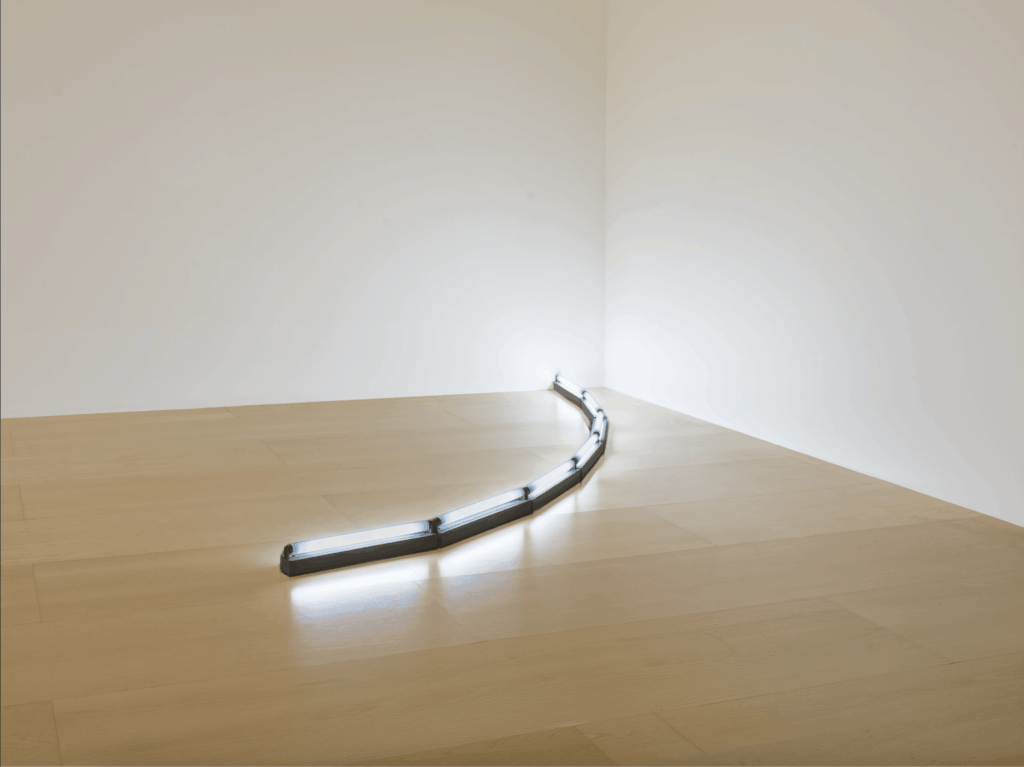
The first galleries of the Guggenheim in Bilbao demonstrate just how multifaceted this body of work is, beginning with an exploration of the possibilities of white light. In In the nominal three (to William of Ockham) (1963), daylight tubes form a sequence of one, two, and three elements. The reference to the medieval philosopher frames a work that reveals the concrete reality of its components. In untitled (1963–66), the interplay of warm and cool white light at the junction of two walls softens the edge; another work, from 1964, arranges the lamps in a semi-elliptical arc that extends onto the floor. The difference between emitted light and perceived light becomes the focus of the installation, determined by the characteristics of the light sources and the response of the surfaces.
Volumes of colour that meet the body
Starting in the middle of the decade, Flavin also explored the possibility of movement within the space by the viewer: «I knew that the actual space of a room could be distorted and manipulated through a careful and meticulous composition of lighting fixtures.» In Greens Crossing Greens (To Piet Mondrian Who Lacked Green) (1966), green tubular structures arranged as uprights and crossbars block off part of the gallery. The Plexiglas covering the lamps diffuses the light, while the title introduces an ironic comparison with Mondrian, who excluded green from his palette. The experience of color shifts from the pictorial surface to the visitor’s path. Two years later, an artificial barrier of blue, red, and blue fluorescent light (to Flavin, Starbuck, Judd) constructs a self-supporting boundary stretching from wall to wall. Red and blue meet on surfaces and bodies, generating shades of violet: the work translates Flavin’s concept – that light, through its diffusion in space, is capable of generating a volume of color – onto an environmental scale.
Dedications and luminous monuments
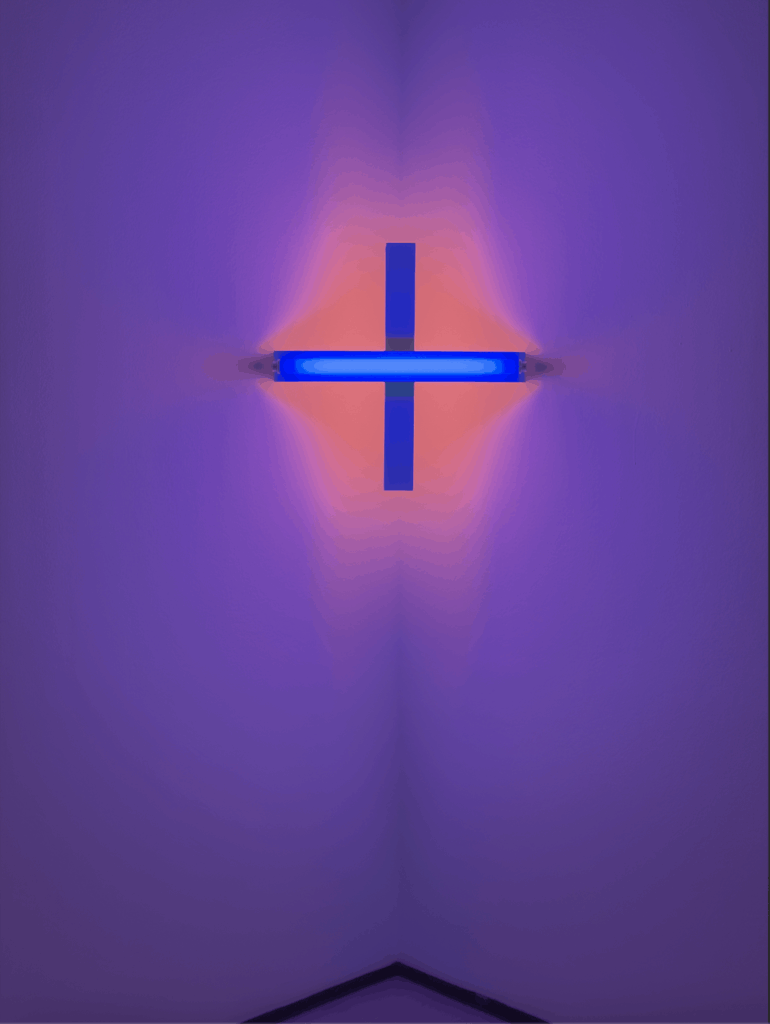
The physical space is then overlaid by the museum context, the memories evoked by the dedications, and the viewer’s subjectivity. This is evident in untitled (to Barbara Nüsse) (1971), a work on view in Bilbao. It consists of a vertical pink tube angled toward the corner and a horizontal blue tube at eye level, forming a luminous cross. The configuration may evoke a domestic icon or a religious stained-glass window, particularly in light of the artist’s Catholic upbringing. Flavin, however, rejected spiritual interpretations, insisting: «It is what it is, and nothing more.»
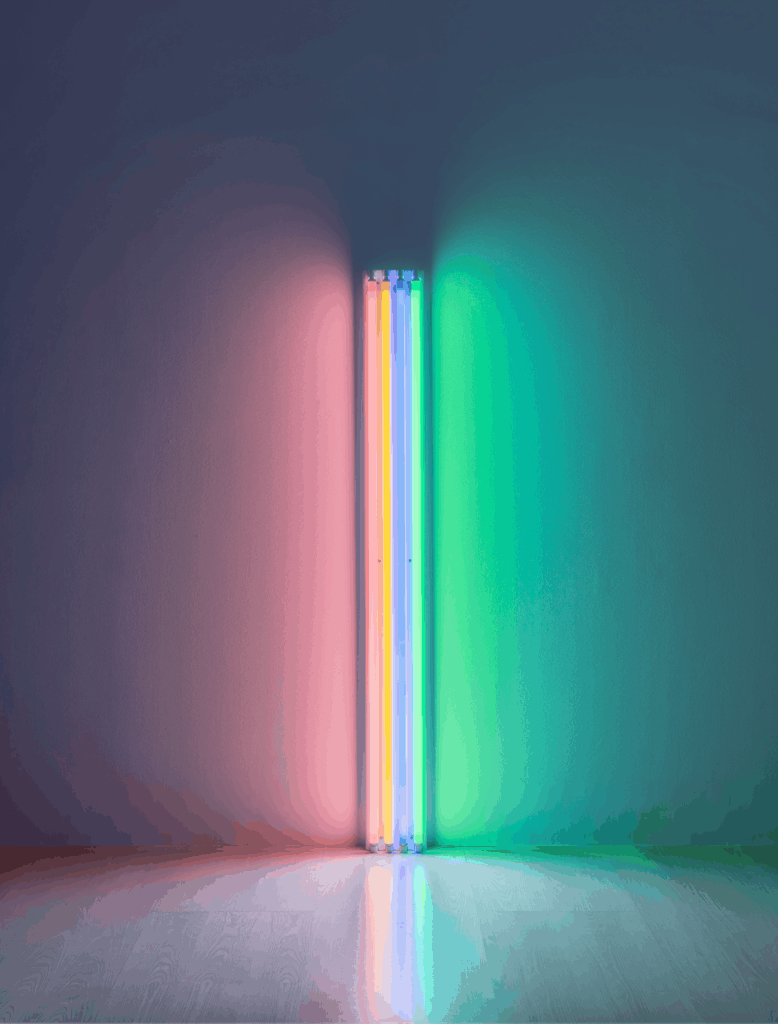
Even the tributes to key figures in art history, featured in the interludes of various untitled works, distance Flavin from the image of an impersonal Minimalism. The «monuments» to Vladimir Tatlin – seven of which are on view in Bilbao, on loan from the Dia Art Foundation – evoke, through vertical beams of white light, the unrealized project for the Third International. The quotation marks in the titles highlight the irony of entrusting the idea of a monument to lamps destined to burn out and be replaced. In the 1980s, in the pink and yellow works dedicated to Margo Leavin and in the grids for Leo Castelli, Flavin further exploited the orientation of the light sources and the reflections produced by the surfaces, while also keeping pace with the evolution of components available on the market.
A living, dynamic material
The exhibition in Bilbao thus brings together the various phases of a study of light and its implications, developed over the course of three decades—from the early wall compositions to light barriers, and on to the more complex structures of the 1980s. The exhibition curated by Lauren Hinkson allows visitors to trace this evolution through a direct comparison of works that, while employing the same industrial elements, present different formal and spatial solutions, which interact with the architecture – designed by Frank Gehry – that also stems from the idea that light is a living, dynamic material.