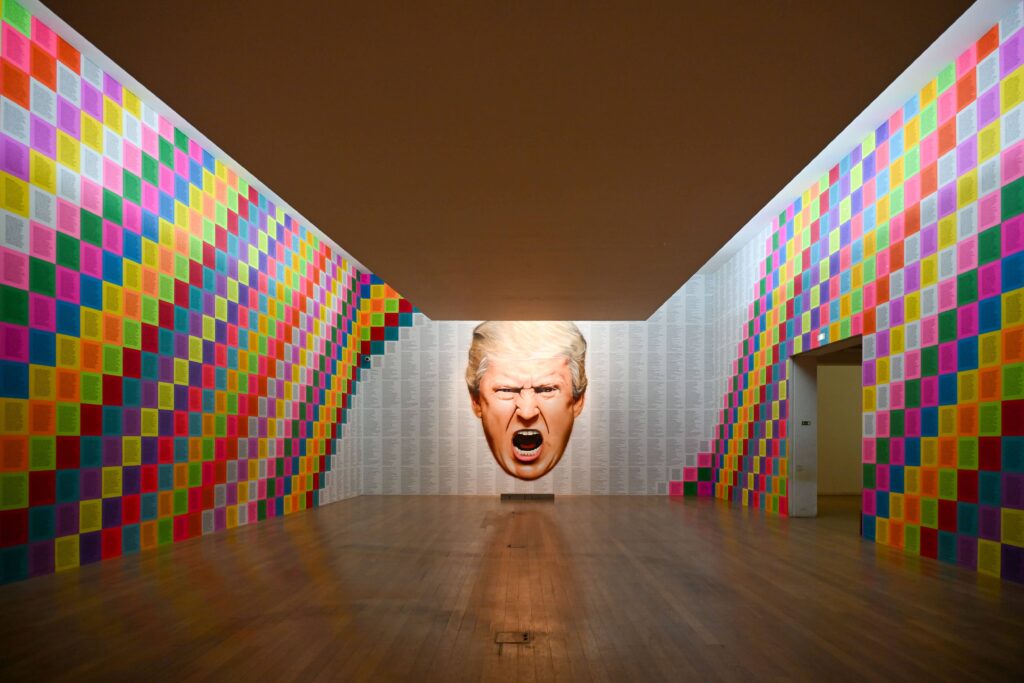

What happens to words when their meaning becomes a matter of power? In the text accompanying the exhibition curated by Philippe Vergne, Jenny Holzer. Wrong Answers, on view at the Serralves Museum in Porto through November 1, American curator Nancy Spector reflects on the relationship between language, democracy, and truth, taking as her starting point the Washington Post’s motto, “Democracy Dies in Darkness”, “Words are the light that pierces that darkness, keeping power in check through untainted facts, irrefutable evidence, and critical opinions grounded in empirical reality,” Spector states, describing words as a force capable of countering the shadow cast by the distortion of reality and censorship. It is precisely this need to make words visible and resounding that turns light into a weapon of resistance in Jenny Holzer’s work: it is through light that words take shape in silence and acquire a public dimension.
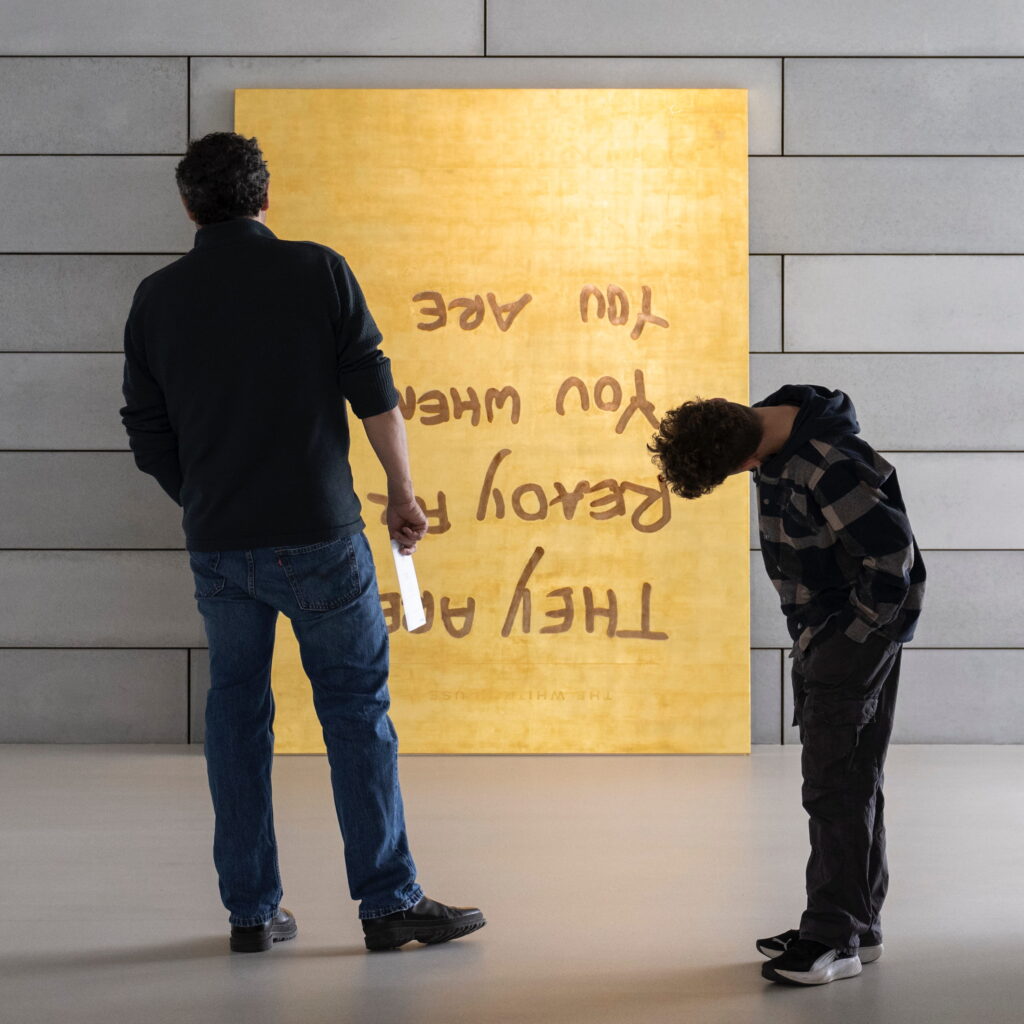
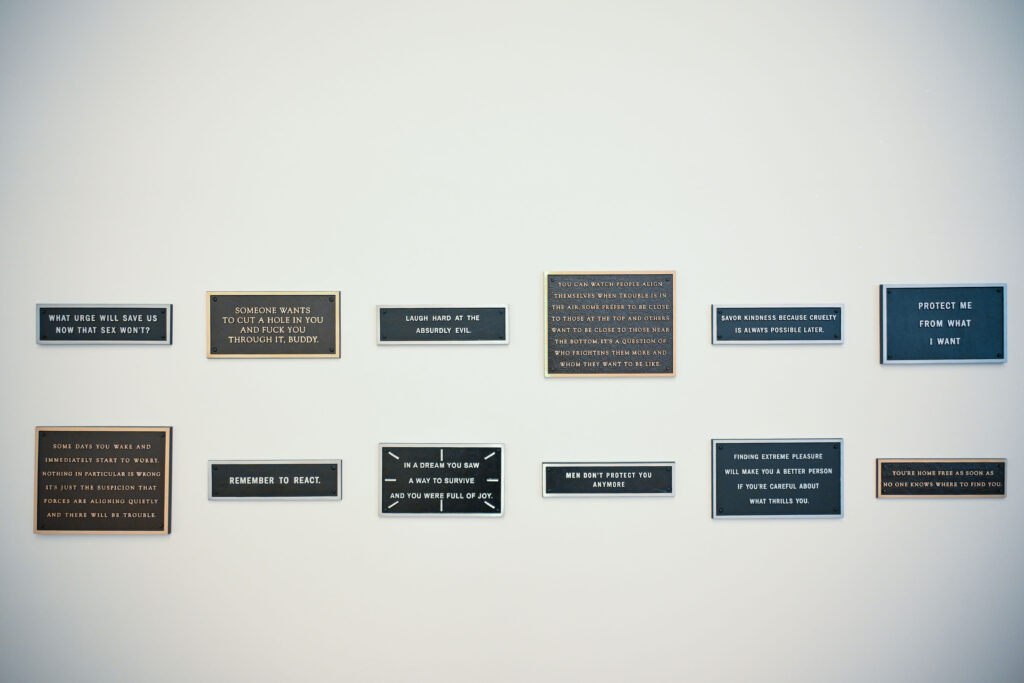
The current exhibition at the Serralves Museum traces over forty years of the artist’s practice, from her early works of the late 1970s to her most recent pieces, exploring the role of words in a historical moment marked by an overabundance of visual and written content, in which language risks losing its meaning. Through works that alternate between writing and erasure – from painterly reworkings of censored government documents to fragments of her own destroyed stone sculptures – Holzer demonstrates how words can amplify ideas and perceptions, but can also be stripped of their value.
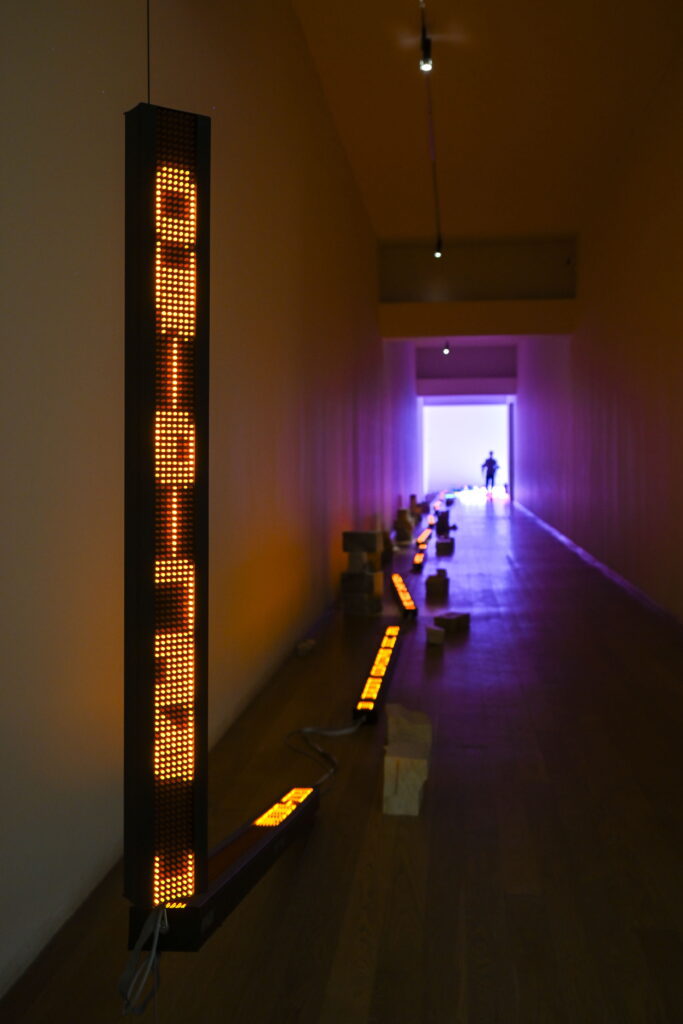
Throughout the American artist’s practice, the relationship between words and light takes on different forms depending on the media used. The posters from the Truisms and Inflammatory Essays series, clandestinely posted in New York in the late 1970s, harnessed the city’s reflected light to insert themselves into the daily flow of urban communication, alongside advertisements and political announcements. The stone engravings in the Stoneworks series shift toward a slower, more environmental dimension, rooted in the relationship between the engraved surfaces and the context in which the marble slabs and benches are placed. With the introduction of LEDs, beginning in 1983, the artistic language entered a new dimension: the word shines with its own light, becomes movement and color, and the interaction with the public takes on an almost performative quality.
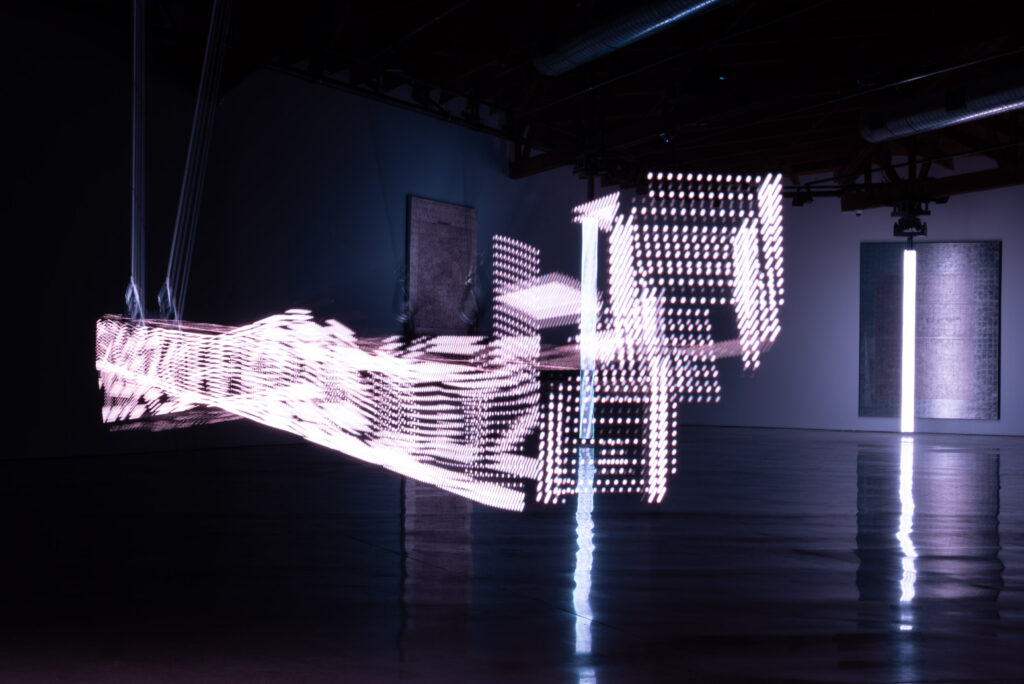
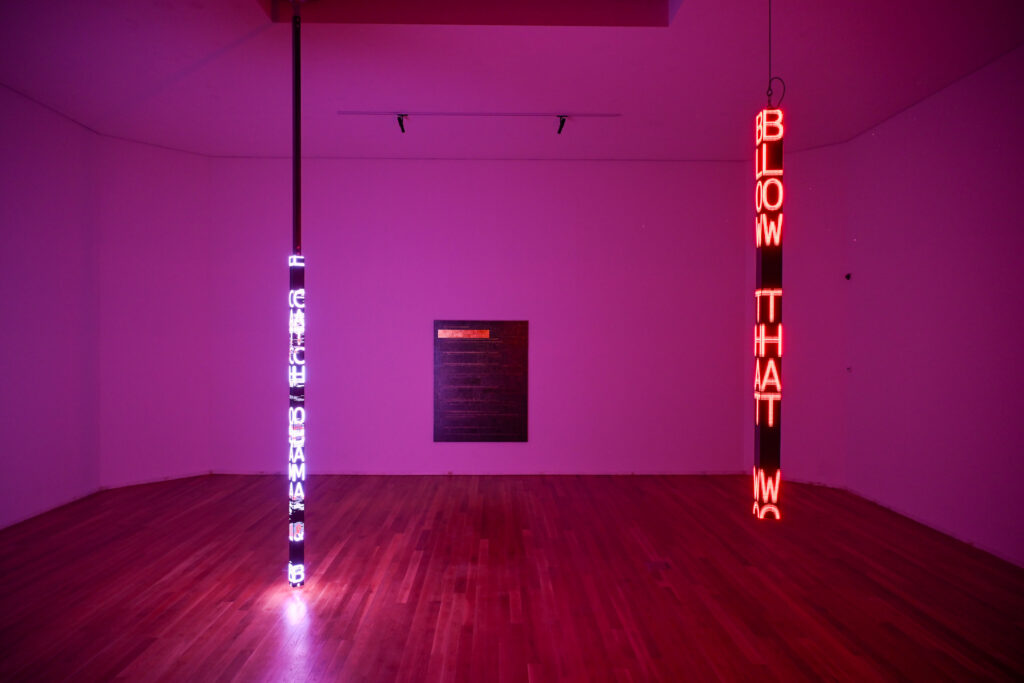
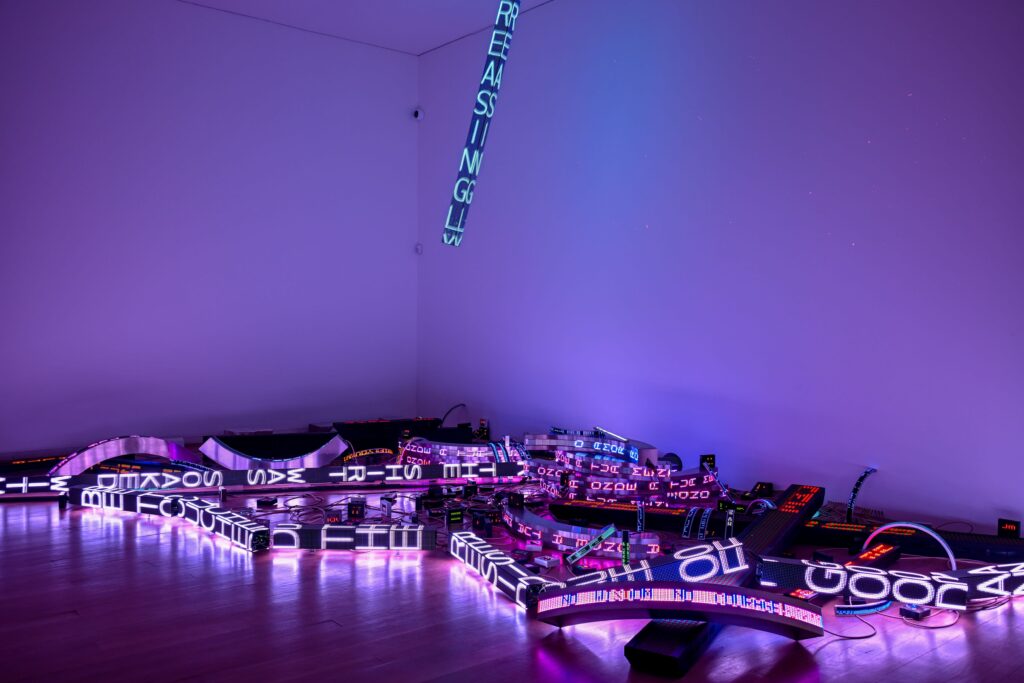
This transformation reaches a particular intensity in the LED works presented in the exhibition. Two luminous structures occupy a dark room: one reproduces hundreds of messages posted by Donald Trump on social media, while the other reworks them through a rewriting generated by artificial intelligence, which is even more aggressive and uncontrolled. The continuous movement of the columns, the hum of the motors, and the ceaseless shifting of colors engage the visitor even before they comprehend the content. Light thus seems to dictate the rhythm of contemporary communication, characterized by speed, repetition, and the difficulty of distinguishing information from manipulated and sensationalized content.
The same tension between what is shown and what is hidden runs through the paintings, such as the Redaction Paintings, illuminated by the same two LED columns. These are large black canvases onto which the artist has transferred censored government documents, printed on metallic foil covered by dark backgrounds. The surfaces seem to deny access to the text, but small cracks allow golden glimmers to emerge, suggesting a memory that cannot be completely erased. As Nancy Spector observes, these works render censorship visible, staging the conflict between revelation and concealment.
The entire exhibition can be interpreted through this continuous oscillation between what is visible and what has been erased. The engraved stone benches, the sarcophagi from the Laments series (1989), the human bones wrapped in texts in Lustmord (1993-95), and the paintings and light installations all belong to the same exploration of the fate of words and their ability to survive the actions that seek to limit them. The new installation Broken (2026), fragmented across several rooms of the exhibition, takes this reflection to its most extreme form through the act of destruction: the engraved stone benches are shattered, relics of a broken language, while the LED installations, also fragmented, are the remnants of unstable and chaotic communication.
Texts by the artist and the poet Anna Swirszczyńska move through the space, evoking war, violence, and loss of control. The work thus reflects on the risks of unchecked power and the tensions generated by new technologies, including artificial intelligence.
In Broken, destruction does not coincide with the disappearance of language. The stone fragments and broken LED signs show how every attempt at erasure paradoxically produces new possibilities for interpretation.
Atmosfera is an open space for dialogue. If light plays a key role in your research or a specific project, we’re ready to listen. We feature lighting design projects, art installations, photography series, and stories that explore the narrative potential of light.
Send us your portfolio or tell us about a project you care about.
It could become part of our editorial programming—or spark a new collaboration.
EMAIL US AT REDAZIONE@ATMOSFERAMAG.IT