
Courtesy Warner Bros. Pictures
Sinners (the Italian title I peccatori) is a film of records and firsts. Sixteen nominations at the 2026 Academy Awards, four wins, including Best Cinematography for Autumn Durald Arkapaw. Before her, no woman had ever won in this category, and certainly not a woman of African descent. A milestone that opens up a broader, metacinematic conversation, the same one the film itself engages with: the pride of Black light prevailing over the shadow of white supremacy, rewriting stereotypes and turning them into something else.
It is a film that resists classification, and precisely for that reason, it lingers. A blockbuster that refuses to behave like one. A charged intersection of twilight horror, comic-book sensuality, Mississippi blues, vampire mythology, and a preemptive Black Lives Matter consciousness. A strange blend—part raw, part stylized—that produces a sense of disorientation rather than coherence.
This fifth feature by Ryan Coogler is set in 1932 Mississippi, in the heart of the Jim Crow era. Two twin brothers, veterans returning from war, arrive in the Delta with a suitcase of dirty money and the ambition to open a juke joint. What awaits them is not only a supernatural threat, but something more deeply embedded: the weight of existing in a Black body in the American South. What awaits them is a supernatural evil, but also something more deeply rooted: the weight of existing in a Black body in the American South. Bringing all of this to the screen—both with precision and emotional depth—is Arkapaw, of Filipino and Louisiana Creole heritage, raised in Oakland and trained at the AFI, who emerges as the architect of a visual language that feels unprecedented.
Postmodern theory has long claimed that everything has already been seen, that pure imagery no longer exists, that every frame is a citation of a previous one. And yet, here, there is the distinct impression that this may no longer hold.
Two formats to enter the story
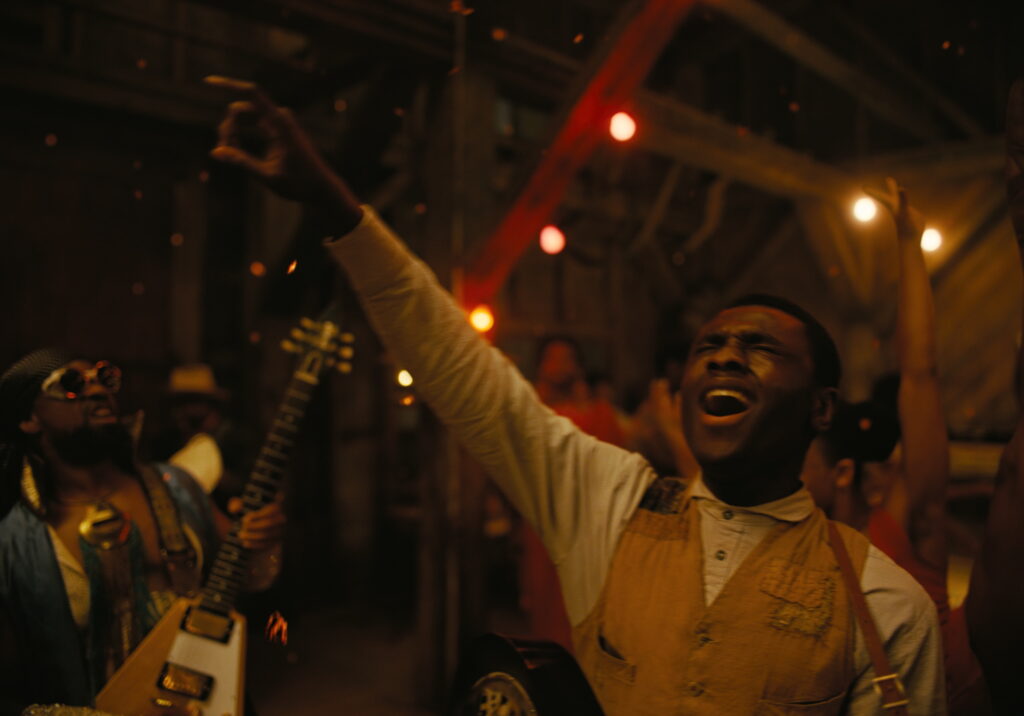
The film initially took shape on a smaller scale: Coogler wrote the script with Super 16 mm in mind, intimate, grainy, almost documentary-like. But the visual complexity of the project, particularly the need to duplicate Michael B. Jordan in the dual roles of Smoke and Stack, required a more stable format.
Through Arkapaw’s direction, the film ultimately moved into large format—first 70 mm, then an unprecedented combination of IMAX 15-perf and Ultra Panavision 70—alternating between aspect ratios of 1.43:1 and 2.76:1. This choice pulls the viewer into the image as an immersed subject, navigating a world that must be crossed with the eyes, continuously recalibrating its horizon line. «Ryan wants to push boundaries every time he looks for the best way to tell a story», Arkapaw told American Cinematographer.
Ultra Panavision’s ultra-wide format is used to capture the weight of the sky and the vast, flat horizons of the Mississippi Delta, emphasizing the landscape’s oppressive beauty; IMAX, by contrast, is reserved for interior perspectives, creating a vertical immersion that pulls the viewer into the frame, as if physically present within it.
An aesthetic rooted in 1930s Mississippi photography
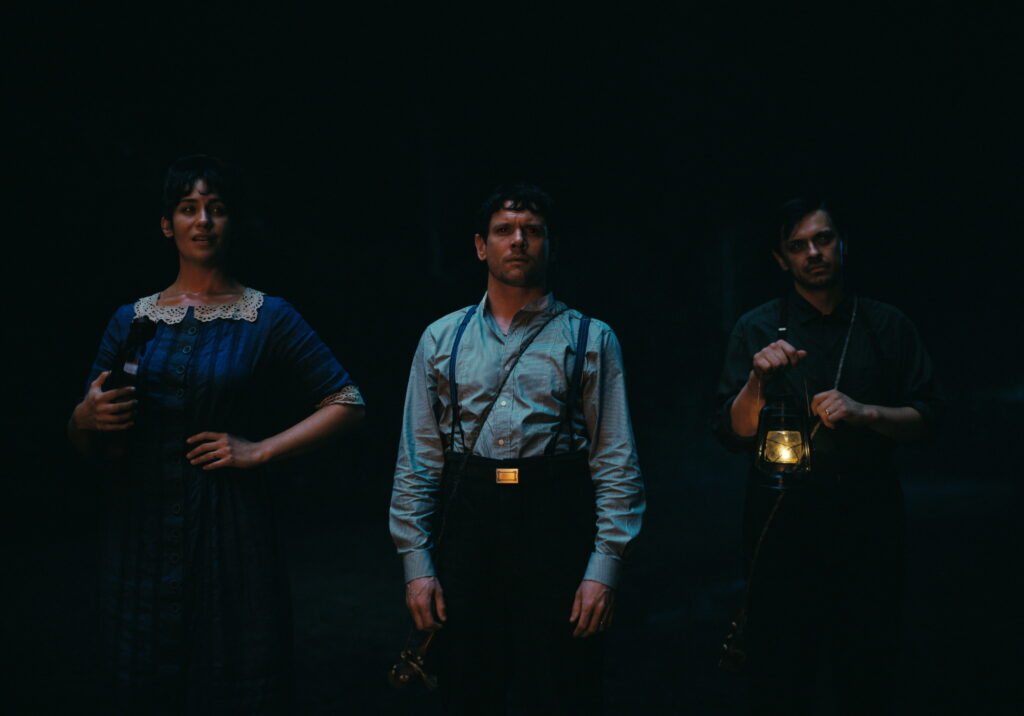
The reference Coogler gave Arkapaw was not a Pinterest board or other films (which is precisely why Sinners feels so singular), but a body of photographs taken in the 1930s by Eudora Welty, who traveled across Mississippi documenting everyday life. Images untouched by Instagram filters or Lightroom edits, raw, direct shots that kept the cinematographer from slipping into the nostalgic trap of period drama: the risk of constructing a polished, overly romantic, and ultimately artificial world.

In the end, she decided to build a world of her own—rooted in her Louisiana heritage—without relying on chromatic seduction or photographic tricks, but instead adopting Welty’s same documentary gaze: a raw yet compelling way of uncovering both the truths and the quiet magic of Mississippi.
Underexposure as a political act

At some point, this had to change. Arkapaw deliberately chose underexposure to preserve highlight detail and create a stronger contrast between light and shadow. In doing so, she demonstrates a sophisticated understanding of how light interacts with darker skin tones, especially under the harsh Mississippi sun.
Color and visual system: a shared language
In Sinners, the aesthetic emerges from an ongoing dialogue between the cinematographer, production designer Hannah Beachler, and costume designer Ruth E. Carter. This collaboration is grounded in a clear principle: when visual registers align—set palettes, costume colors, light temperature—the viewer settles into a new kind of comfort zone. When they diverge, the body registers it before the mind does: a sense of unease begins to surface.
The juke joint sequence: golden light moving through time
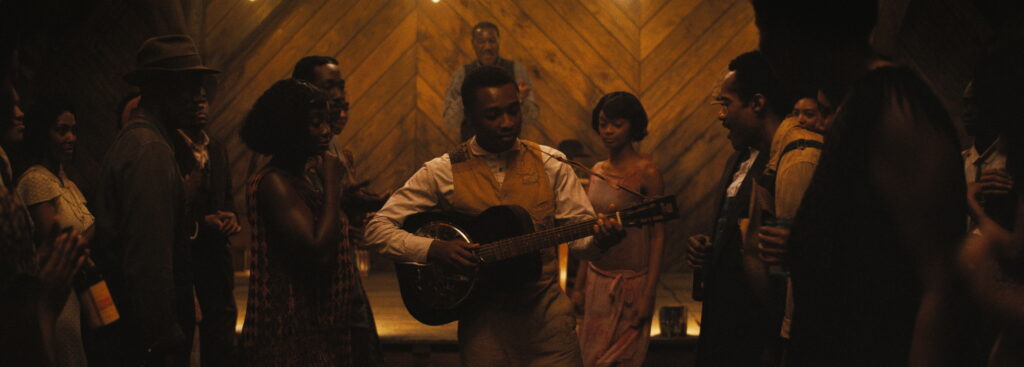
One could describe a kind of “Droste effect” in Sinners: an image in which a smaller version of itself keeps recurring. This is most evident in what becomes the film’s core, the long Steadicam sequence inside the juke joint. Watching it, there’s a clear sense that something unprecedented is about to unfold, while the heartbeat seems to fall out of sync, caught in an unfamiliar rhythm.
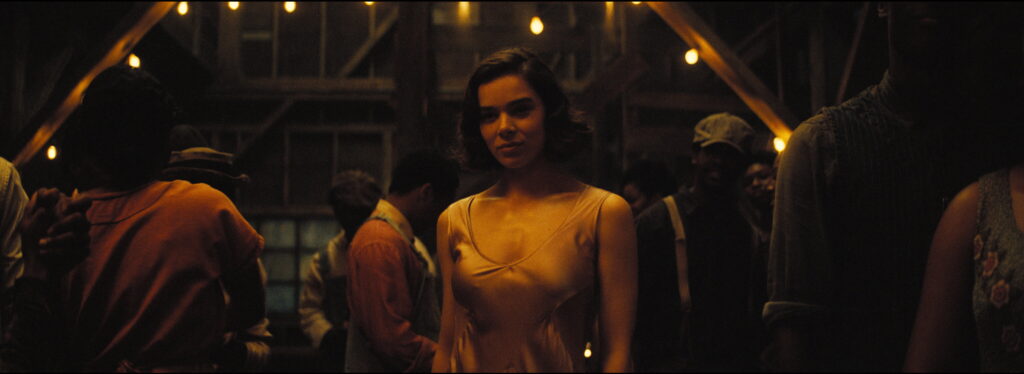
On stage, Miles Caton picks up his 1932 Dobro Cyclops and begins to play the blues. Then, through what feels like a visual and sonic miracle, figures start to appear around him: a West African griot, a 1970s guitarist with the energy of Jimi Hendrix, an ’80s hip-hop DJ, a dancer. Decades of Black American music converge, compressed into the same space, the same moment—inside the twins’ unpredictable, almost mythic juke joint.
As Caton reaches the peak of his performance, the glow of the room envelops the crowd, dissolving into what Made Journal has described as a dusty gold. The light, dense, and warm fuels the scene like an accelerant, sustaining the wild, intoxicating force of the music, pulsing with an ancestral rhythm rooted in memory and tradition.
Daylight vs Night: vampires as allegory
Over the course of the 24 hours in which the story unfolds, the sun and the moon take on a moral dimension within the film, one that Arkapaw deliberately amplifies through cinematography. Daylight is rendered in amber and honey tones, with the Delta’s colors pushed to high saturation; night, by contrast, turns silvery and cold, with an atmosphere that feels alien and unsettling. The logic is clear: sunlight stands for good, while moonlight—used in its natural form during shooting—signals evil. It is the vampires themselves, through their parasitic nature, that lower the chromatic temperature of the scenes.
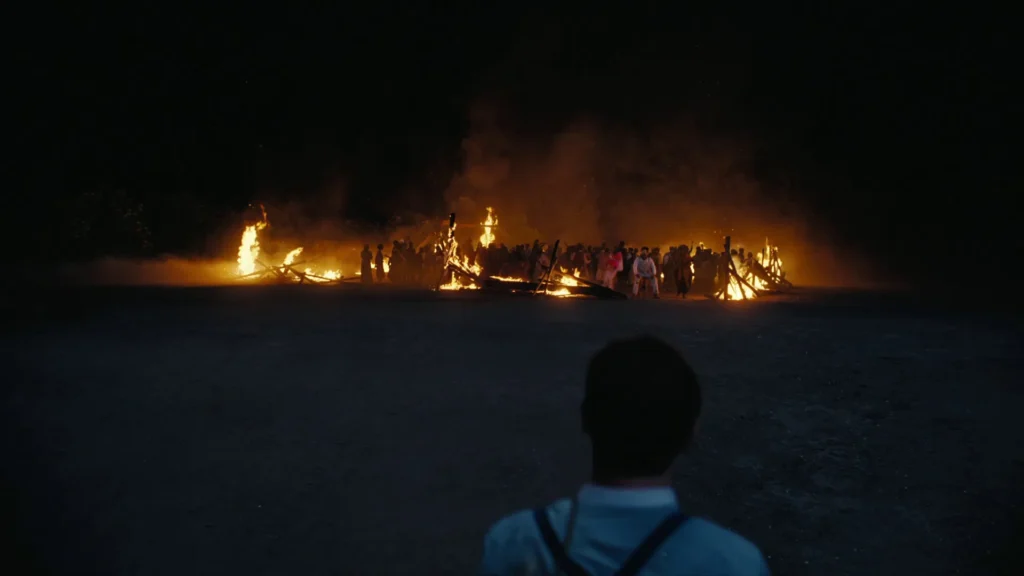
Light takes on a new semantic role: when it is present, there is a sense of safety. It reassures, envelops, protects, and even destroys the vampires. But when it fades, at the edge of dusk, what is coming is already clear.
Sinners is a singular film, one that asks the eye to move through the layers of the Delta, down to the oil lamps of a juke joint. In this work, Autumn Durald Arkapaw demonstrates that light has the potential to transcend mere illumination. It can become a stance, a redefinition of aesthetics, and a unifying force for supernatural allegories. The film’s visual language lingers, its golden-blue atmosphere settling in and proving impossible to shake off.