
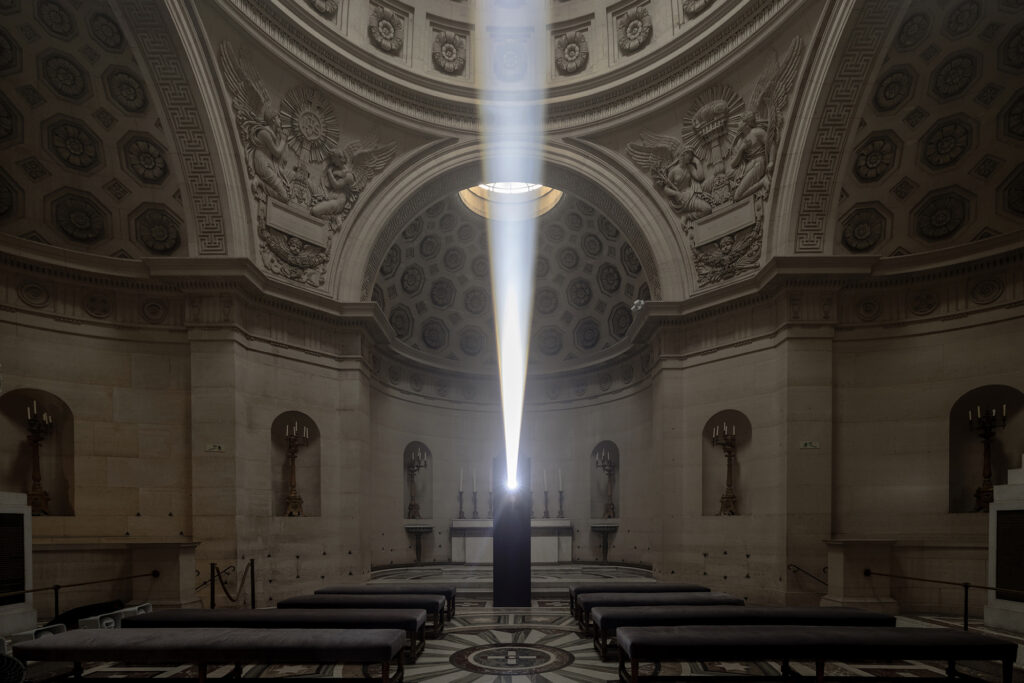
Cover photo: Threshold, 2026. Photo by Roberto Conte
Emilio Ferro is one of those artists who has transformed a deeply personal sensitivity into a distinctive creative practice. Over the years, his ability to perceive the layers of memory and spirituality—in the broadest sense of the term—that permeate monuments and sacred sites around the world has evolved into a body of immersive, site-specific installations, united by the dialogue between light and sound that has become the defining hallmark of his research. Nearly all of his projects are rooted in history; others, in some way, have become part of it themselves, such as Portal of Light, the first artistic intervention ever staged at the Pyramids of Giza in Egypt. It is an approach that often requires months of site inspections and countless nights of installation work. While setting up Portal of Light, he found himself working surrounded by the wild dogs that roam freely among the pyramids. «For miles and miles, there was no one around, and it was completely dark. In the distance, you could make out the lights of Cairo, but all around us there was nothing but the desert and the pyramids». After studying at IED in Turin and building a career that led him to contribute to more than 500 international architectural lighting projects, he now leads an independent studio that actively collaborates with museums, public spaces, and historic monuments.
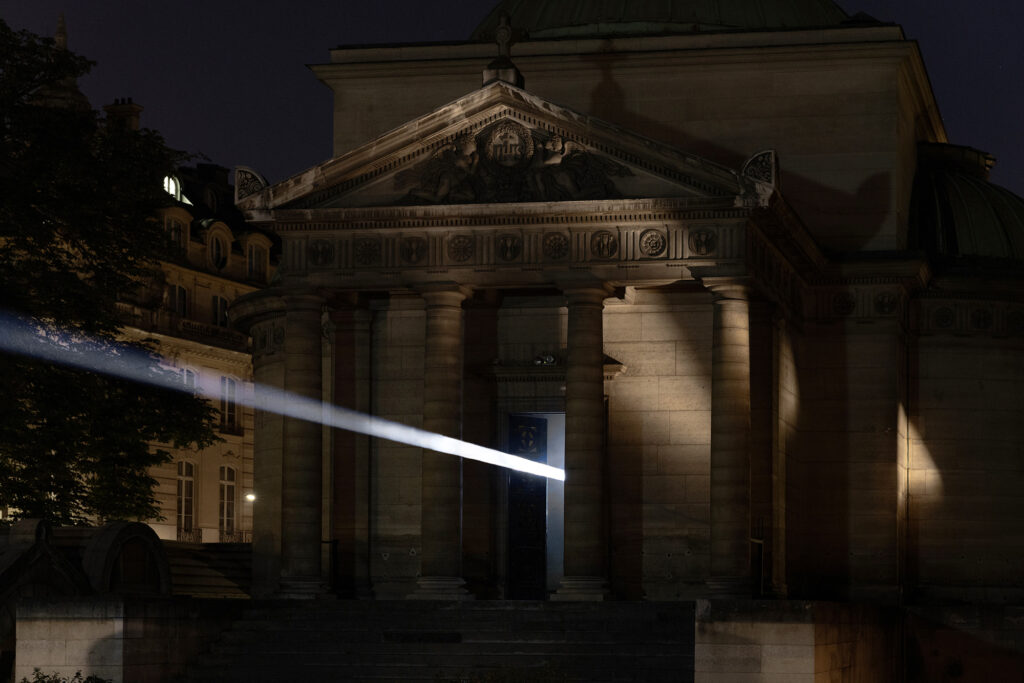
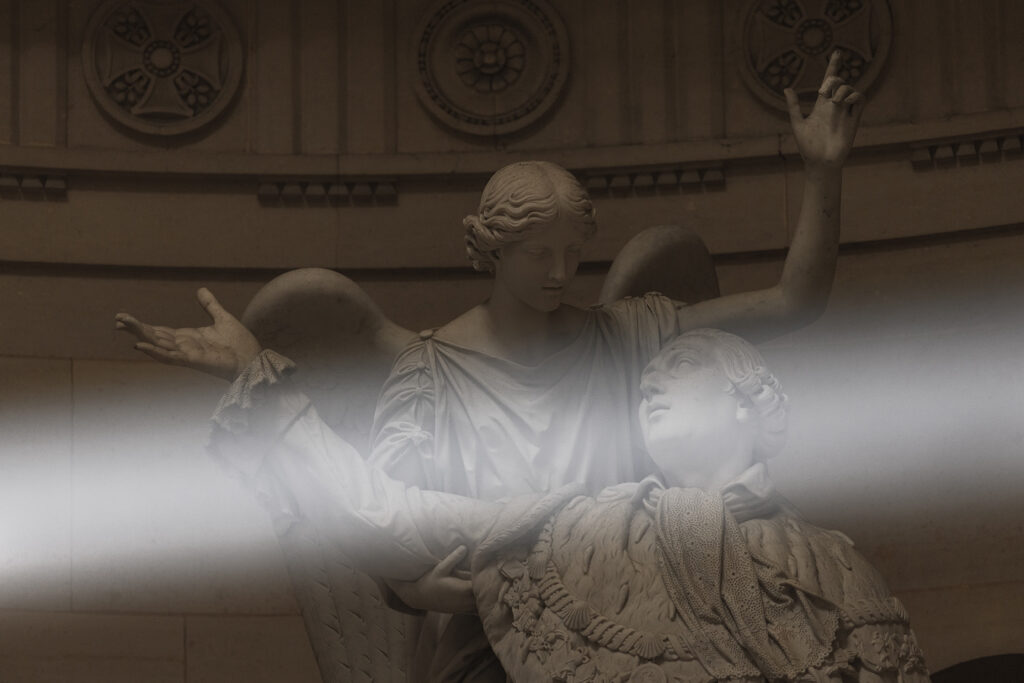
An evolution that culminated last June with the unveiling of Threshold, an installation conceived for Paris’s Chapelle Expiatoire, built on the site where Louis XVI and Marie Antoinette were buried after their execution, alongside the bodies of around 500 people guillotined at Place de la Révolution—today’s Place de la Concorde. Here, Ferro intervenes with a powerful beam of white light that establishes a perceptual threshold between the interior and exterior of the Neoclassical monument, transforming both the presence of visitors and the duration of their stay into the work’s defining elements. We spoke with him on the occasion of this project, commissioned by the City of Paris and coordinated by Studio Artera, which granted him an unusual degree of creative freedom: the opportunity to choose, from among several monuments across the French capital, the one in which to intervene. His choice fell on a place of profound historical significance, which he had considered from the outset the ideal setting for developing his research into the relationship between light, architecture, and perception.
Using Threshold as a point of reference, can you explain how you construct the relationship between a work and the place that hosts it?
I am usually commissioned to create an intervention for a specific space, and the concept grows out of the history of the place itself. In the case of Threshold, the starting point was the idea of the threshold. Other projects bring different ideas to the surface, but the process remains similar. One recurring element in my research is the idea that light can become matter. I try to make it solid, as though it were a sculpture. In this case, it is a static sculpture: there are no flashes, blinking effects, or movements. Light becomes a presence that permeates the space, both inside and outside, integrating itself into it. It can do so temporarily, as in this work, or permanently, depending on the context. As for the route through the space, in the specific case of Threshold, it is almost predetermined. There is a very imposing entrance, followed by a garden that leads to the chapel. Visitors are given no instructions upon entering: everyone is free to interact with the space and, through spontaneous gestures such as opening or closing the door, reshape the relationship between light, the interior, and the exterior.
A sonic component is always present in your work. How do you coordinate these two dimensions, light and sound?
In my research, light is connected to time, while sound is connected to place. I generally use recordings made directly in the space where the work is installed. They may include magnetic fields, ambient noises, or other sonic traces gathered on site. I then sample this material—often white noise—and create a composition lasting around thirty minutes, which I may produce on my own or in collaboration with others, depending on the project. The composition evolves and allows visitors to enter a meditative state, helping them “synchronize” with the energy of the place. That is the sense in which I consider sound to be connected to space. Light, by contrast, is connected to time because, although it is static, it possesses a vibration that allows time to be perceived in a different dimension.
Monuments, sites of memory, and sacred spaces—both consecrated and secular—recur throughout your research. What draws you to these contexts?
I am interested in engaging with the history of these places and in the possibility of adding something, either temporarily or permanently, that changes how they are perceived and remains in people’s memories. I believe that a place in which prayers, intentions, or, more generally, a particular kind of energy have accumulated over a long period—whether positive or negative, since both are possible—possesses a different power from an architecture without that kind of stratification. A space charged with energy and rich in memories has greater force. I therefore do not associate the idea of the “sacred” with a single religion. I understand it instead as a form of mysticism open to everyone, without a predetermined channel. Naturally, perception changes from one individual to another. This idea is also connected to light: light is energy, and it enters a place already traversed by other forms of energy.
Your work engages both with lesser-known histories, such as the one evoked through Fenoglio in Cardiopulso, and with places embedded in the collective imagination, such as the Pyramids of Giza.
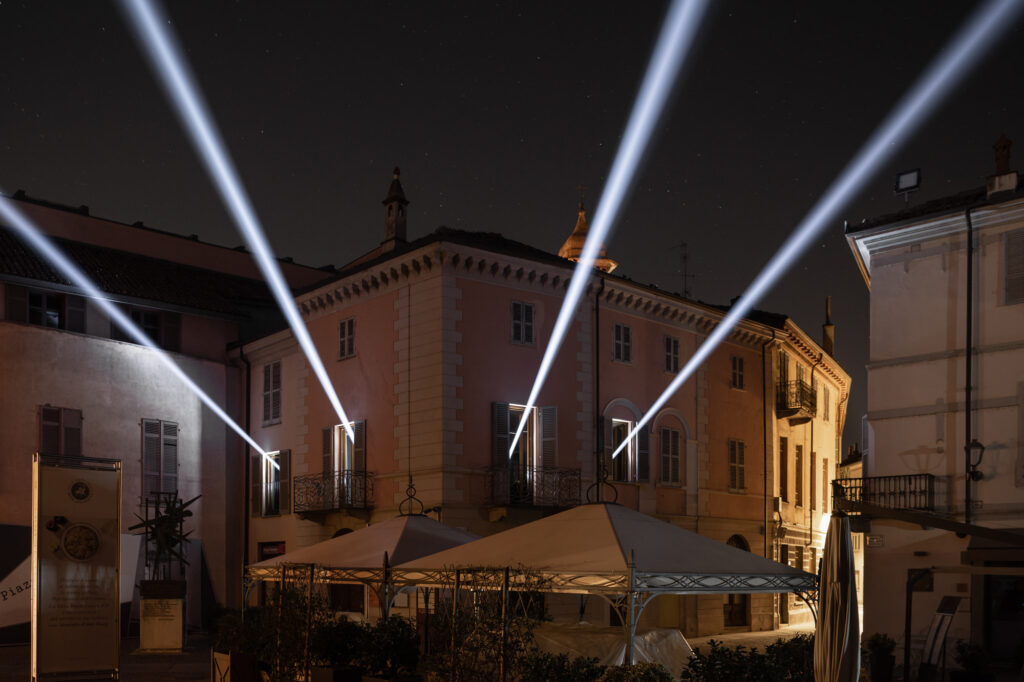
Yes, Cardiopulso was commissioned for the centenary of Beppe Fenoglio’s birth. In that work, the direction of the light takes on the opposite meaning from the one it has in Threshold. I had been asked to bring back to life the expression ‘segreto cardiopulso’ (‘secret heartbeat’) coined by Fenoglio in reference to the partisan struggle for the liberation of the city, which began on October 10, 1944, and continued over the following twenty-three days. I therefore conceived four adjustable beams of light projected from the first-floor rooms of the Centro Studi Beppe Fenoglio in Alba, where the writer loved to work, toward the direction he himself described in his writing: the point from which the partisans observed Alba at night.
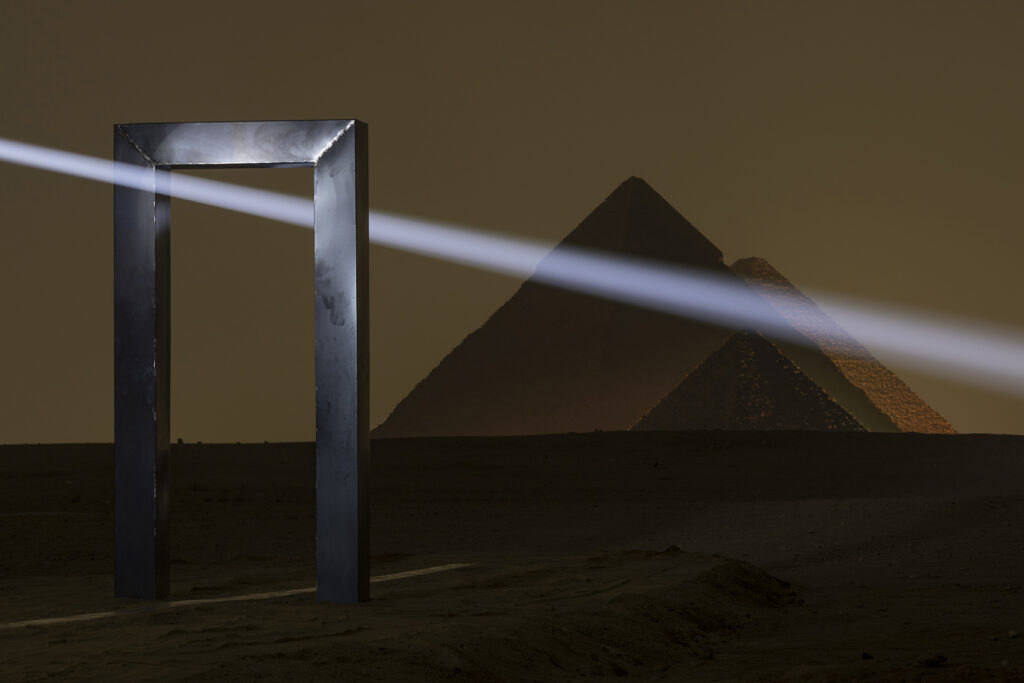
In this case, people were not expected to physically cover that distance, because the point being indicated was much farther away. Light itself established the connection. The direction could also be read in reverse: seen from the hill, it corresponded to the trajectory through which one could imagine the city’s hidden heartbeat. The process at the Pyramids of Giza was more complex. Art d’Égypte first contacted me between late 2020 and early 2021, inviting me to take part in the event’s inaugural edition. At the time, however, travel was difficult, and it would have been challenging to take on a project of that scale and symbolic weight. They contacted me again in early 2022, saying they wanted to create one of my works. This time, I was able to travel to the site, and Portal of Light was born. It received an extraordinary response and became the first light art installation ever created at the Pyramids of Giza. It is a place deeply charged with memory, perhaps the most intensely charged site I have ever worked in.
Are there projects you are already working on, or directions you would like to explore?
There are several, but I prefer to leave them simmering. I like to think that fate allows them to mature and, in some way, draws them toward me. It may sound incredible, but I had designed an intervention for the pyramids before I was ever contacted, probably in 2017 or 2018. It was not the work that was eventually realized; it was another project, and it would not have been the right one, but I had already produced several drawings.
It seems unbelievable, but sometimes things really do appear to arrive on their own. The further you take your research and experimentation—and by that I mean drawings, sketches, intuitions—the more likely it becomes that the right project will arrive at the right moment.