Aura by Viabizzuno: for Snøhetta, designing a lamp means starting with light

The Norwegian firm turns the conventional way of thinking about a lamp on its head: the quality of light comes first, then the object’s form. Viabizzuno translates this idea into a patented optical system, designed to precisely control the light beam while reducing energy consumption.

Newsletter

NEWSLETTER

Stay updated

Become a vital part of our thriving community:
subscribe to the ATMOSFERA Newsletter.

Subscribe

Read also..

Highlights

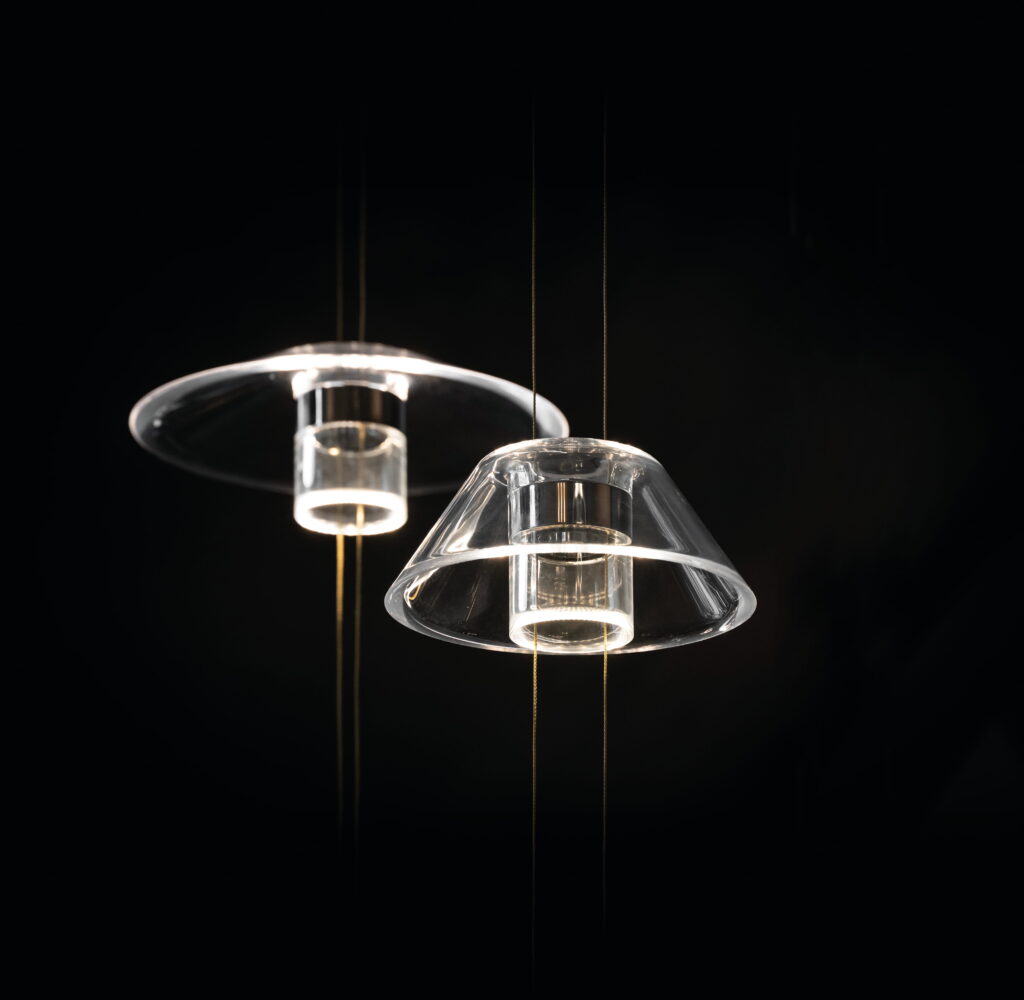
Cover: Aura sospensione and Aura parete. Photo by Viabizzuno

In the design of a lighting fixture, there is an unspoken rule—almost a conditioned reflex on the part of the designer: a good product must be beautiful even when turned off. Everything that is visible in the absence of light—first and foremost, the object’s form—is often the true focus of the design, the aspect by which a product’s quality is judged even before its function comes into play. This holds true even fortechnical lighting.

With the Aura collection for Viabizzuno, Snøhetta overturns this assumption: the starting point is not the material that houses and generates light, but light itself—its quality and the experience associated with it. It is a paradigm shift that goes beyond product aesthetics, directly addressing sustainability and energy efficiency—the core of the Norwegian firm’s design philosophy.

Marius Myking, director of Snøhetta’s Product Design department

As Marius Myking, director of Snøhetta’s Product Design department, explains, “The project emerged from the realization that, from a physical standpoint, light is entirely predictable. This became a very interesting design question for us: What would a lamp look like if we were designing the light itself, rather than simply designing an object that contains it?”

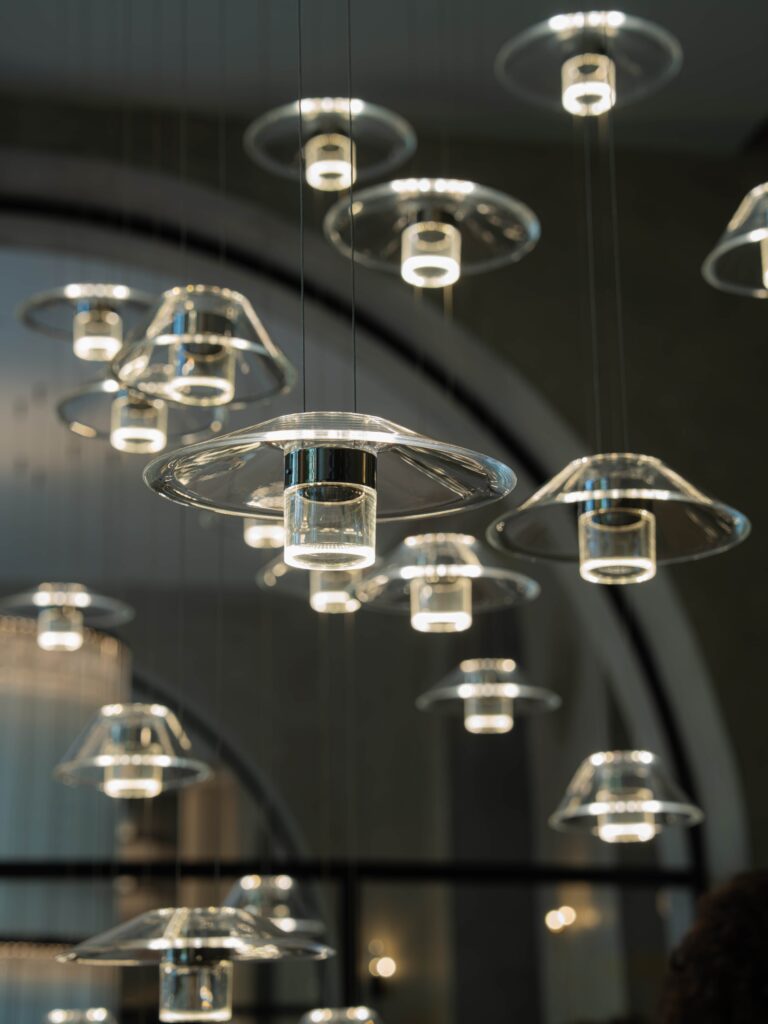
Aura sospensione. Photo by Viabizzuno

Designing light before the lamp

It is a shift in perspective that leads to considering the behavior of light as the primary material, from which the object itself derives. For Snøhetta, this approach does not arise in isolation but is part of a well-established working method, rooted in ambitions shared with its collaborators rather than in academic research. And it is precisely in this context that sustainability and efficiency cease to be an added layer to the project and instead become its connective tissue. “In Aura, the energy-saving strategy is an integral part of the ambition from which the project was born: to create high-quality light, with the lowest possible energy consumption and the best performance over time,” Myking explains.

Aura sospensione and Aura parete. Photo by Viabizzuno

A patented optical ring to control the light beam

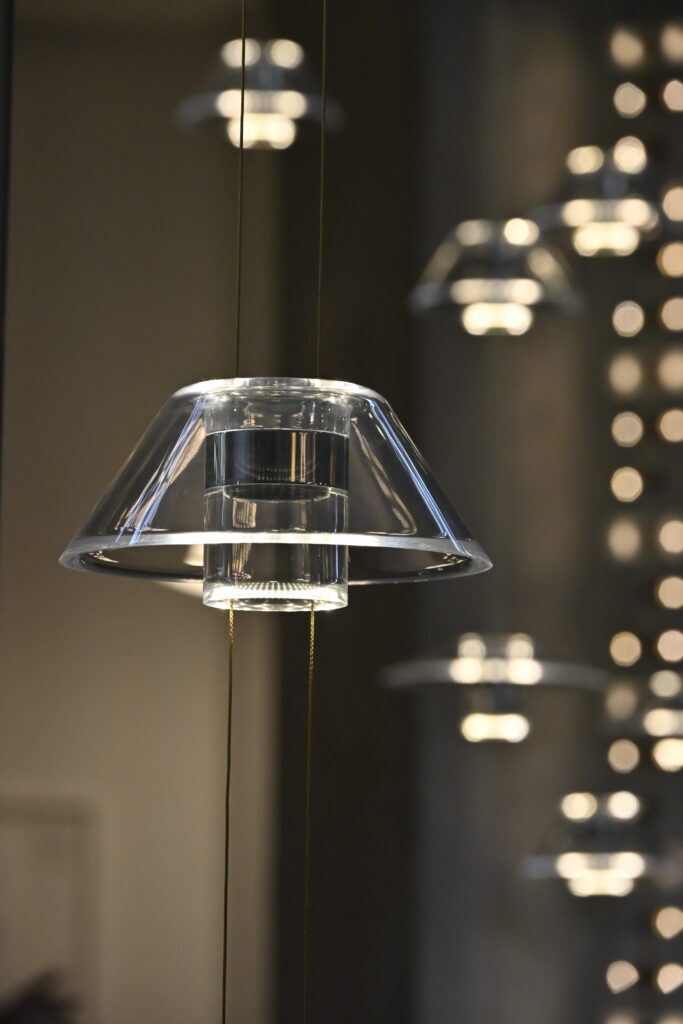
The collaboration with Viabizzuno—which for over thirty years has built its identity on research, patents, and high-end artisanal production—made it possible to translate the designers’ vision into a collection of seemingly simple fixtures backed by complex technology. Sebastiano Vasta, the company’s technical director, describes the origins of the system that made Aura possible: “When Snøhetta entrusted us with the challenge of designing light that was completely predictable, we embarked on a research journey that led us to develop an optical system capable of controlling the light beam with extreme precision and generating a veritable vortex of light. From this insight emerged an innovative technology based on an optical ring—which was subsequently patented—that, combined with a heat-dissipating ring-shaped body, a minimalist design, and innovative materials, gave rise to a highly successful collection.”

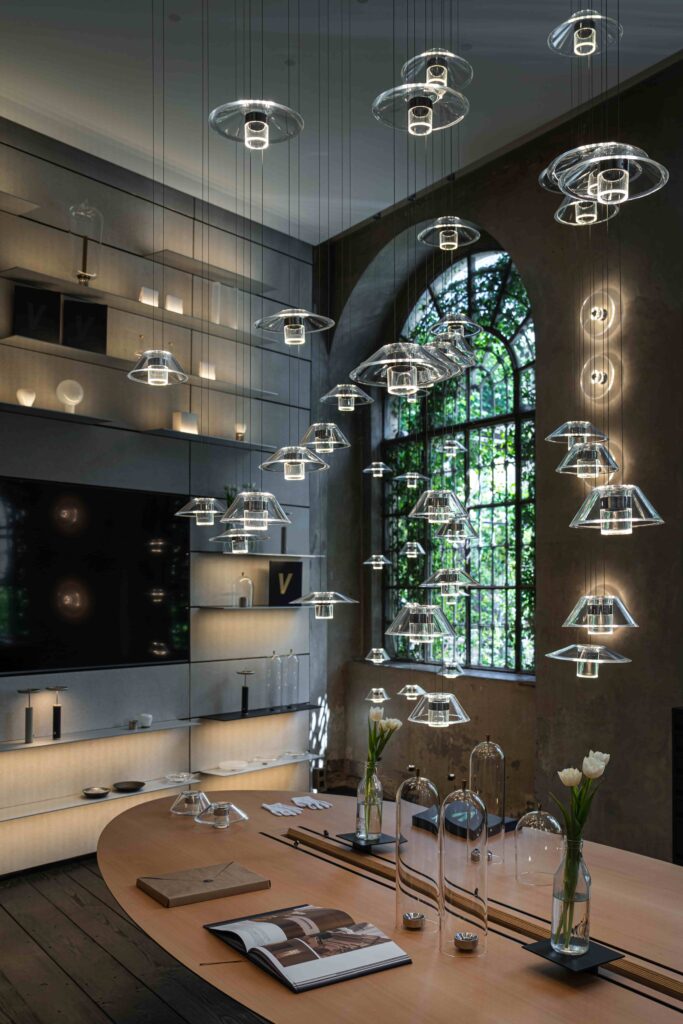
Aura sospensione. Photo by Fabio Gambina

From pendant to wall-mounted: how Aura evolved in 2026

Aura was unveiled last year during Milan Design Week at the Viabizzuno spaces in the heart of Brera, with an event bearing the emblematic title “Shaping the Invisible,” which highlighted the visionary collaboration between designers and manufacturer. In 2026, the pendant was joined by a wall-mounted version, marking a significant evolution of the collection that expands its range of applications in both residential and hospitality settings. The wall-mounted version maintains the same design philosophy, establishing a more direct relationship with the architectural surface.

Aura sospensione. Photo by Fabio Gambina

At the heart of the creative process that guides Snøhetta’s entire body of work lies a philosophy rooted in a deep sense of environmental, social, and economic responsibility—considered, in the realm of product design, the prerequisite for truly meaningful product innovation. Over the years, these principles have guided projects of varying scales and types—from the Array modular sofa for MDF Italia to the Forite recycled glass tiles for Fornace Brioni, to the FLYNT permeable concrete flooring system—and have led the firm to receive international awards such as the Compasso d’Oro and Dezeen’s Sustainable Design of the Year. When sustainability is the starting point rather than an added requirement, form, too, can stop being the project’s first question.

Do you have a project to share?

Atmosfera is an open space for dialogue. If light plays a key role in your research or a specific project, we’re ready to listen. We feature lighting design projects, art installations, photography series, and stories that explore the narrative potential of light.

Send us your portfolio or tell us about a project you care about.
It could become part of our editorial programming—or spark a new collaboration.

EMAIL US AT REDAZIONE@ATMOSFERAMAG.IT

Read also..

10
At Jago’s new museum in Capri, light opens a new dialogue with the stone of his sculptures
At Villa Lysis, Jago’s new museum puts the relationship between sculpture and lighting to the test. Light Company works with light sources, contrasts,...
Read Article
anatomy of a presence
Light on the skin, flickering through flames. “Anatomy of Presence” turns SCHAUWERK Sindelfingen into an experience that is as physical as it is visual
Lucia Koch, Vivian Caccuri and Henrique Oliveira transform the former industrial building through a material dialogue between light, colour and sound....
Read Article