

Cover photo: Warner Bros
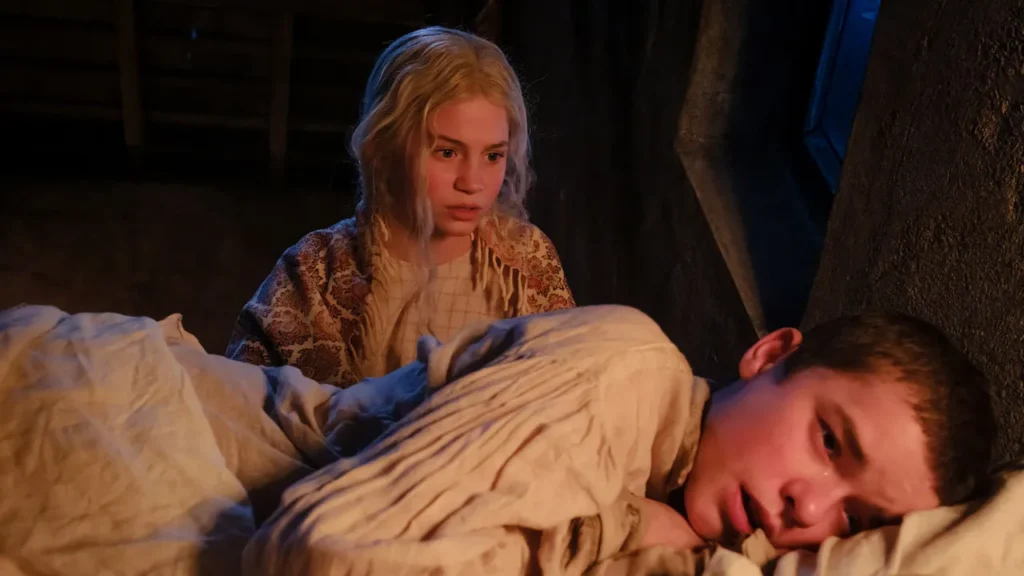
The film—one of the most watched and debated of 2026—opens on a labored breath: that of a young Cathy (Charlotte Mellington)—an ambiguous moment, suspended between fascination and terror. Then the frame widens, she screams, and we realize we are witnessing a public hanging. The scene is bathed in a milky light that avoids sharp separations between bodies and setting, immediately establishing the direction of the cinematography—by Linus Sandgren, Academy Award winner in 2017 for La La Land—a direction that remains consistent throughout the film: fear, passion, and violence occupy the same physical and psychological space. Light takes on weight; it presses down on everything and everyone.
Emerald Fennell’s ultrapop aesthetic
To understand the film’s photographic choices—and consequently its use of light—one must begin with Emerald Fennell’s decision to reject, from the writing stage, both a faithful adaptation of the novel and any philological adherence to 19th-century aesthetics—quite the opposite. In numerous interviews before the film’s release, the director reiterated that she intended to convey a deeply personal experience of reading the novel: not the plot itself, but the adolescent emotions and sensations—Heathcliff and Cathy are between 15 and 17 years old—that Emily Brontë only evokes in the book, yet that dominate the film.
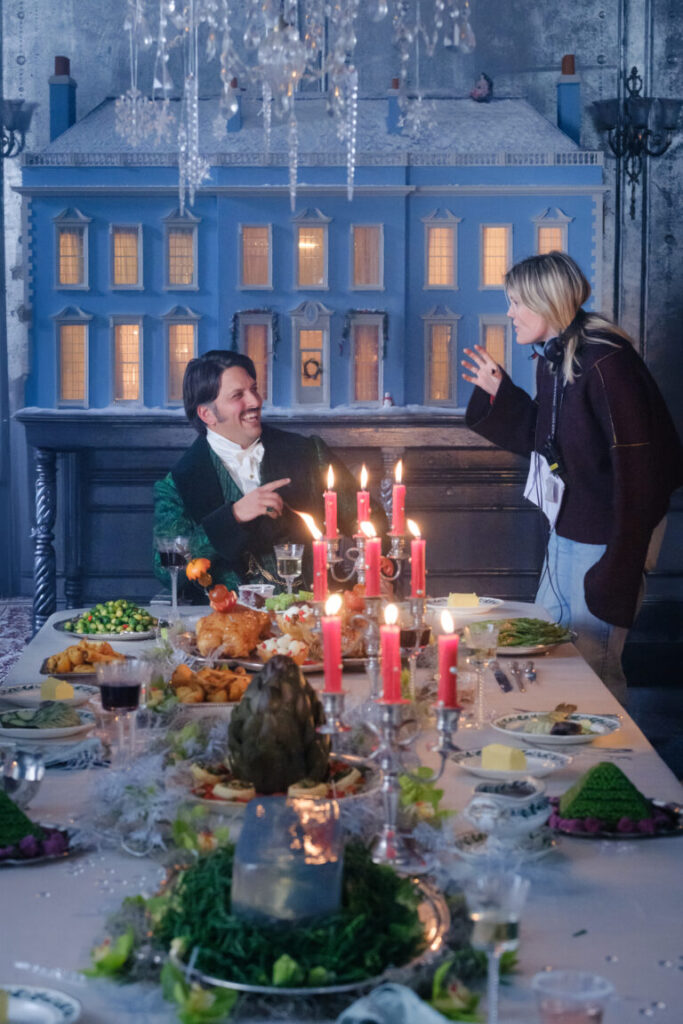
Referring to the Gothic style of the original work—here “softened” through a deliberately ultrapop aesthetic—Fennell noted: «If Gothic is about pathetic fallacy, then it cannot be limited to the weather». The emotionality of the story must extend beyond the landscape; it must overwhelm objects, food, fabrics, and surfaces. It must involve light itself.
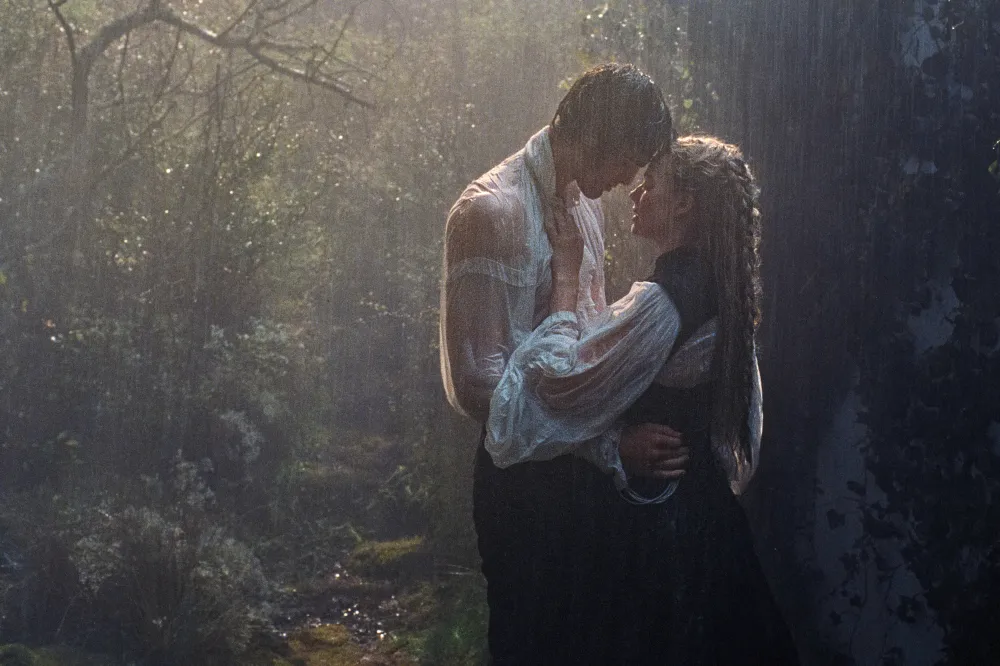
Speaking about her visual influences, she added: «That vapor… there’s a kind of humid warmth you can almost feel on your skin». The goal is for every image to convey the dampness of the English moor—the moisture that clings to hair, skin, and clothing, that soaks the earth, rendering everything simultaneously excruciating and passionate.
Why 35mm film reshapes the cinematography of Wuthering Heights
From this premise comes Sandgren’s decision to shoot on 35mm film (using 3-perf and VistaVision), with development and 4K scanning handled by Cinelab Film & Digital, and color grading by Matt Wallach at Company 3. The choice stems from the film’s ability to introduce grain and to respond to light in a more complex—if less controllable—manner. Wet surfaces catch and scatter the light, skin glistens with sweat, and mist lingers in the air—central elements in Fennell’s visual imagination—appearing not polished but dense and tactile. This texture is further enhanced by the use of Panavision lenses (Millennium XL2 with Primo).
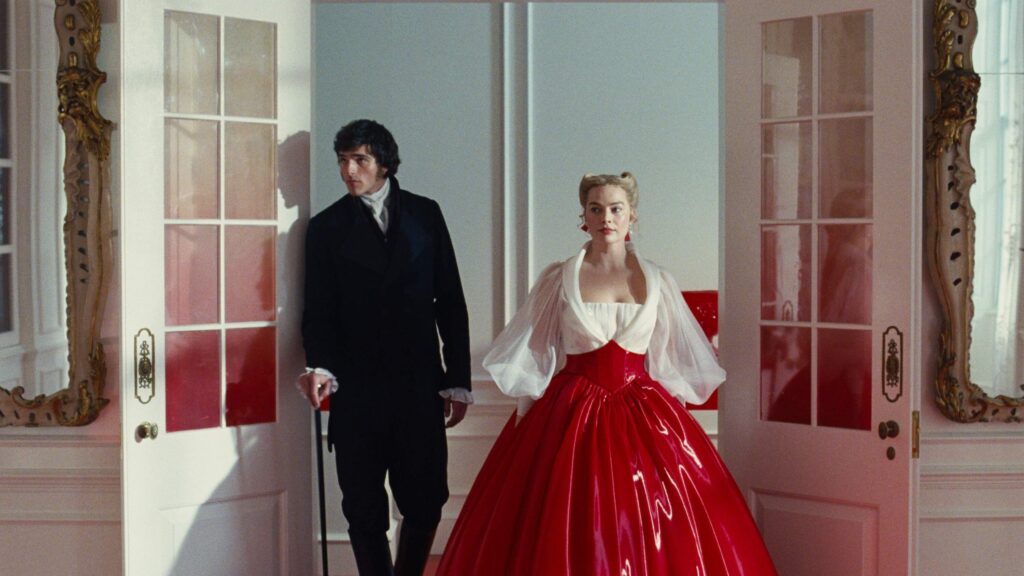
The overall palette moves through natural tones, slightly bruised. Production designer Davies describes them as «very marked, natural colors—except for red». Whenever red appears, it is always on Cathy, and impossible to miss: on her cheeks and lips, in the bows fastening her hair, in the fabrics of the dresses designed by Jacqueline Durran upon Cathy’s return to Wuthering Heights after her stay with the Lintons. It functions as a kind of «visual signal» marking moments of heightened emotional intensity or transition.
Interiors: warm light, passion, proximity
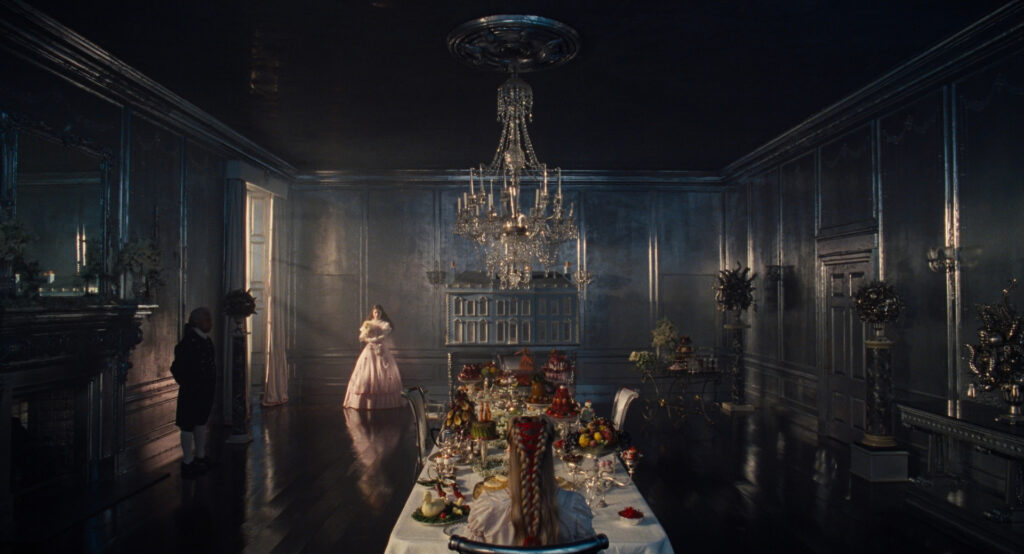
Many interior scenes—both in the increasingly dilapidated Wuthering Heights and in the opulent Linton household—are illuminated almost exclusively by candlelight. Amber dominates; shadows are soft yet enveloping.
This is a calibrated choice, also responding to the camera’s insistence on tightening into close-ups of Catherine and Heathcliff’s disappointed, betrayed, suffering, and enamored faces (Heathcliff portrayed by Jacob Elordi).
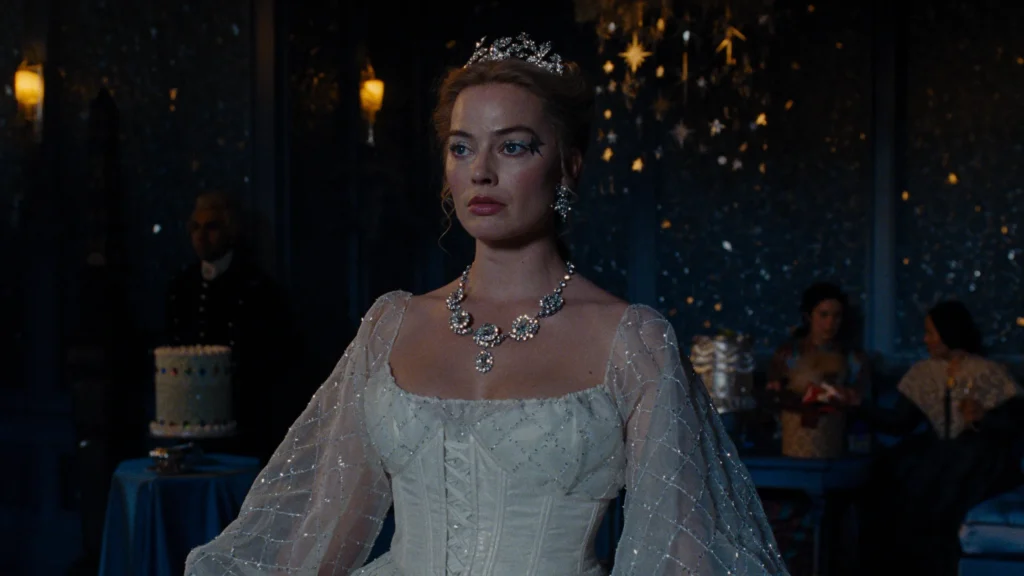
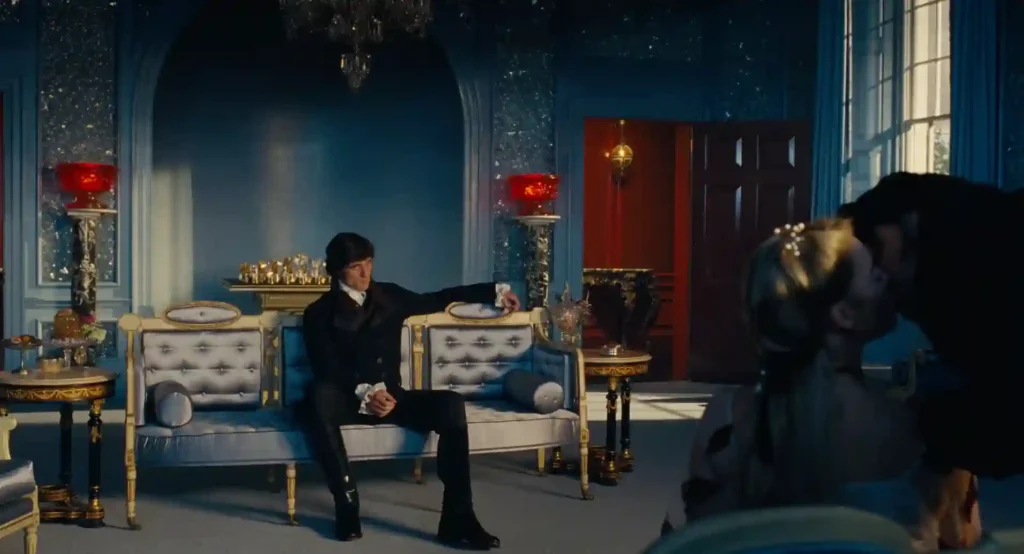
When the two move through the rooms of Thrushcross Grange—such as the “skin room,” Catherine’s chamber lined in latex printed with Margot Robbie’s skin—the spaces seem to react to their presence. In an interview with Motion Pictures, production designer Suzie Davies explained: «Anything that glitters or shines makes everything feel alive… we wanted every surface to have a kind of sparkle». Spaces are therefore designed not merely to respond to light but to amplify it. And yet, at a certain point, that very brilliance begins to lose its initial vitality. As their relationship deteriorates, the space visually conveys the imprisonment their love confines them in.
Exteriors — cold light, dispersion, rage
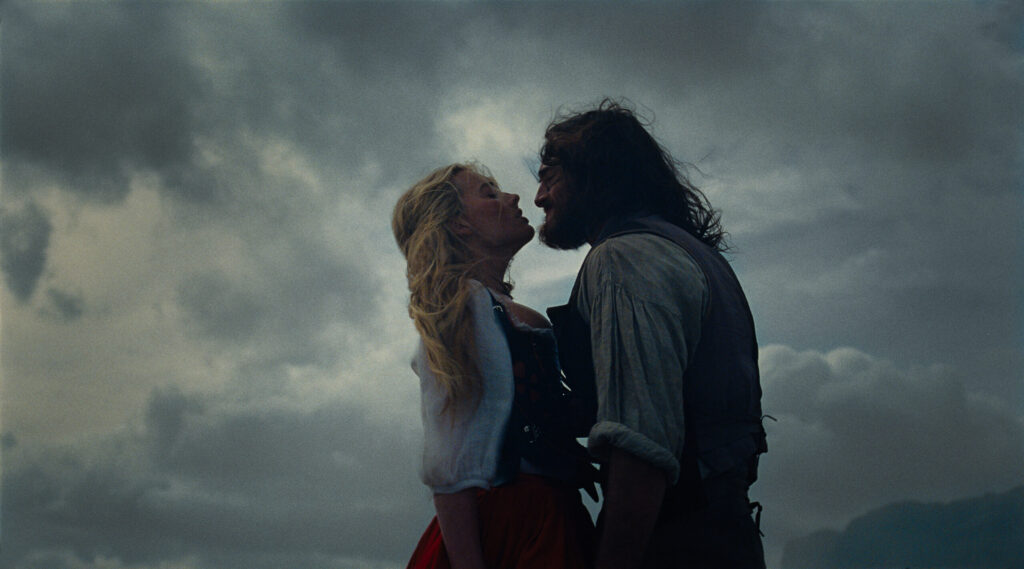
In contrast, the moor—the landscape where Cathy and Heathcliff learn to know and love each other, and with which they ultimately merge—is generally crossed by a cold light that allows us almost physically to feel the wind on our skin. The contrast between light and shadow lowers; the contours of bodies dissolve into mist; film grain restores the sense of disorientation that both characters endure.
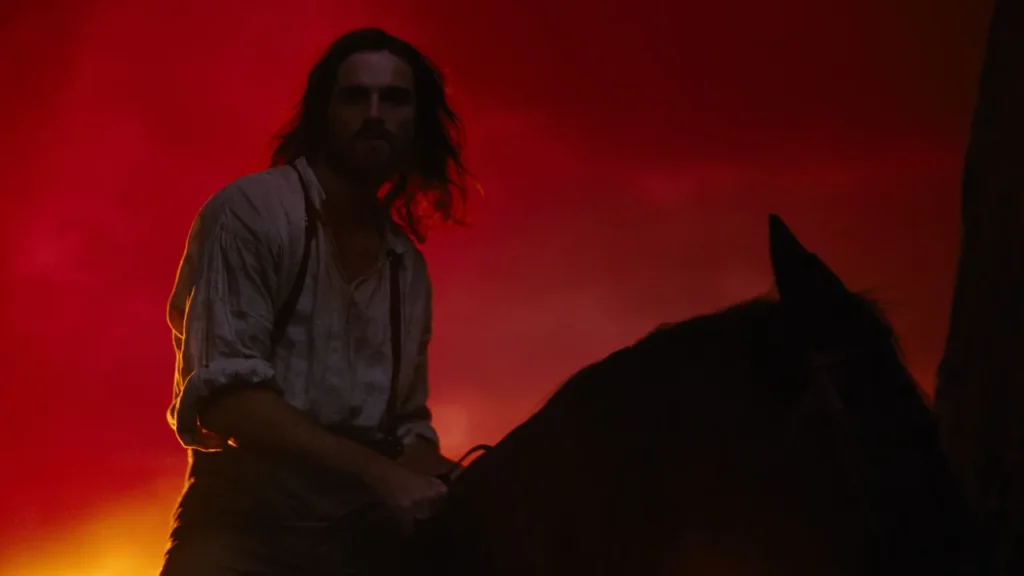
Yet such an effect requires rigorous photographic control. It is no coincidence that a significant portion of the moor sequences was shot in a studio. The most evident scene may be the one in which Heathcliff, consumed by resentment over Cathy’s abandonment, rides against a blazing red sky—a clear reference to Ernest Haller’s cinematography in Gone with the Wind.
Davies describes the use of a 360-degree lighting rig that allowed the team to «look in any direction on that set». It is precisely in technical choices like this that the film’s aesthetic ambition becomes clear: beyond any judgment on the screenplay, Wuthering Heights is—quite literally—a film that worked on every detail to be beautiful.