

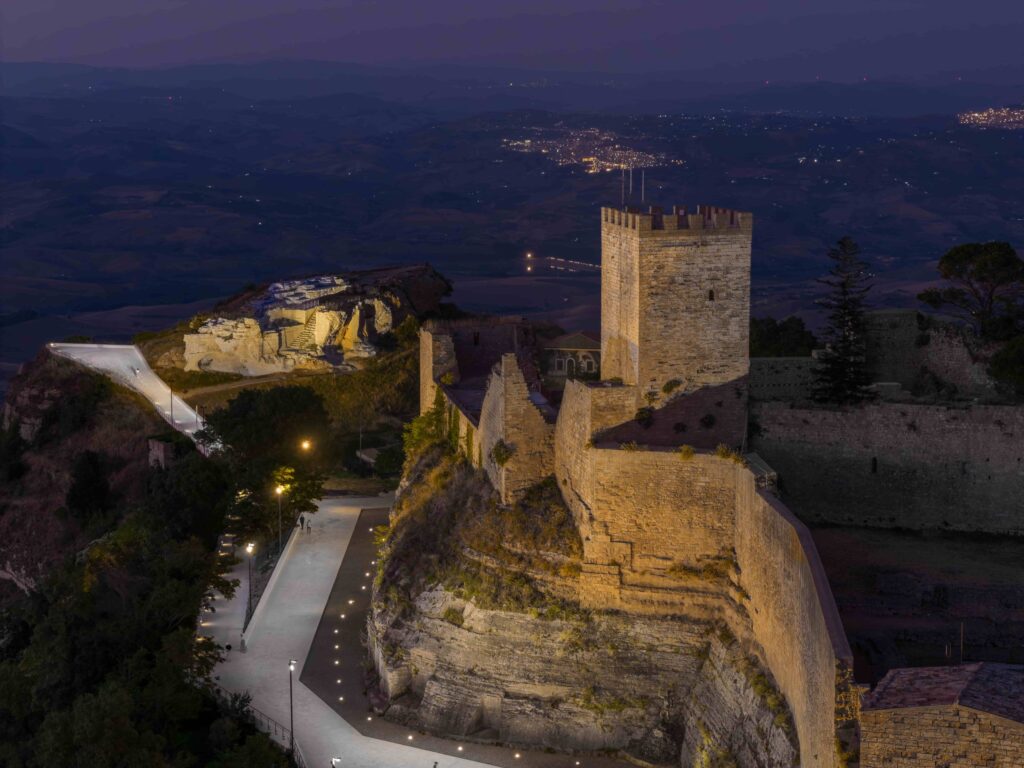



A defining symbol of the Sicilian city, the Castello di Lombardia—one of the largest and best-preserved medieval fortresses in Italy—was at the center of a major enhancement plan completed in 2025. Promoted by the Municipality of Enna and financed through PNRR funds, the project, entrusted to architect Andrea Caporali with support from Studio Omphalos, involved the entire network of public spaces leading to the fortress: Viale Nino Savarese, Piazza delle Rimembranze, the Rocca di Cerere, and the adjacent pedestrian paths. The intervention was developed through a multidisciplinary approach that took into account historical and archaeological constraints. It successfully combined landscape and heritage sensitivity with high-performance contemporary technologies. The goal was to improve usability while strengthening the site’s cultural identity. Particular emphasis was placed on environmental sustainability and on reconnecting the complex to the urban environment.
Enhancement and preservation were the guiding principles of the lighting design developed by the architects to give this historic site a functional, discreet, and non-intrusive illumination. The result is a project that makes the Castello di Lombardia a true protagonist while harmonizing it within the landscape—promoting its cultural use and reconnecting it to the city through improved circulation and panoramic routes.
Platek, a company specializing in outdoor lighting, played an active role in the redevelopment by supplying a complete range of lighting solutions—including custom products—to address different needs. The fixtures were selected for their low visual impact, structural robustness, and precision optics.
«Platek was selected after a thorough assessment, based on the technical and architectural requirements of the project. What made the difference was the wide range of lighting bodies designed to last—weather-resistant and characterized by a sober, elegant design. A discreet presence, capable of interacting with the identity of the site without disrupting its balance», explains architect Caporali.
Each area of the complex required a specific lighting response, which was designed to highlight its architectural and landscape features. The staircase connecting Viale Nino Savarese to the Museo del Mito was addressed with the installation of the minimal Tikal step-marker fixtures.
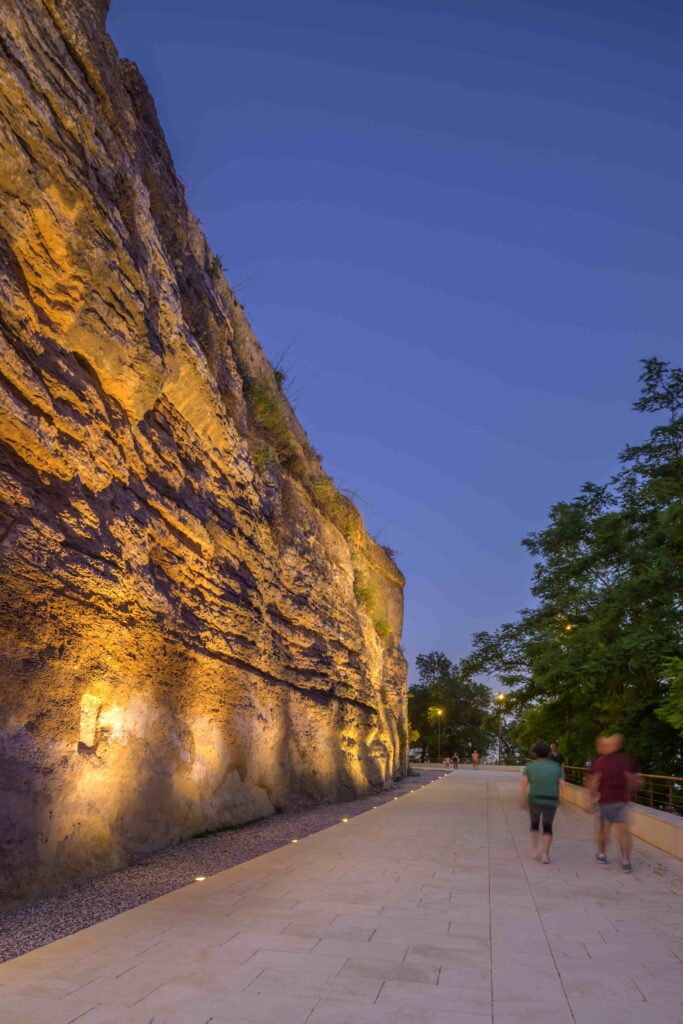
The masonry surfaces of the Castello, the Rocca di Cerere, and the pedestrian paths were illuminated with Sun pole-mounted projectors, while the rocky escarpment is lit from below using Medio in-ground fixtures, recessed into the gravel.
In Piazza delle Rimembranze, Mini recessed elements were used for the trees and the Monumento ai Caduti, paired with Tris pole fixtures for the paved surfaces. Finally, Spy step markers integrated into the low walls guide visitors toward the Rocca di Cerere with a soft, measured light.
This is a lighting project that not only enhances what already exists but interprets it with respect, coherence, and contemporary clarity. In a place so rich in history and symbolism, achieving that balance was the most important goal.
Atmosfera is an open space for dialogue. If light plays a key role in your research or a specific project, we’re ready to listen. We feature lighting design projects, art installations, photography series, and stories that explore the narrative potential of light.
Send us your portfolio or tell us about a project you care about.
It could become part of our editorial programming—or spark a new collaboration.
EMAIL US AT REDAZIONE@ATMOSFERAMAG.IT