In the history of design, there are many projects where, at a certain point, function stopped referring solely to practicality and became, in a way, poetry. It’s 1965, and in a Paris Olivetti store, one of the most iconic objects of the 20th century makes its debut: the Pipistrello Lamp, designed by Gae Aulenti. Architect and designer, a key voice of the Italian Neoliberty movement, Aulenti conceived the lamp for the Paris showroom, imagining it as part of an “Italian piazza”, halfway between a column, a streetlamp, and a sculpture. The name, as one can easily guess, refers to the European bat: it comes from the large diffuser divided into four lobes, reminiscent of outstretched wings.
A bat made of methacrylate and steel: Gae Aulenti’s idea of light
The Pipistrello lamp was designed to work as both a table and a floor lamp. Its key feature is an adjustable telescopic stem, which means you can change its height from 66 to 86 cm. This technical element, considered innovative in 1965, allows users to easily adjust the size for different spaces and lighting needs by simply moving the stem up or down.
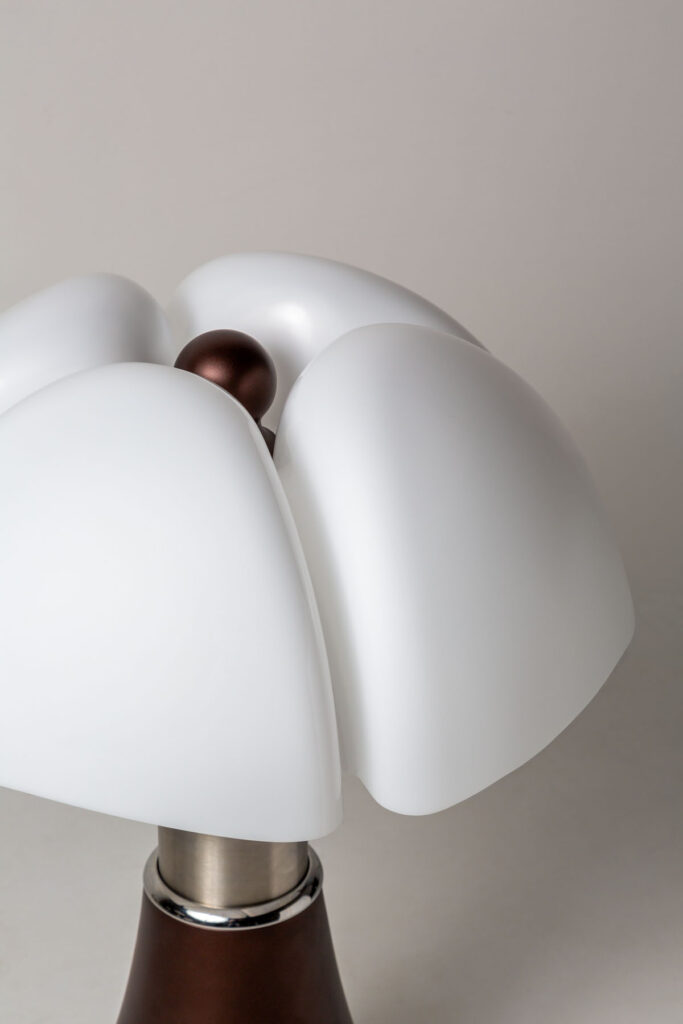
The lamp’s shade, called a diffuser, is made of opal methacrylate and molded into four curved sections, imitating bat wings. The base is made of enameled aluminum with a flared shape, making the lamp stable. The light passes through the diffuser, softly glowing upwards and shining more directly downwards for balanced room lighting. The lamp remains a subtle sculptural feature that does not overpower the space.
From collaboration with Martinelli Luce, a legend is born.
To realise it, Aulenti turned to Elio Martinelli, founder of Martinelli Luce, who immediately recognised the visionary potential of the project. Production began in 1966, after months of experimentation due to the complexity of the base. The first versions had white or brown enamel bases, but over time, the lamp was released in ever-new finishes — including glossy black, brass, purple, and gold — as well as limited editions created in 2015 to mark the 50th anniversary.

Mini and Pop Pipistrello Lamps: new proportions, same icon
The original Pipistrello has a height ranging from 66 to 86 cm and a diameter of 55 cm, which led to the creation of theMini and Pop versions, more compact (the Mini reaches 35 cm) but still perfectly proportioned: ideal for those who want a more discreet light source without giving up its iconic silhouette.
Gae Aulenti, the power of a name
Behind the Pipistrello lamp stands one of the most charismatic figures of 20th-century design. Gae Aulenti, born in 1927 in Friuli, was among the first women to graduate in architecture from Politecnico di Milano. Her career spanned various fields, including furniture and interiors, theatre, and museography: from transforming the Gare d’Orsay into a museum to directing Palazzo Grassi in Venice and designing projects for the Centre Pompidou.
In 1987, she was awarded the Chevalier de la Légion d’Honneur, and in 1995, the Knight Grand Cross of the Order of Merit of the Italian Republic. In 2012, Milan dedicated a square to her in Porta Nuova, acknowledging her impact on the city. Her luminous path began in 1964 with Giova for FontanaArte, continued with King Sun and Queen Sun (1967, Kartell), then Oracolo (1968), Patroclo (1975, both for Artemide), and Parola (1980, FontanaArte, with Piero Castiglioni), up to the Cestello Projector (1993) designed with Castiglioni and iGuzzini. She had a very clear view of light:
«Too many different lights, as if each function required its own bulb, when in fact we know that the same light changes depending on what surrounds it. For instance, I’ve always hated those American directional technical spotlights that light in points instead of spreading: it’s the opposite of what architecture does with light. I’m against glare, and even more so in daily life. It seems some new lights have turned conversations in living rooms into interrogations.»
Consider its practical versatility in your own space
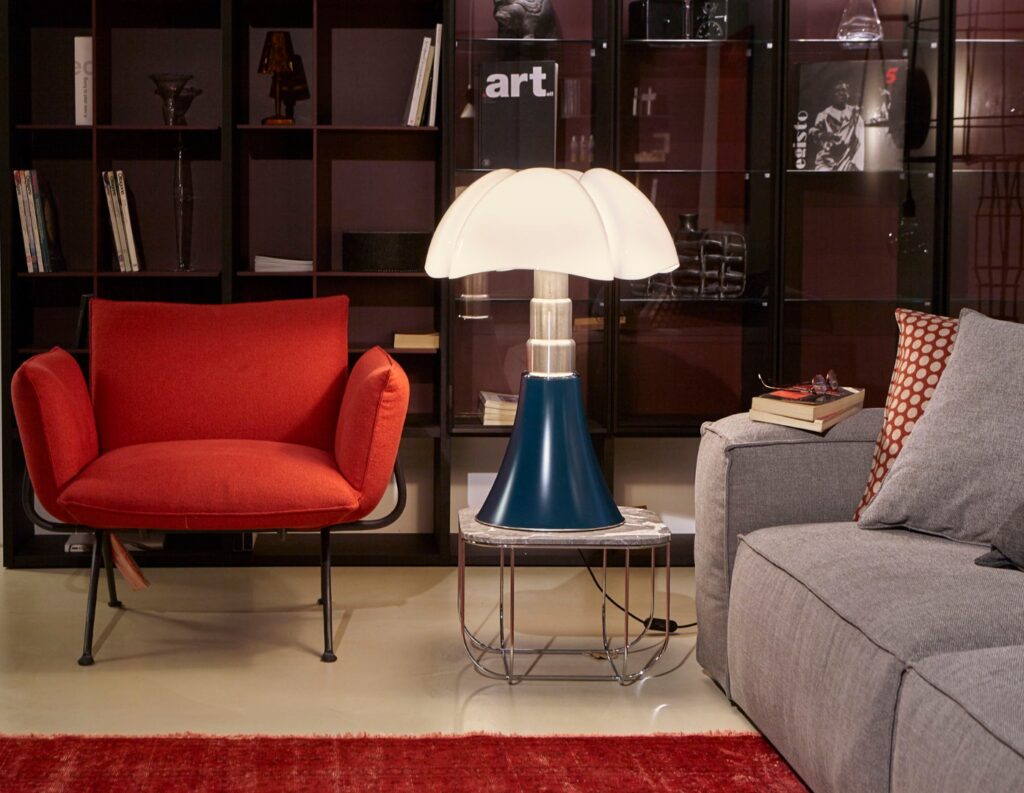
You’ve dreamed of it, you’ve bought it. Now, where to put it? The answer might seem too simple: anywhere. Its versatility makes it perfect for almost any space, so the choice is entirely yours. On a table next to an armchair, on a bookshelf, in an entryway, or on a bedside table — change the perspective and the light transforms. In larger rooms, the full-size version serves as a floor lamp, creating an elegant focal point of light. It’s an object that doesn’t impose itself: it harmonises with spaces and with the habits of those who live in them.
A global icon, from homes to major museum collections
Since the 1960s, the Pipistrello has been recognised as a symbol of Italian pop design, able to merge the grace of Art Nouveau with the rigour of modernist functionalism. Over time, it has become an integral part of our collective visual culture, a silent protagonist on film and TV sets, such as Pedro Almodóvar’s Pain and Glory and The Batman (2022).
Today it is regarded as a true work of industrial art: its light resides in the world’s most prestigious museums — from the MoMA in New York to the Metropolitan Museum of Art, from the Cooper Hewitt to the Centre Pompidou and the Triennale di Milano — continuing to embody the elegance and ingenuity of Italian design.