
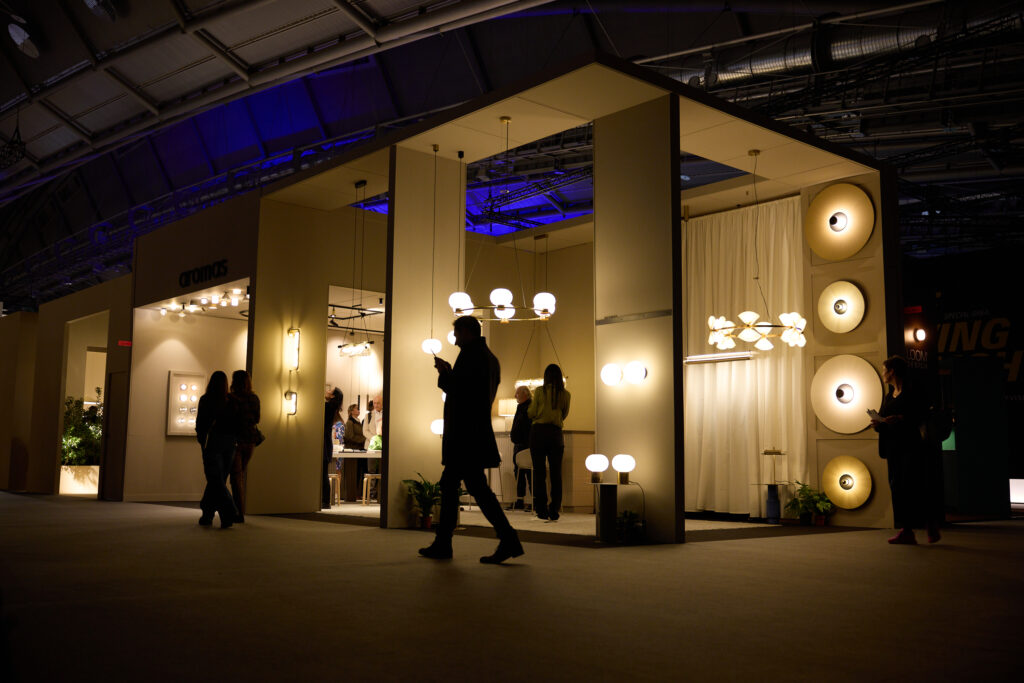
Cover photo: Aromas booth, photo by Davide Farabegoli.
Light + Building 2026 confirms its role as an international platform for exchange within the world of technical and architectural lighting. The Frankfurt fair is a forum for dialogue and collaboration, where many companies showcase their processes, research, and design capabilities alongside new products.
The broader picture also reflects the current international context: notable absences among long-standing exhibitors, a more selective audience, and some last-minute withdrawals are evident. At the same time, discussion inside the halls remains lively and concrete. Moving through the booths are primarily lighting designers, architects, and industry professionals interested in closely examining new technological solutions for lighting control, energy efficiency, and more conscious resource use. What emerges is a fair that may be less crowded, but more focused and oriented toward the quality of exchange.
Entering Hall 3.1, each booth becomes a small world of its own, a fragment of narrative where companies choose how to present their approach, often relying on installations that help frame the product and clarify its meaning.
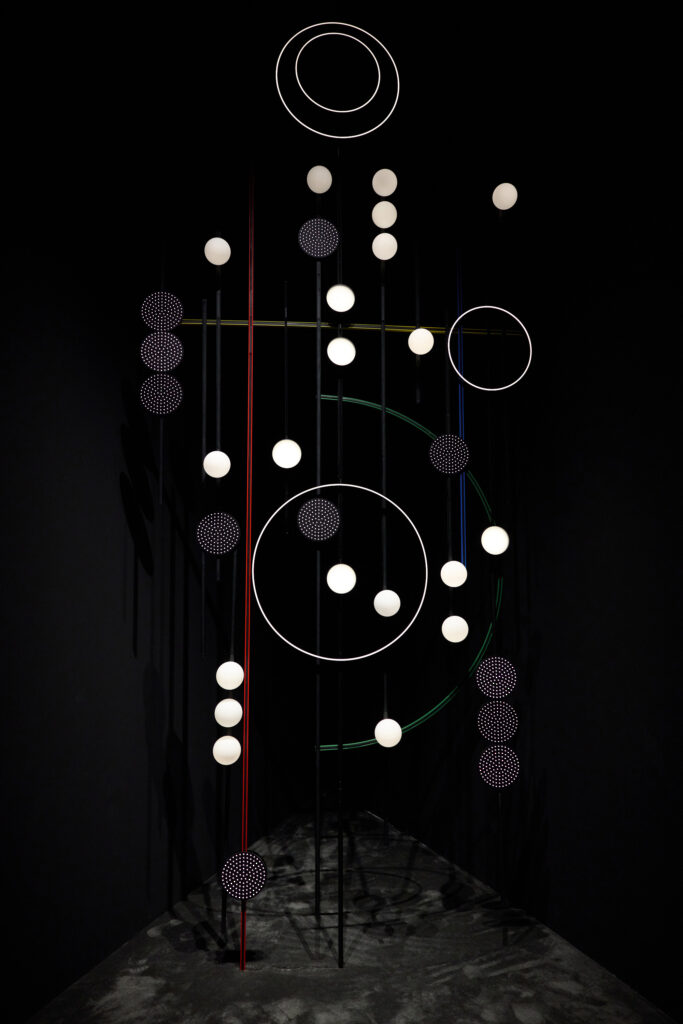
This is the case with Prolicht (Hall 3.1 – Booth B90). The booth opens with a completely dark room, an introductory passage that summarizes the three concepts at the core of the brand’s research: Point, Line, Shape. An essential language that guides visitors along a path where light is treated as a design tool. At the center, the installation curated by D’Alesio&Santoro—who will be the protagonists of the ATMOSFERA Mag lecture scheduled for March 24—uses catalog products assembled into a composition that transforms points, lines, and shapes into luminous signs in space. A measured intervention that accompanies the product without overpowering it.
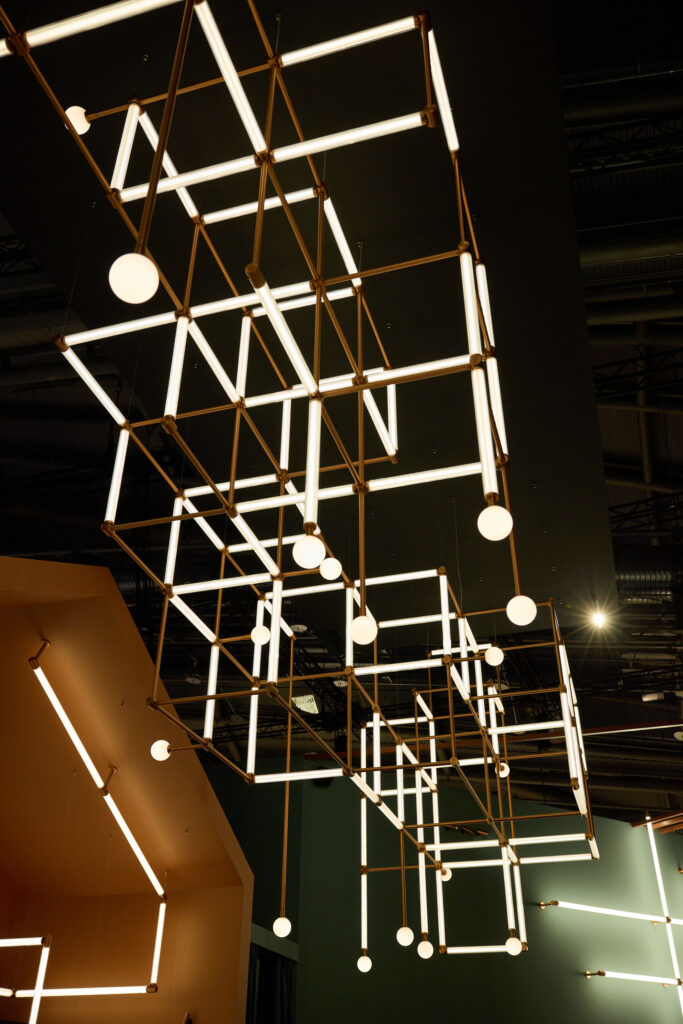
Only later do the new releases emerge: solutions controllable through the Matter protocol, designed primarily for small-scale applications, and a collaboration with OIDO that extends research intoacoustics. The path concludes with Line in Motion, a flexible, modular system that can be configured into different shapes, where glass and metal balance architectural rigor with decorative presence.
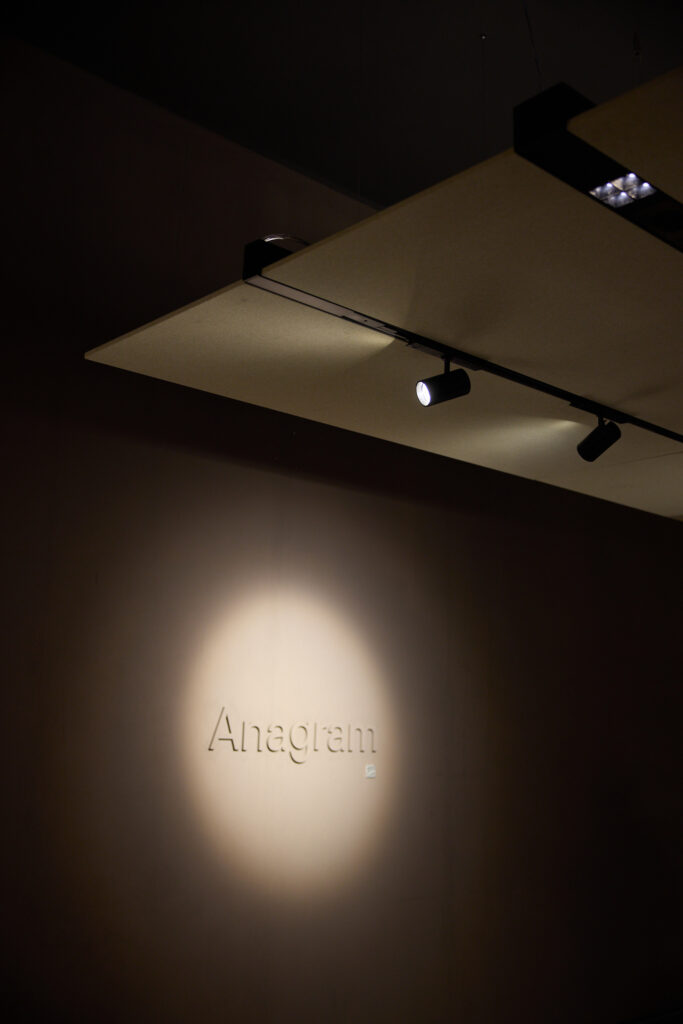
A little further on, the ceiling becomes the central theme at the Targetti booth (Hall 3.1 – Booth D55). The company presents Anagram, a project developed in collaboration with Park Associati. It was created in response to a very specific design requirement: to overcome the limitations of traditional modular drop ceilings. The system offers an integrated solution that combines lighting, acoustic comfort, and sound diffusion in a single element, using luminaires engineered for high glare control. The modular structure, composed of acoustic panels and electrified tracks, is designed to be repeated and reconfigured potentially without limit. A solution that moves beyond the standard technical ceiling and gives designers greater compositional freedom.
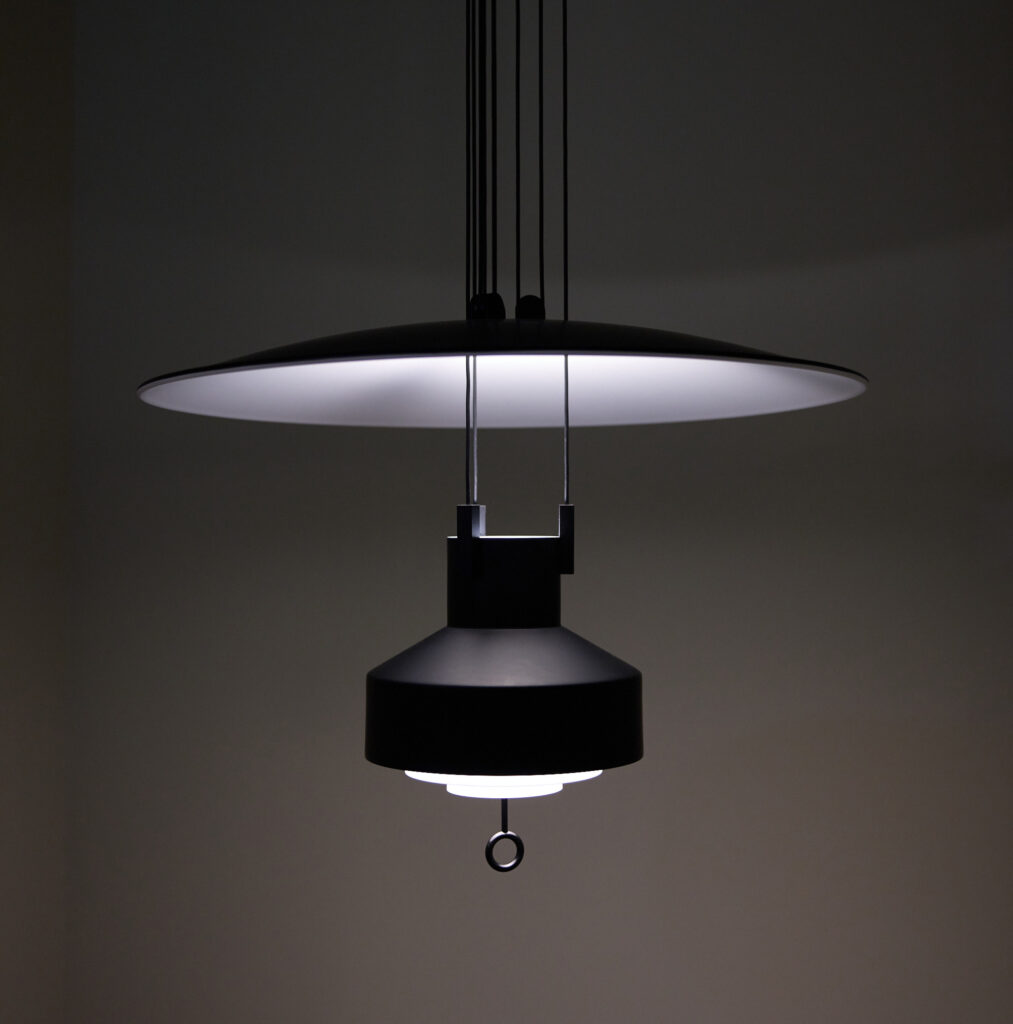
Among the more distinctly decorative presences is the Italian brand Stilnovo (Hall 3.1 – Booth F75), a historic label now part of the Linea Light Group. The company’s presence at the fair focuses on reinterpreting its archive alongside new collections. Among the restyling projects stands the iconic Saliscendi lamp, designed in 1957 by Achille and Pier Giacomo Castiglioni, now presented in new matte black and white finishes that update its image without altering its original character. This icon is accompanied by the debut of Nido, a collection designed by Paolo Cappello, available as wall lamps, pendants, and floor lamps. The system comprises cups that can be positioned either upwards or downwards, creating an interplay of smooth and matte surfaces. Among the novelties is Papylia, designed by Giuseppe Maurizio Scutellà, a family of lamps where the interweaving of glass elements with satin lines recalls the overlapping of petals. When switched off, the luminous body almost disappears, allowing the material’s transparency to come through.
The route continues into the Linea Light space (Hall 3.1 – Booth F75), where the focus shifts to outdoor lighting and sustainability. The company offers a range of BUG 0 fixtures designed to prevent emissions into the night sky and reduce light pollution. Among the most interesting solutions are the Drift and Buzzer bollards, characterized by a clean, controlled light distribution that defines pathways with uniformity.
For gardens, the Filray and Filray Spot family debuts—slender stake-mounted stems that alternate diffuse light with precise accents, ideal for discreetly highlighting greenery. The proposal includes an application-based system designed primarily for residential use that enables simplified management of lighting scenarios via a smartphone.

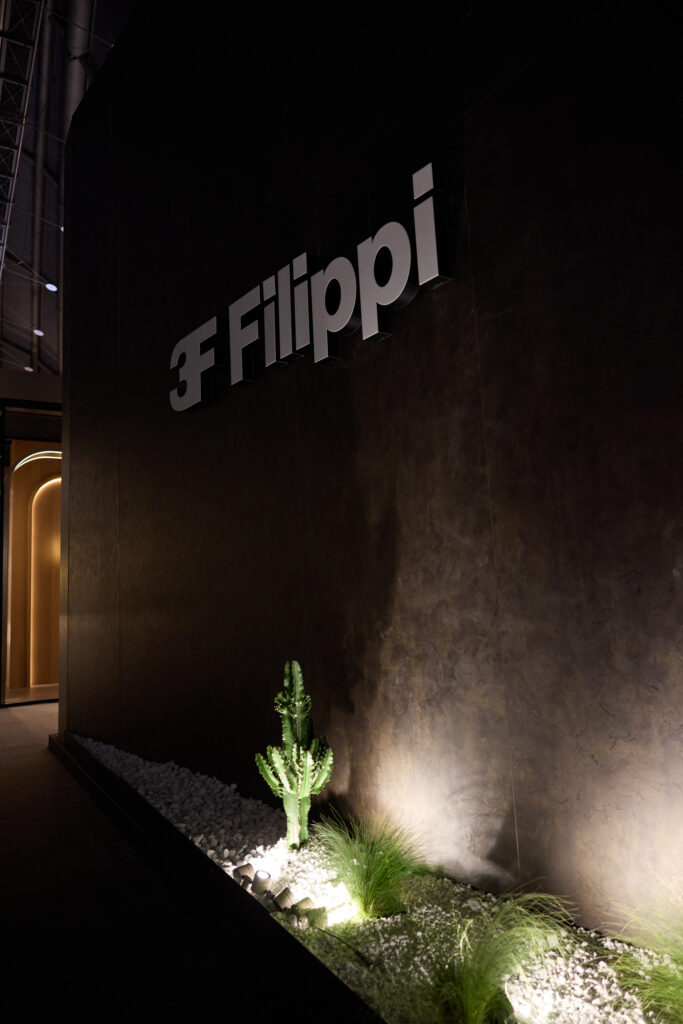
To conclude this initial tour of the booths, it is worth highlighting a product that exemplifies the fair’s more industrial approach. 3F Filippi (Hall 3.1 – Booth D55) presents Savena28, a new interpretation of the waterproof luminaire. The product was developed to meet the needs of designers, installers, and end users, with a focus on fast installation, reliability, and standardization.
Savena28 is the result of a significant industrial investment supported by a dedicated production line capable of producing one luminaire every 30 seconds. This is a concrete example of how, in this context, innovation also involves making products simple, replicable, and efficient while maintaining strict quality control.