
Cover photo: After the Hunt, courtesy Sony Pictures Entertainment / Amazon MGM Studios
Before the story even takes shape, Luca Guadagnino’s After the Hunt overwhelms us with a hypnotic image. From the prosaic inertia of our daily lives, we slip into the screen like down the rabbit hole, finding ourselves captivated by the magnetism of Julia Roberts — in Ralph Lauren — as Alma, moving through a “Classic Seven” apartment where velvet and boiserie meet academic volumes, slender candles, and appliances with a distinctly New York flair.
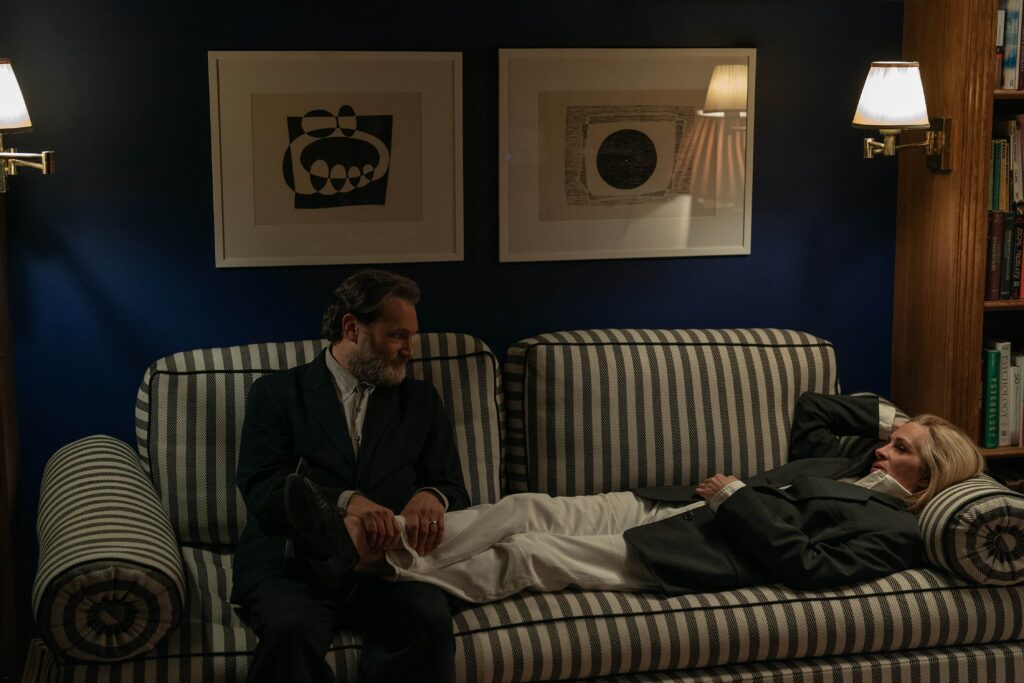
Light and shadow — the most primordial binary code — are the key to this film. The cinematography of After the Huntforeshadows the central dilemma of the narrative. Set at Yale, it tells the story of philosophy professor Alma Himoff as she confronts a sexual assault accusation made by her protégé, Maggie, against Hank, Alma’s best friend and possible (un)spoken romantic interest. When a dark secret from Alma’s past resurfaces, her life begins to fracture.
Cinematography and lighting as narrative apparatus
The cinematography of After the Hunt has an immediate power — in the heightened contrast between whites and blacks, in the multiplication of table lamps juxtaposed with the snowy light of Yale. Even the least attentive viewer notices it, perhaps without knowing it stems from a radical choice by cinematographer Malik Hassan Sayeed, who explained to Yahoo that he used only lighting technologies predating 1988.
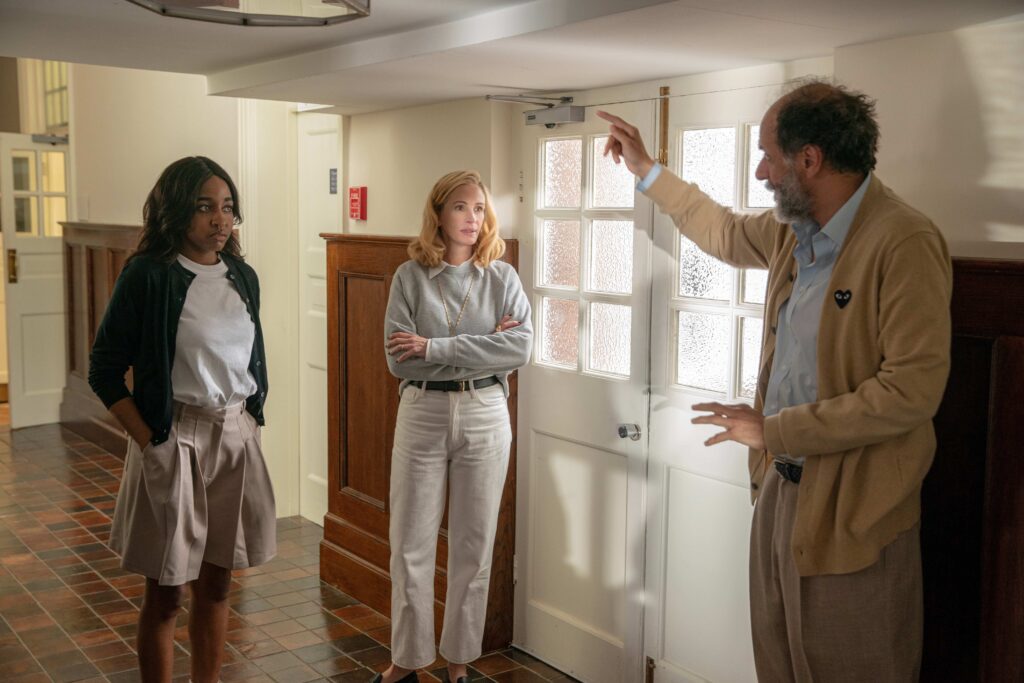
And so Guadagnino builds his discourse on cancel culture, starting from light and from space. Sayeed’s cinematography is conceived in symbiosis with design: the sets, their furnishings, and the razor-sharp deployment of lighting become a prolepsis of the characters and of the narrative itself. Guadagnino personally oversees every production process, every photographic decision, and — in agreement with Sayeed — shot the film on Kodak 35mm, as reported by The American Society of Cinematographers.
Sayeed hadn’t shot a feature in 25 years, but he had met Guadagnino on the (fabulous) Chanel commercial See You at 5, and it was — as they say — love at first sight.
All of After the Hunt unfolds in this dialectic: light supports the scaffolding of meaning and becomes its mise en scène, illuminating (and obscuring) the ambiguities between guilt and innocence, power and vulnerability, public and private, woke and patriarchal.
Is Hank guilty or innocent? Is Maggie a victim, or has she invented/manipulated a story? Light helps us grasp what Guadagnino wants us to grasp: truth sometimes doesn’t exist, because it is too contaminated by perspective — and especially by the theatricality of the social(media) stage.
Yale as an aesthetic and moral framework
After the Hunt, as mentioned, is set at Yale — a prestigious East Coast university where preppy-academic vibes (shirts, blazers, pleated skirts, and above all loafers worn with visible white socks) blend with pompous debates on ontology and morality, and with apartments that reflect the layering of influences and cultures.
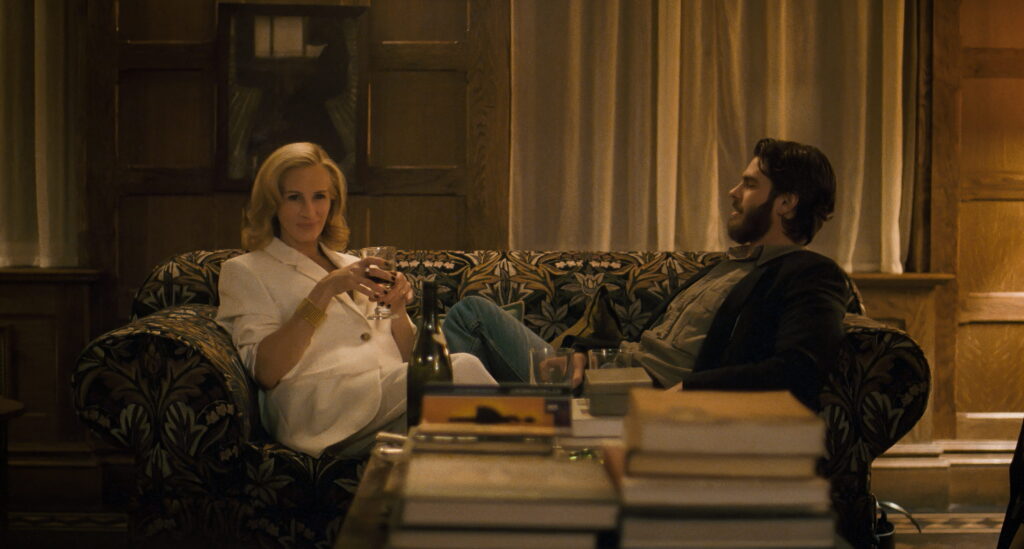
Recreated inside Amazon’s studios, Yale is enveloped in Sayeed’s gilded light — a lighting quality that technicians define as sublimatory, capable of gilding and beautifying reality. Here, it lays bare a world (academic and beyond) where people speak of moral philosophy while appearance remains the metric that matters. The staging of truth more than truth itself, representation as one of its many interpretive layers.
In other words, there is no single truth, and light reflects this thesis by fragmenting, contradicting itself, and modulating according to space and inhabitant.
Alma and Frederik’s apartment as a performative space
Anyone familiar with Guadagnino already knows: he manages sets “more obsessively than the most obsessive interior designer.” Production designer Stefano Baisi conceived the apartment of Alma and Frederik — upper-bourgeois couple (she a professor, he a psychoanalyst) — as a multi-layered performative space.
This is precisely where the film begins, with the disturbing tale of the Panopticon — Bentham’s surveillance model — which then materializes in the narrative structure itself, through accusations against Hank and the ambiguities of Maggie. And just as in that architectural model, transparency conceals control, this apartment reveals the contradictions of those who inhabit it.
Film and Furniture reconstructs a fascinating design map where nothing is left to chance. The mix stems from the idea of the couple’s grandparents — European emigrés who brought Bauhaus and tapestries — while the two boomers added more contemporary (but not “too contemporary”) influences: from Annie Hall to what Film and Furniture calls the “cultivated nonchalance” of the Kennedy era.
The film’s aesthetic codes
Velvet surfaces crossing a Hoffmann table, the comfortable modernisms of Eileen Gray, the square geometries of Albers, plus African or Haitian sculptures alluding to the cultured couple’s habitual travels. In the living area, with red walls and orange-tobacco velvet sofas, stands a green Flowerpot lamp by Verner Panton, designed in 1968, warming the space with its glow.
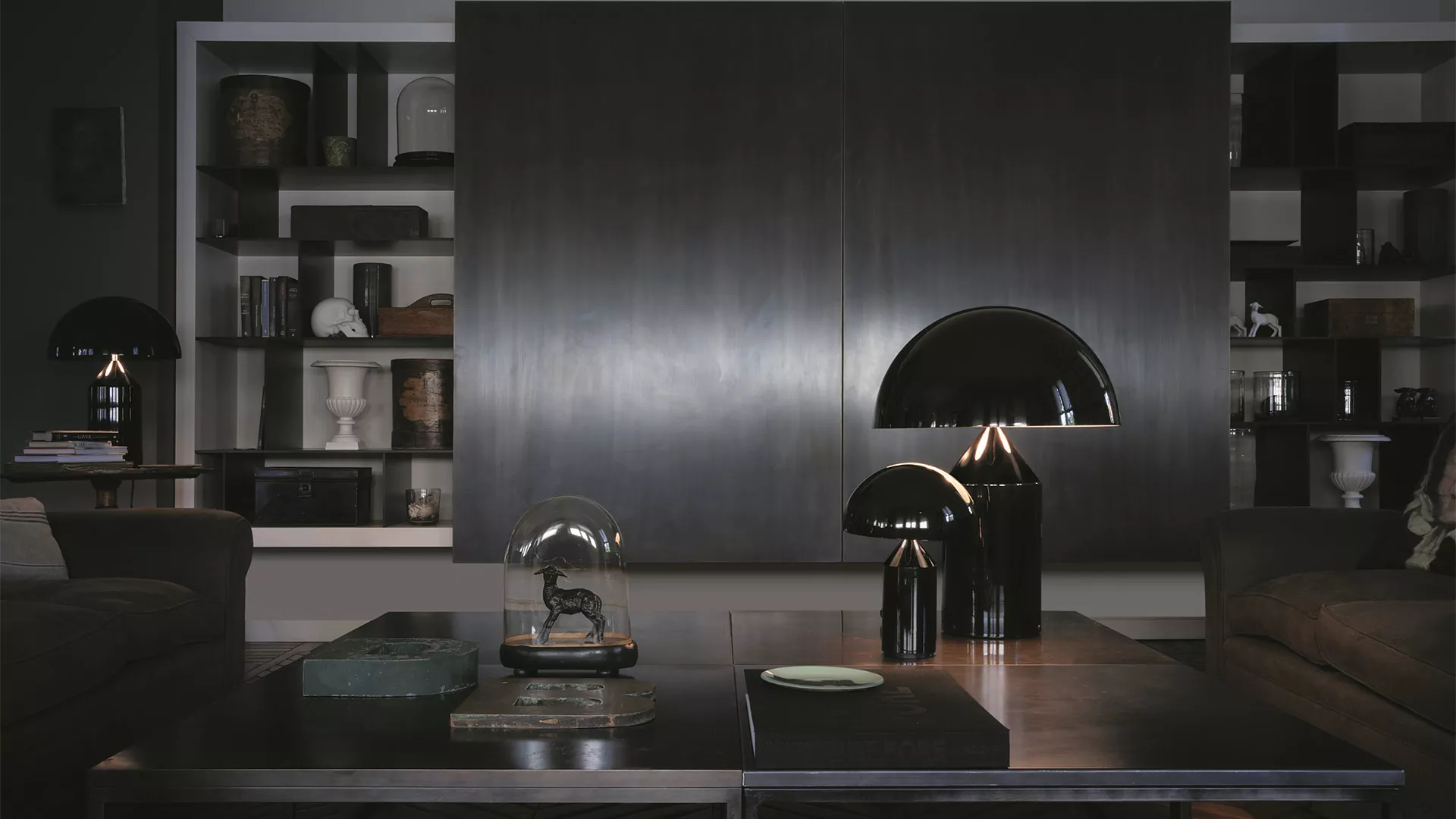
Baisi’s approach began with geometric analysis to achieve an optical balance within the room. The two white bedside lamps resemble sculptures; set decorator Lee Sandales selected them for their soft, diffused qualities.
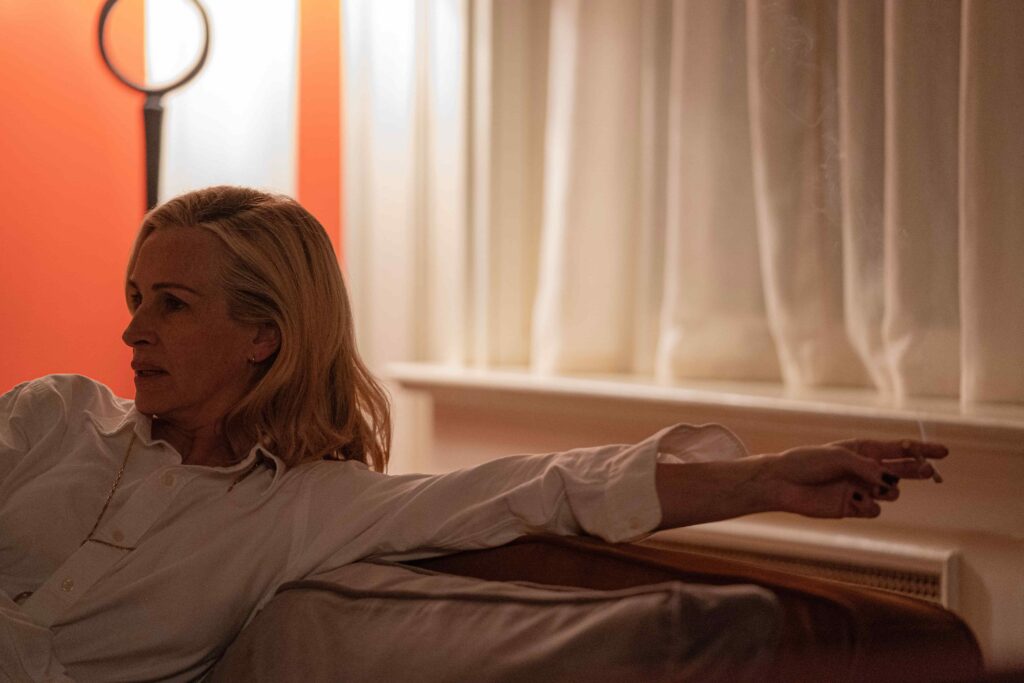
The differentiation of aesthetics and lighting across the seven rooms is masterful. In the bathroom — where Alma suffers and unravels — the light remains still, illuminating an elegant dissolution. In the bedroom, the severity of Ulrich’sfurniture (such as the bed) meets the softer effect of Anni Albers’ tapestries and a more distributed light. Repetition matters: every space is calibrated down to the last lumen.
«Luca gave me two precise and wonderful cinematic inspirations that I absolutely loved,» Sayeed told Kodak. «Sven Nykvist FSF ASC with Ingmar Bergman, and Gordon Willis ASC with Alan J. Pakula, among others. He wanted After the Hunt to feel like it was shot in the 1980s.»
Guadagnino doesn’t shoot many takes, also to preserve spontaneity. This forced the camera and lighting departments — from DP to electricians — to “improvise,” adding freshness and realism to the scenes.
The Wharf apartment as an antithetical space
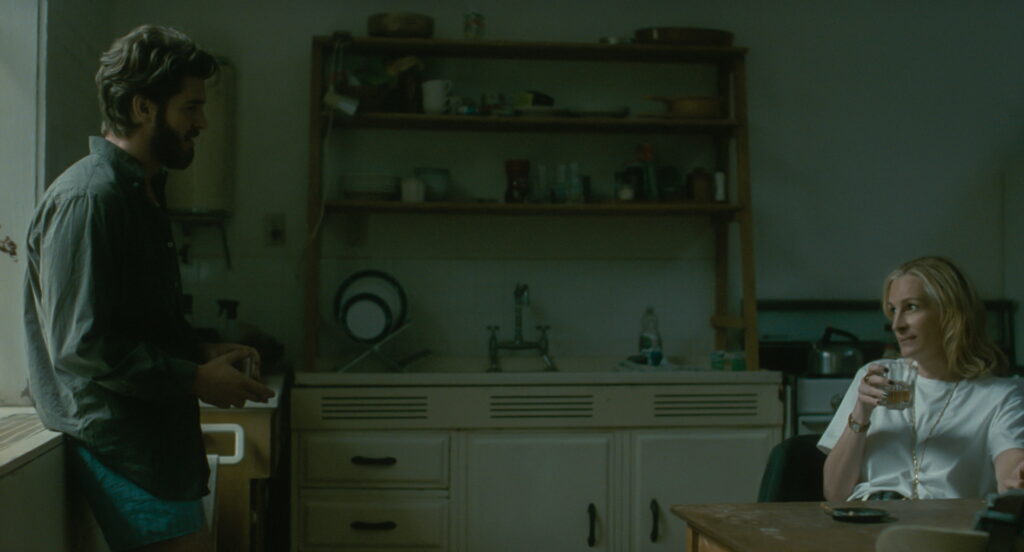
At a certain point in After the Hunt, as doubt overtakes Alma, another apartment surfaces: a Wharf apartment with a freer, ocean-inflected aesthetic — a refuge for Alma’s authentic self. Everything here shifts. The antithetical colors strike immediately, as does the vignette from the K35 lenses, distorting the edges. A cold, fluid light opposes the “Classic Seven” palette and, from domesticated, becomes raw.
It is here that secrets and double selves emerge. It is here that we begin to doubt even our own doubts. And this may be Luca Guadagnino’s most powerful message: that “after the hunt,” we remain alone inside a system of mirrors. We are left only with doubts — with a simple, ruthless light that illuminates the questions and casts the answers into shadow.
We find ourselves in a mise en scène of reflections and perspectives, where Guadagnino constructs a mirror-film.
From the gilded light of Yale to the unyielding brightness of the seaside refuge, cinematography and design become the language through which the film articulates the characters’ moral ambiguity and Alma’s existential crisis.
Watching the film means watching ourselves watching, losing our footing among lamps and lunar East Coast tones, inside a labyrinth of refractions where every certainty breaks against its own silhouette of shadow.